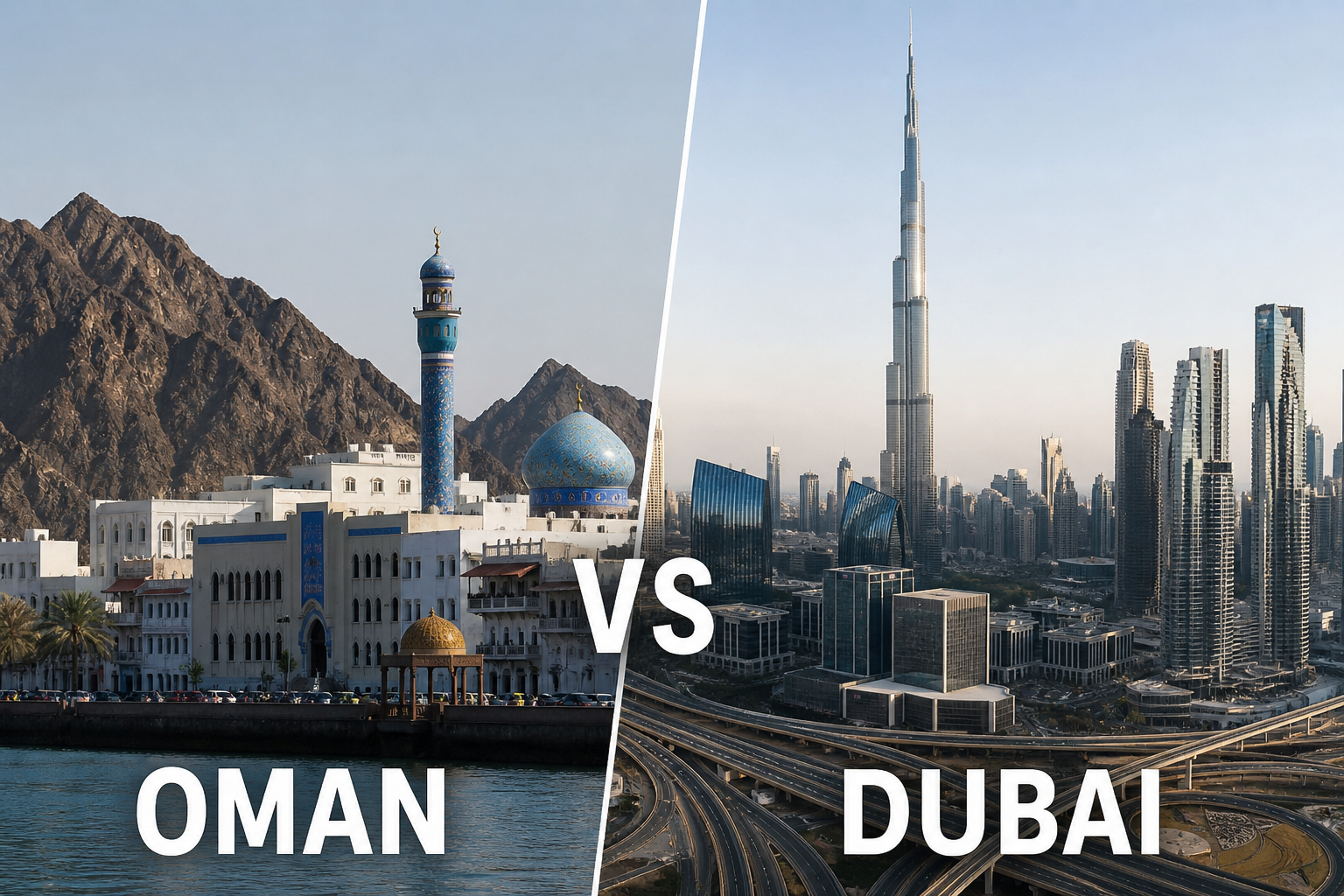
In the 2026 economic landscape, the Persian Gulf region has moved beyond traditional patterns of competition. Expert consultants believe that the absolute superiority of one geography is no longer the main issue; rather, the key to success is the “alignment of the business model with the host ecosystem.” Dubai, as the operating system for rapid innovation and scalability, and Oman, as the strategic fortress of stability and sustainable production, each offer a distinct value proposition. Making an intelligent choice requires a deep understanding of hidden cost layers, new tax compliance regulations, and logistical potentials, which this report proceeds to dissect.
Strategic Architecture: Dubai’s Digital Ecosystem vs. Oman’s Geographical Security
In 2026, Dubai has solidified its position as the global hub for Artificial Intelligence and the digital economy. In this environment, you pay the cost of presence in a “dense ecosystem” that provides immediate access to venture capital and global markets. Conversely, Oman, relying on its Vision 2040, has positioned itself as a Strategic Hedge—a safe haven where the location of its ports, Duqm and Salalah, outside the Strait of Hormuz, creates unparalleled security for the supply chain of heavy industries and new energies.
On the other side, the Sultanate of Oman has chosen a path based on “sustainable and managed growth.” In 2026, Oman acts as a “Strategic Hedge” against regional tensions. Its geographical location outside the Strait of Hormuz and ports like Duqm and Salalah create geopolitical appeal for industries where supply chain security is the top priority. Therefore, comparing the two solely through cost figures means neglecting Dubai’s “institutional depth” and Oman’s “strategic security.” The investor in Dubai pays the price of “speed,” and in Oman, they pay the price of “stability and longevity.”
Table 1: Comparison of Macroeconomic Indicators and Business Environment 2025–2026
| Indicator | UAE (Dubai) | Sultanate of Oman | Strategic Analysis |
| Predicted GDP Growth (2025) | 4.9% – 5.3% | 2.8% – 3.8% | Dubai is the driving engine of rapid non-oil growth. |
| Economy Scale (GDP) | ~$530 Billion | ~$111 Billion | Dubai’s market is 5 times larger and denser. |
| Economic Freedom Ranking 2026 | Leader in the region | 39th globally (up 19 ranks) | Oman is rapidly reforming traditional structures. |
| Strategic Focus | AI, FinTech, Global Trade | Green Hydrogen, Manufacturing, Port Logistics | Clear distinction between the digital economy and the physical economy. |
| Political Stability and Risk | Low risk with diplomatic dynamism | Very low risk, absolute neutrality | Oman is known as a mediator and safe haven. |
Operational Costs Dissection: The Real Difference in Survival (Not Just Registration)
Consultant’s Recommendation: Do not be misled by low initial registration costs in Oman. Although the registration bureaucracy in Oman has been reduced, the “Omanisation” law (mandatory employment of a national citizen after the first year) is a serious fixed operational cost. In contrast, despite ancillary housing and visa costs, Dubai offers much higher flexibility in international workforce management, which is vital for agile businesses.
Conversely, while Dubai has higher initial costs (including knowledge and innovation fees), it offers greater flexibility in workforce management. In Dubai, businesses located in Free Zones still enjoy high freedom in hiring global talent without severe quota restrictions. However, investors must consider the “invisible layers” of cost in Dubai, including the fee for the Establishment Card, repeated medical tests, and annual Ejari costs, which can unexpectedly increase the annual budget.
Table 2: Dissection of Operational and Living Costs 2026 (Approximate amounts in USD)
| Cost Type | Dubai (UAE) | Muscat (Oman) | Difference and Considerations |
| Office Rent (Annual – Mid-Level) | $7,000 – $22,000 | $3,000 – $15,000 | Oman is 40% to 60% cheaper. |
| Residence and Work Visa (Per Person) | $1,500 – $2,700 | $1,260 (Includes Labor Card) | Ancillary costs in Dubai (typing, medical) are higher. |
| 1-Bedroom Apartment Rent (Monthly) | $1,200 – $2,500 | $400 – $800 | Oman is a savings paradise for employees. |
| National Employee Social Insurance Contribution | Varies based on salary (Emirati) | 20.5% (12.5% employer share) | Employment cost in Oman is heavy due to SPF. |
| Fuel and Transportation Cost | Higher (Global price increase) | Very cheap (Relative subsidy) | Internal logistics cost in Oman is lower. |
Deeper analysis shows that for companies with a small number of employees (SMEs) that cannot afford the salary and insurance of an Omani citizen (a total cost of at least $930 per month), Oman practically ends up being more expensive than Dubai. This phenomenon, referred to as the “Omanisation Cost Cliff,” means Dubai remains the more logical choice for micro-startups and freelancers, despite its higher general costs.
Corporate Tax Structures: UAE (9%) vs. Oman (15%) – Compliance and Predictability
With the UAE’s entry into the 9% Corporate Tax regime, the era of unconditional exemptions has ended. Now in Dubai, enjoying the 0% rate is conditional upon “strict compliance” and rigorous auditing. On the other hand, Oman’s 15% rate, while appearing higher, provides greater financial predictability for large infrastructure projects due to its structural clarity and long-term 30-to-50-year exemptions in Free Zones.
On the other side, Oman has maintained a flat rate of 15% for most companies. Although this rate seems higher than the UAE’s 9%, Oman’s tax structure is “more traditional and predictable.” For an investor in Oman, there is less ambiguity regarding “Qualified Income.” Furthermore, Oman’s Free Zones (such as Sohar and Duqm) offer 30-to-50-year tax holidays, which are significantly longer than current exemptions in the UAE.
Major Shift: Personal Income Tax in Oman (2028)
A historical turning point that investors in 2026 must factor into their long-term calculations is the introduction of Personal Income Tax (PIT) in Oman starting January 2028. This law, approved in 2025, imposes a 5% tax on incomes exceeding $109,000. This action distinguishes Oman from other GCC countries that still have 0% personal income tax (such as the UAE) and may impact the attraction of high-level executives in the future.
Table 3: Comparison of Tax Regimes and Compliance 2026
| Tax Parameter | Dubai (UAE) | Sultanate of Oman |
| Corporate Tax Rate (Mainland) | 9% (on income exceeding AED 375,000) | 15% (Flat Rate) |
| Free Zone Tax Rate | 0% (subject to QFZP and Auditing) | 0% (30-to-50-year tax holidays) |
| Personal Income Tax | 0% (No plans for change) | 5% (Effective from 2028 for high incomes) |
| Value Added Tax (VAT) | 5% | 5% |
| Auditing and Compliance Costs | High (due to Transfer Pricing rules) | Medium (Standard processes) |
| Research and Development (R&D) Incentives | Up to 50% Tax Credit | Sectoral exemptions in specific industries |
The key takeaway for investors in 2026 is to recognize Dubai’s “Free Zone Trap”; companies that fail to provide accurate audits or violate economic substance requirements will immediately be subject to the 9% rate and will not be able to return to 0% status for up to 5 years. In Oman, although the base rate is higher, the risks stemming from differing legal interpretations are assessed as lower.
Market Comparison: Dubai’s Red Ocean vs. Oman’s Blue Ocean for Production
Dubai today is a “Red Ocean” with intense competition and high marketing costs, but the reward is access to a wealthy consumer market of 200 nationalities. Oman, however, is a virgin “Blue Ocean” for production. The Hafeet Rail project in 2026 has linked the two; thus, our proposed model is “Production in Oman at low cost and Distribution in Dubai’s consumption hub.”
Oman is a “Blue Ocean” for heavy industries and value-added production. Under the Eleventh Five-Year Plan (2026–2030), Oman has focused on sectors such as fisheries, mining, and cultural heritage tourism. The Omani market is more attractive for businesses seeking “gradual and stable growth.” Unlike Dubai, which operates on “speed,” Oman moves based on “sustainability.”
A massive logistical transformation that has tied the markets of the two together in 2026 is the “Hafeet Rail” project, which, with 40% progress, is creating a rail link between Oman’s Sohar Port and Abu Dhabi/Dubai. This project means Oman is no longer an isolated market, but acts as a “production backyard” for Dubai, where goods are manufactured at a lower cost in Oman and reach the UAE’s consumption centers in less than 100 minutes.
Banking and Credit Access: Dubai’s Digital Fortresses vs. Oman’s Simplicity
While Dubai’s banking faces severe bureaucracy in account opening due to global AML standards, Oman, in 2026, has opened a more flexible and faster path for investors by establishing the OGFC Financial Center. However, if you require international credit rating and complex FinTech tools, Dubai’s digital fortresses remain unrivaled.
In contrast, Oman, in 2026, is attracting investors as a “flexible alternative.” Opening an account with Omani banks such as Bank Muscat or Sohar International can be done within 1 week. Omani banks are more flexible regarding the source of initial capital and have less bureaucracy in the initial stages. Furthermore, Oman established the “Oman Global Financial Center” (OGFC) in January 2026 to facilitate innovation in FinTech and digital banking.
However, there is a fundamental difference in “access to credit”:
- In Dubai: The credit system is highly advanced. Companies with a transparent financial history easily access commercial loans, international trade facilities, and capital markets.
- In Oman: Banks tend to lend primarily to government sectors or large infrastructure projects. Small foreign investors may face restrictions in obtaining credit lines.
3 Structured Scenarios: Choosing the Right Location (Tech, Manufacturing, SME)
The choice between these two geographies in 2026 is divided into three main scenarios based on business models:
Scenario 1: Tech Founder, FinTech, or Digital Agency
- Choice: Dubai (Free Zones such as DMCC or Dubai Internet City).
- Reason: Dubai’s ecosystem is “vital” for these individuals. Access to global talent, AI-Ready infrastructure, and the “Golden Visa” for elite professionals make Dubai the only option for rapid scalability. In this scenario, the 9% tax and higher cost of living are the price paid for global market access.
Scenario 2: Industrial Manufacturer, Heavy Logistics, or Re-exporter of Goods
- Choice: Oman (Free Zones of Duqm or Sohar).
- Reason: Land and energy costs in Oman are up to 60% lower than in the UAE. Duqm Port, with its capacity to accommodate mega-vessels and its location outside the Strait of Hormuz, ensures supply chain security. The Hafeet Rail project also provides quick access to the UAE market, while production occurs in a lower-cost environment.
Scenario 3: Small Consulting Firm, Trader, or Freelancer with Moderate Income
- Choice: Dubai (Cheaper Free Zones like IFZA, Ajman, or Umm Al Quwain).
- Reason: Despite Oman’s apparent attractiveness, the “Omani hiring” law (an annual cost of at least $11,000 for salary and insurance) is crippling for these types of businesses. In Dubai, using the “Small Business Relief” (SBR) facilities allows for practically no tax payment up to an income ceiling of AED 375,000, and there is no need to hire Emirati nationals for small operations.
When Choosing Oman is a Strategic Mistake (Based on 2026 Challenges)
Based on field analysis and reported challenges in 2026, choosing Oman could lead to a commercial failure under the following conditions:
1. Business Model Dependent on Cheap, Unskilled Foreign Labor: Oman is strictly limiting work visas for foreign nationals in over 200 specialties (from HR management to sales and consulting). If your business relies on extensive hiring of foreign employees at mid-levels, Oman will be a hostile environment with strict Omanisation quotas and heavy penalties (doubling of visa costs for non-compliant companies).
2. Need for Rapid Capital Attraction (VC): The venture capital ecosystem in Oman is still in its nascent stages. Startups looking for Series A or B funding rounds will face a bottleneck in Muscat, whereas hundreds of active funds exist in Dubai.
3. Bureaucratic digital speed dependencies: Although Oman is digitizing, a “consultative and traditional approach” still prevails in many sectors. Processes for trademark registration, health approvals or special permits in Oman can take months, while Dubai, under the “Zero Bureaucracy” program, seeks to complete these matters in less than 24 hours.
4. Companies with Very Low-Profit Margins: The cost of employing an Omani citizen along with social insurance (SPF) swallows the profit margins of small businesses such as cafes, repair shops, or small retailers. In these cases, Oman is not an opportunity, but a “liquidity trap.”
Final Strategic Summary: A Dual-Location Approach for Global Investors
Strategic Conclusion: To succeed in the volatile 2026 market, one should not be limited to a single geography. Dubai offers you “access and credibility,” and Oman offers “sustainability and reduced infrastructural costs.” The intelligent combination of the two is the secret to survival and growth in the region’s new economy.
Table 4: Final Checklist for Choosing Between Dubai and Oman 2026
| Your Priority | Winner | Why? |
| Speed of setup and digital bureaucracy | Dubai (UAE) | “Zero Bureaucracy” initiative and AI-driven services |
| Low living and operational costs | Muscat (Oman) | 50% to 70% cheaper in housing and fuel |
| Geopolitical stability and supply chain security | Oman (Duqm/Salalah) | Outside the Strait of Hormuz, policy of absolute neutrality |
| Attracting global talent without quotas | Dubai (Free Zones) | National diversity, Golden Visa and Freelancer systems |
| Energy, mining, and heavy manufacturing industries | Sultanate of Oman | 50-year exemptions, access to raw resources |
| Tax transparency and international compliance | UAE (Dubai) | Full compliance with OECD Pillar Two and Digital FTA system |
Investors aiming for success in 2026 should not limit themselves to one geography. The winning strategy often involves a “holding” structure in Dubai to benefit from banking credibility and global networking, and an “operational/production unit” in Oman’s Free Zones to reduce fixed costs and benefit from long-term stability. Dubai gives you “access,” and Oman gives you “resilience”; and in the volatile world of 2026, having both is essential for survival.
Schreiben Sie einen Kommentar