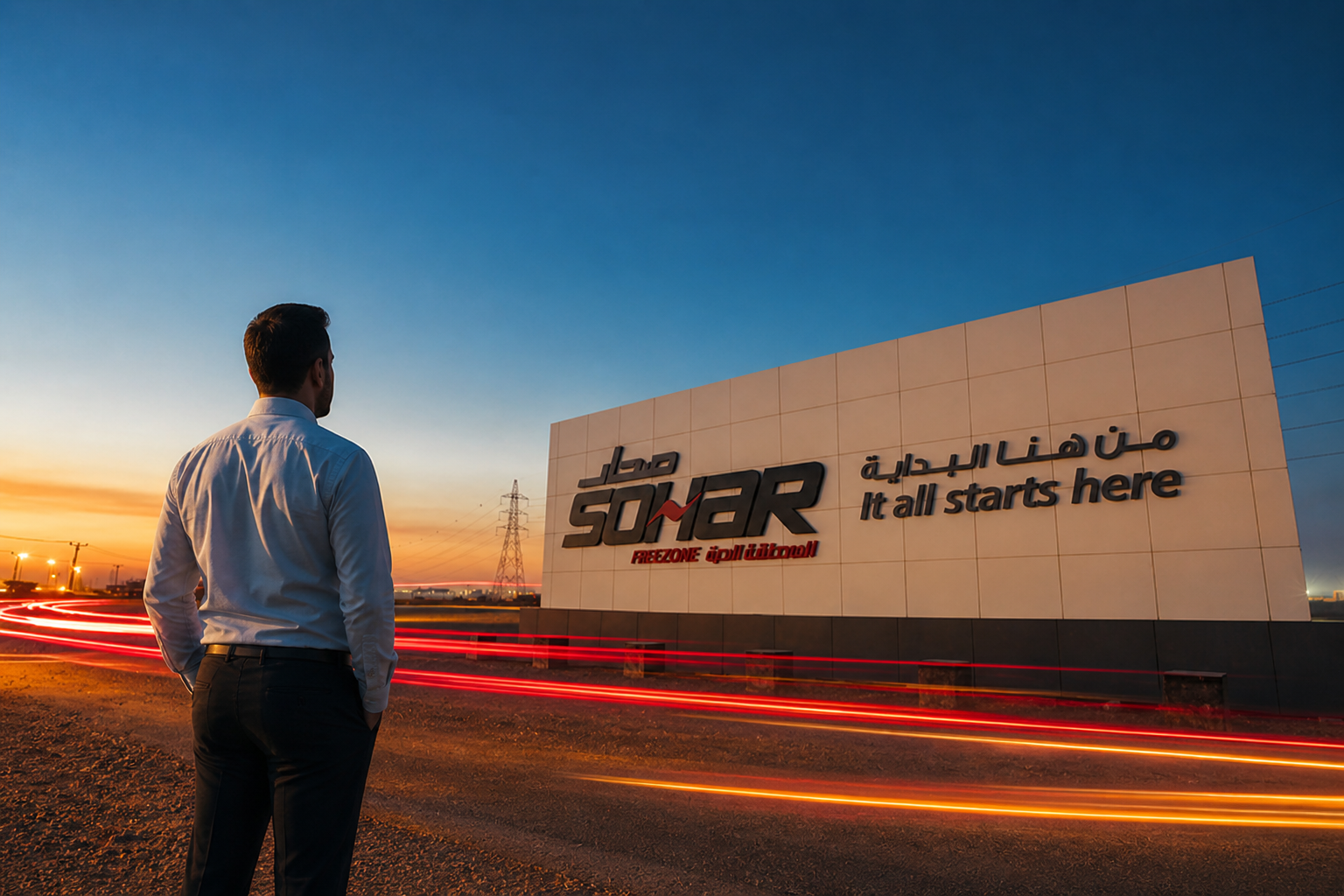
Recent economic advancements in the Sultanate of Oman, particularly within the framework of “Vision 2040,” have transformed the country from an oil-dependent economy into a global logistics and industrial hub. At the core of this transformation lies the SOHAR Freezone, recognized as one of the most successful port and free zone integration projects internationally. Managed through a strategic partnership with the Port of Rotterdam, this area is not just a production base but a vital gateway to markets in the Persian Gulf, the Indian Subcontinent, and East Africa. For investors seeking stability, modern infrastructure, and direct access to global trade routes, SOHAR offers more than simple tax exemptions; it is a complete ecosystem designed to reduce operational costs and minimize geopolitical risks.
1. Analysis of Strategic Necessities: Why SOHAR?
International investors look for a balance between cost, accessibility, and security when choosing a location for their facilities. SOHAR, positioned on the coast of the Sea of Oman and outside the Strait of Hormuz, guarantees supply chain security during periods of regional tensions. This geographical location means reduced vessel travel time and the elimination of extra insurance costs associated with passing through high-risk maritime points.
1.1. Multimodal Connectivity and the Hafeet Rail Project
One of SOHAR’s most powerful growth drivers is the development of its multimodal transport infrastructure. The Hafeet Rail project, which reached 40% physical completion by April 2026, will create a structural shift in regional logistics. This 238 km rail line connects SOHAR Port to the UAE national rail network, reducing cargo transfer time between SOHAR and Abu Dhabi to 100 minutes and to Al Ain to 47 minutes. For a manufacturing unit, this means rapid and inexpensive access to the large consumer market of the UAE and, beyond that, connection to the entire Gulf Cooperation Council (GCC) rail network.
| Key Indicators of the Hafeet Rail Project (2026) | Technical and Operational Details |
| Total Route Length | 238 km |
| Freight Train Speed | 120 km/h |
| Passenger Train Speed | 200 km/h |
| Cargo Capacity per Trip | 15,000 tons |
| Travel Time SOHAR – Abu Dhabi | 100 minutes |
| Project Progress (April 2026) | 40 percent |
1.2. Integration of Port and Freezone
Unlike many free zones separated from their ports, SOHAR Freezone is directly connected to the deep-sea SOHAR Port. This direct 6 km link, via dedicated highways, minimizes internal transfer costs. This structure allows heavy and petrochemical industries to rapidly unload raw materials and export finished products without leaving the customs boundaries, leading to significant liquidity improvement and reduced working capital needs.
2. New Legal and Regulatory Framework (Royal Decree 38/2025)
In April 2025, the Sultanate of Oman issued Royal Decree No. 38/2025, promulgating the new law for Special Economic Zones and Free Zones. This law aims to integrate processes and increase investor confidence, replacing older legislation. Under this law, the “Public Authority for Special Economic Zones and Free Zones” (OPAZ) acts as the single regulatory authority.
2.1. Advantages of the New Law for Investors
The 2025 law offers stronger legal guarantees against nationalization, property seizure, or asset freezing. Furthermore, complete freedom to transfer profits and capital abroad in any currency is guaranteed. Another critical aspect is the exemption of free zone companies from the “Commercial Agencies Law,” meaning foreign investors do not need a local Omani representative or agent for their activities.
2.2. One-Stop-Shop System (OSS)
The OSS system in SOHAR acts as a centralized hub for all government permits, visas, and approvals. The goal of this system is to reduce bureaucracy; according to the new law, the time period for issuing necessary permits should not exceed 5 working days. If a decision is not issued within this time, the application is deemed approved, demonstrating the government’s commitment to expediting processes.
3. Operational Process for Company Registration and Factory Setup
The establishment process in SOHAR follows a structured model, covering the stages from initial concept to the start of production.
3.1. Step One: Choosing Structure and Activity
The investor must first select their company type. Available options include:
- Free Zone Limited Liability Company (FZ LLC): The most popular choice for independent companies, allowing 100% foreign ownership.
- Branch of a Foreign or Domestic Company: For existing companies looking to expand their operations.
- Free Zone Establishment (FZE): A structure for companies with a single shareholder.
Activities are also classified into three main categories: Industrial (manufacturing and assembly), Logistics (warehousing and distribution), and Commercial (buying and selling).
3.2. Step Two: Name Reservation and Submission of Feasibility Study
The trade name must be unique and align with the company’s activities. Submission of a comprehensive Business Plan is mandatory, including details on investment, production capacity, land and electricity requirements, and the Omanisation strategy (localization).
3.3. Step Three: Land Allocation and Usufruct Contract
Following initial approval, OPAZ allocates suitable land or office space. Land lease (Usufruct) contracts in SOHAR can be for up to 25 or 50 years and are renewable for similar periods. Industrial land lease rates in 2025, based on new OPAZ incentives, start from approximately 250 to 500 Baisa per square meter per year.
3.4. Step Four: Environmental and Technical Permits
Industrial units must obtain a “Plot Work Permit”. This process involves the approval of engineering drawings by the Freezone’s technical department and the Civil Defence organization. Furthermore, depending on the industry’s nature, an Environmental Impact Assessment (EIA) is mandatory. Industries are classified into three categories, with heavy industries (Category I) having the most stringent monitoring requirements.
| Stages and Timeline for Company Registration and Setup (2025) | Approximate Duration |
| Trade Name Reservation and Initial Approval | 2-5 working days |
| Commercial Registration (CR) and Temporary License Issuance | 10 working days |
| Land Allocation and Lease Contract Signing | 5-7 working days |
| Environmental Permit Acquisition (depending on category) | 10-30 working days |
| Investor Visa Issuance and Bank Account Opening | 5-10 working days |
4. Analysis of Financial Costs and Operational Tariffs (2025-2026)
Accurate calculation of running costs is essential for maintaining the competitiveness of the final product. Due to the large scale of operations, SOHAR has lower service costs compared to many competing zones.
4.1. Industrial Electricity and Water Tariffs
Oman uses a Cost Reflective Tariff (CRT) system for large industries. These rates change seasonally to better manage energy consumption during peak heat.
| Electricity Connection Type | Summer Tariff (Baisa/kWh) | Winter Tariff (Baisa/kWh) |
| High Voltage Connection (132 to 400 kV) | 29 | 16 |
| 33 kV Connection | 32 | 19 |
| 11 kV Connection | 33 | 20 |
| Flat Tariff for Industries | ≈ 21-26 (average) | – |
*Note: Summer season is defined from May 1st to September 30th, and winter season from October 1st to April 30th.*
The water tariff for industrial sectors is approximately 1.320 Omani Rials per cubic meter. Water connection fees also vary based on building area, ranging from 200 Rials for small areas to over 1300 Rials for large buildings.
4.2. Administrative Costs and Permits
Initial registration and annual renewal costs for permits are as follows:
- Industrial or Logistics Permit: 385 Omani Rials.
- General Trading Permit: 3,000 Omani Rials (with a possibility of a 30% discount in the 2025 incentive campaigns).
- Service Provision Permit: 560 Omani Rials.
- Initial Commercial Registration: 1,050 Omani Rials.
- Investor Visa (2 years): Costs related to document issuance and approval.
4.3. Port Tariffs (2024-2025)
SOHAR Port adjusts its tariffs annually based on the average Consumer Price Index (CPI) of Oman and the USA. For the 2024/2025 period, an adjustment rate of 2.53% has been applied.
- Port Dues: Approximately $0.0600 per GRT for general cargo vessels for the first 5 days.
- Tugboat Cost: Approximately $1,544 per hour of activity for one tugboat for large vessels (over 200 meters).
- Pilotage: Varies between $143 and $801 based on the vessel’s GRT.
- Bank Guarantee: Port customers must provide a bank guarantee of at least 5,000 Omani Rials.
5. Tax Regime and Financial Incentives
SOHAR offers one of the most attractive tax packages in the Gulf region, aimed at ensuring rapid return on investment for industrial projects.
5.1. Corporate Income Tax Exemptions
Companies established in SOHAR Freezone benefit from a “tax holiday” of up to 25 years. Based on the new 2025 law, this exemption can be extended for additional periods for projects of a strategic nature. It should be noted that this exemption does not include banks, financial institutions, insurance companies, or telecommunication companies.
5.2. Other Tax and Customs Exemptions
- Personal Income Tax: Zero percent. Oman does not levy any tax on employee salaries (both local and foreign).
- Customs Duties: Import of machinery, equipment, raw materials, and spare parts into the Freezone is exempt from customs duties.
- Value Added Tax (VAT): Within the Freezone and for international exports, the VAT rate is zero percent or is suspended.
- Capital Repatriation: Investors have the right to transfer 100% of their profits and capital without any Withholding Tax.
6. Sales Goods in Oman and International Markets
One of the key questions for investors is how to move goods out of the Freezone and sell them in the Mainland or export them to other countries.
6.1. Sales in the Omani Domestic Market (Mainland)
When goods enter the Omani Mainland from SOHAR, they are legally considered an “import”.
- Customs Duties: A 5% customs duty (according to the GCC common tariff) is applied to the CIF value of the goods.
- VAT: A 5% Value Added Tax is calculated and collected at the point of entry into the Mainland.
- Distribution Requirements: A Freezone company cannot directly engage in retail in Oman unless it registers a branch on the Mainland or acts through an authorized Omani distributor.
- Bayan System: Goods clearance for the domestic market must be done through the “Bayan” system using 12-digit HS codes (mandatory from January 2025).
6.2. Export to GCC Countries
Goods produced in SOHAR, provided they comply with the rules of origin (usually a minimum of 40% value addition or change in customs tariff), are recognized as “Omani National Goods”. These goods can be exported under the GCC agreement to Saudi Arabia, UAE, Qatar, Kuwait, and بحرین without paying customs duties. For this purpose, obtaining a “National Certificate of Origin” from OPAZ is mandatory.
6.3. Export to the US (US-Oman FTA)
Oman is the only GCC country (along with Bahrain) that has a Free Trade Agreement (FTA) with the United States. Products manufactured in SOHAR can enter the US market duty-free.
- 35% Condition: The product must have a minimum of 35% value added in Oman (including local raw material costs and direct production costs).
- Substantial Transformation: The goods must have been converted in Oman into a new product with a different name and character.
| Comparison of Sales Markets for SOHAR Products | Customs Duties | Tax (VAT) | Main Requirements |
| Omani Domestic Market | 5% (Standard) | 5% | Registration in Bayan system |
| GCC Countries | Zero percent | 5% (Destination) | National Certificate of Origin |
| United States of America | Zero percent | According to US laws | 35% Domestic Value Added |
| Other Global Markets | Zero percent (Export) | Zero percent | Compliance with 12-digit codes |
7. Investment Challenges and Risks: Critical Analysis
No investment environment is without challenges. Awareness of these points is essential for formulating a preventive strategy.
7.1. Omanisation Policy
The Omani government has specified quota rates for the employment of its citizens. These rates are more flexible in Free Zones than on the Mainland.
- Rates: The quota for Omani employment in SOHAR Freezone is typically between 10% and 15%, whereas it may reach 30% to 35% on the Mainland.
- Expertise Challenge: There is a severe shortage of specialized labor in fields such as port automation engineering, marine pilots, and metal industry specialists. This leads to intense competition among companies for limited talent and an increase in payroll costs.
7.2. 12-Digit HS Codes and the Bayan System
Since January 1st, 2025, all GCC countries have migrated to the 12-digit coding system. Many old formats in the “Bayan” system no longer work, leading to the automatic rejection of declarations. For the investor, this means a need for precise goods auditing and updating ERP systems before commencing customs activities.
7.3. High Initial Fixed Costs
Although operational costs are competitive, initial setup costs (such as company registration and customs deposits) are higher compared to the Mainland. For instance, Freezone company registration costs between 1,500 and 4,000 Rials, while on the Mainland, it is estimated to be between 150 and 500 Omani Rials.
8. Specialized Infrastructure and Environment
SOHAR is built based on the concept of “Industrial Clusters” to ensure the supply chain is formed within the shortest possible distance.
8.1. Strategic Clusters
- Metals Cluster: Focused on aluminum and steel. Downstream companies can use the molten metal produced at the SOHAR Aluminum plant, resulting in massive energy cost savings.
- Petrochemicals Cluster: Access to refinery products for the production of plastics, chemicals, and pharmaceuticals.
- Food Cluster: Includes grain silos, flour mills, and packaging. SOHAR aims to become the region’s food security hub.
8.2. Green Energy and Solar Initiatives
SOHAR is transitioning towards becoming a “Green Port”. The “Solar-Ready Plots” program allows investors to use the flat rooftops of their factories to install solar panels. Estimates suggest that installing Photovoltaic (PV) systems can reduce grid electricity consumption by up to 18% and has a 5-year return on investment period. In 2025, major contracts were signed for the production of solar cells with a capacity of 6 GW, turning SOHAR into a new energy hub.
9. Visa and Foreign Labor Management
You can request visa for 85% of foreign labors
- Investor Visa: Typically issued for 2-year periods and is renewable.
- Visa Facilities: Visa and residency card (Oman ID) issuance is expedited through a dedicated branch of the Directorate General of Passport and Residence located within the Freezone boundaries.
- Labor Camps: Dedicated areas for worker accommodation, meeting health and welfare standards, are provided near the Freezone.
10. Waste Management and Environmental Analysis
The standard for environmental precision in SOHAR is very high. Heavy industries are required to adhere to strict protocols for wastewater and waste disposal.
- Waste Management: Companies must contract with authorized contractors for the collection and disposal of industrial waste.
- Category A Permits: Large industrial projects must submit a Scoping Study to ensure that all environmental risks are identified and mitigation solutions are included in the plan during the design phase.
11. Strategic Recommendations for Investors (Checklist)
For a successful entry into SOHAR Freezone, investors should prioritize the following actions:
- HS Code Assessment: Ensure all your products comply with the new 12-digit GCC codes.
- Omanisation Strategy: Engage from the outset with local training centers (such as the National University or the Oman Maritime College) to secure specialized Omani personnel and avoid non-compliance penalties.
- Rail Utilization: Consider access to the future rail network (Hafeet Rail) in your factory design, especially if the UAE is your target market.
- Financing: Oman now holds an “Investment Grade” credit rating, which facilitates access to internal bank facilities at favorable rates for industrial projects.
- Energy Management: Given the CRT tariffs, schedule your energy-intensive production processes for off-peak hours or during the winter season.
12. Summary and Future Outlook
SOHAR Freezone was recognized in 2026 as one of the world’s top three Free Zones in the fDi Intelligence index. With the injection of over $1.3 billion in new investment in the first half of 2025 alone, the region has demonstrated that global confidence in its stability and growth is at the highest level. The integration of physical infrastructure (port and rail) with advanced digital systems (Bayan and OSS) and transparent legal support (Law 38/2025) makes SOHAR an unparalleled destination for smart manufacturers. Investors looking to move beyond local markets and access large economies through FTAs will find SOHAR not just an option, but a strategic necessity.
Schreiben Sie einen Kommentar