
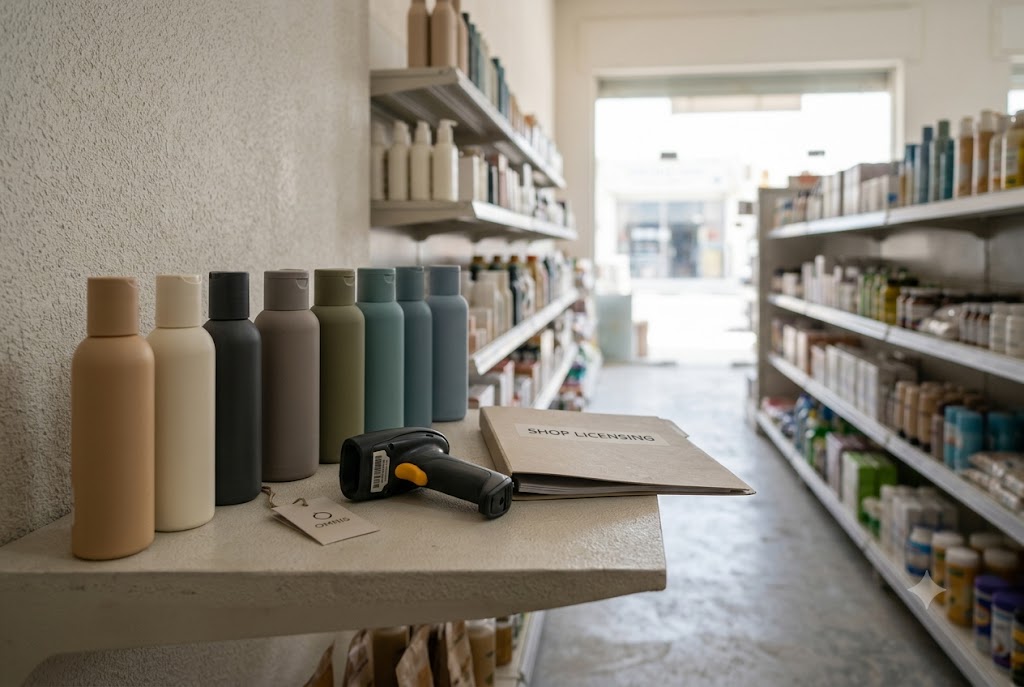
Opening a retail store in Oman starts with the exact product. A clothing shop, food shop, cosmetics store and jewellery shop do not follow one identical licence path.
A physical shop normally needs a suitable commercial activity, an approved location, a municipal activity licence and an approved signboard. Imported or controlled products may also need permits, registration, testing or another regulator’s approval. If the store will trade under a protected brand, review trademark registration in Oman separately from the company and signboard approvals.
Online ordering adds another sales channel. It does not remove the rules for the physical shop, products, stock, invoices, tax, delivery and consumer rights.
Before you sign a shop lease
- Define every product group that you plan to sell.
- Check the correct retail activity for each product group.
- Confirm foreign-ownership eligibility for the exact activity.
- Ask whether the proposed unit can receive the required municipal approval.
- List product, import, storage, safety and signboard approvals before paying deposits.
Retail store setup in Oman at a glance
| Setup point | Main question | Practical result |
|---|---|---|
| Retail model | What will the shop sell and how? | The model controls activities, premises, stock and online operations. |
| Product activity | Does each product match an approved activity? | One broad activity may not cover every product line. |
| Foreign ownership | Is the exact activity open to foreign investment? | Some retail and local-trade activities can be restricted. |
| Commercial premises | Can the unit legally support this activity? | The lease, property use, layout and storage must fit the licence. |
| Municipality | Which local authority approves the shop? | Requirements can change by governorate, location and activity. |
| Signboard | Does the design need owner and technical approval? | Install the sign only after the required approval. |
| Products and stock | Are permits, labels, records or special storage needed? | Controlled products may need approval before import or sale. |
| Online orders | Will customers order through a website, app or social media? | Use one stock, invoice, payment, delivery and return process. |
| Tax and invoices | Is the business registered for VAT? | Configure the shop and online system with the same tax treatment. |
Choose the retail model first
A retail business is more than a room with shelves. The operating model should be clear before licence applications and lease negotiations begin.
Start by deciding whether the shop will hold its own stock, sell on consignment, represent a franchise, display samples, import products, buy from local distributors or combine several methods.
| Retail model | Main feature | Licence and operating question |
|---|---|---|
| Specialist shop | One main product family | Is the selected specialist retail activity open and sufficient? |
| Multi-product shop | Several product families | Are several retail activities or product approvals needed? |
| Showroom with warehouse | Display at the shop and stock elsewhere | Does the warehouse need a separate approved location or activity? |
| Shop with online ordering | Walk-in sales, delivery and collection | Are the online channel and physical activity correctly connected? |
| Franchise or branded shop | Use of another brand and operating system | Are brand rights, supply terms and local licences aligned? |
The shop licence should match the real source of sales. A company should not register one activity and operate a different product model in practice.
Product category comes first
Retail permissions depend on the exact goods. The product name used in daily language may not be the same as the official economic activity.
You can search Oman business activity codes to find possible activity wording. The tool helps with searching. It does not confirm foreign ownership, regulator approval or final licence acceptance.
Why product detail matters
- Different product groups can have different retail activity codes.
- Some goods need approval before import, display or sale.
- Some goods need special labels, laboratory reports or conformity documents.
- Some shops need security, health, cold-storage or professional conditions.
- Some retail activities may be reserved or restricted for foreign investors.
| Product group | Extra point to check | Possible authority or system |
|---|---|---|
| Ordinary fashion, home or general consumer goods | Correct retail activity, product standards and import documents | MOCIIP, municipality, Oman Customs and standards authorities |
| Food and drinks | Product registration, label, health documents, storage and expiry control | MAFWR, Food Safety and Quality Centre, municipality and Customs |
| Cosmetics and chemical products | Conformity documents, safety data, testing and import permit requirements | Standards and Metrology and Oman Customs |
| Medicines, medical products or pharmacy goods | Facility, professional and product approvals | Ministry of Health and Drug Safety Centre |
| Gold and jewellery | Security permit and physical security conditions | Royal Oman Police and other relevant authorities |
| Agricultural inputs | Product and retail trading licence for the exact item | MAFWR and Oman Customs |
| Excise goods | Excise registration, product rules and tax treatment | Oman Tax Authority, Customs and sector regulators |
Important: Do not order commercial stock only because the company has a CR. Check the activity, import requirements and product approval route before shipment.
Foreign-investment restrictions
Oman permits full foreign ownership in many activities. This does not mean every retail activity is open to a fully foreign-owned company.
The current prohibited list includes a number of small local trades, traditional activities and retail activities. Other products may be regulated under separate laws even when they are not on that list.
Review the current restricted activities for foreign investors in Oman before selecting the shop activity or paying for premises.
Use this order of checks
- Find the exact activity that matches the products.
- Check the current foreign-investment status of that activity.
- Check whether a sector regulator must approve the activity.
- Check premises and municipal conditions.
- Check staff, import, tax and banking needs.
A similar activity name is not enough. The final check should use the current live government systems and the exact operating model.
Commercial premises
The shop address is part of the licence structure. A low rent does not help when the unit cannot receive approval for the planned activity.
Check the unit before signing
- Confirm that the property is approved for commercial use.
- Ask whether the exact activity can operate in that building or mall.
- Check access, parking, loading, waste handling and delivery collection.
- Check power, water, ventilation, cooling and internet needs.
- Check fire exits and any safety conditions for the product category.
- Confirm whether stock may be stored inside the unit.
- Ask whether a separate warehouse is needed for the planned stock volume.
- Get written landlord approval for the signboard and required modifications.
Municipal procedures are not identical across Oman. Muscat, Dhofar and other governorates may use different services, documents and inspection steps.
Premises document file
| Document or evidence | Why it may be needed |
|---|---|
| Valid commercial lease or ownership document | Proves the right to use the location. |
| Landlord approval | May be needed for signs, fit-out and technical changes. |
| Property or cadastral information | Helps the authority identify and review the unit. |
| Shop layout or fit-out plan | Shows customer areas, stock, exits and technical work. |
| Economic activity licence or application record | Connects the premises to the approved business activity. |
| Signboard design and dimensions | Supports the municipal sign application. |
| Sector approval | May be needed for food, health, security or controlled goods. |
| Safety documents | May be requested based on the unit, building and activity. |
Lease warning: Do not rely only on a landlord or agent saying that “all activities are allowed.” Ask for an activity and premises check before committing to a long lease or expensive fit-out.
Municipality approval and shop signage
A commercial registration does not by itself open the shop. The operating location normally needs the relevant economic or municipal activity licence.
For Muscat services, the municipality links the activity licence to proof of location and the economic licence. The live service also asks for a signboard model and related documents.
Signboard planning
Do not manufacture and install the sign before checking the local approval process. The required sign type can depend on the shop position and building.
- Use the approved company or trade name.
- Prepare a clear design with exact dimensions.
- Obtain the building owner’s approval where required.
- Check trademark or logo evidence when a protected brand appears.
- Keep doors, windows, architectural details and exits clear.
- Follow the technical conditions for the exact sign type.
- Keep the final permit with the shop’s licence records.
A side sign, roof sign, mall sign and roadside sign can follow different rules. Fees and approval times should be checked in the live local service.
Stock, invoices and consumer duties
Retail compliance continues after the shop opens. The business should be able to show where goods came from, how they were priced and what happened after a customer return.
Keep a clear stock record
| Stock field | Purpose |
|---|---|
| SKU or internal product code | Connects the shelf, POS and online listing. |
| Supplier and purchase invoice | Shows the legal source and purchase value. |
| Import and customs documents | Supports imported stock records. |
| Batch, serial or lot number | Helps with warranty, recall and controlled products. |
| Expiry date | Supports safe sale and stock rotation. |
| Warranty information | Helps staff handle defects and repair requests. |
| Storage location | Shows whether stock is in the shop or approved warehouse. |
| Online availability | Prevents the website from selling unavailable stock. |
| Reserved and collected stock | Controls click-and-collect orders. |
| Return status | Separates resaleable, damaged and quarantined items. |
Invoices and customer records
Oman’s Consumer Protection Law requires the provider to give the consumer a clear purchase document or invoice in Arabic with the required basic information. A bilingual invoice can also support customers and internal records.
The invoice should match the actual item, price, quantity, tax treatment, date and seller details. Warranty or serial information should be added when relevant.
Defects, returns and warranties
A shop policy cannot remove legal consumer rights. Defective goods may require repair, replacement or refund under the applicable rules.
- Write a clear return and exchange policy.
- Separate change-of-mind returns from defective-product claims.
- Explain exclusions only when the law allows them.
- Keep proof of inspection, repair, replacement and refund.
- Use the same policy for shop, website and social-media orders.
- Train staff not to reject a valid claim without review.
VAT in the retail system
The standard VAT rate in Oman is 5% for most taxable goods and services. Mandatory VAT registration applies when annual taxable supplies reach or are expected to reach OMR 38,500. Voluntary registration may be available from OMR 19,250.
A VAT-registered retailer should use one tax treatment across the POS, invoices, online checkout, discounts, returns and credit notes. Some products can have zero-rate, exempt or excise treatment, so do not apply one rule to every item.
Omnichannel operations
An omnichannel shop connects walk-in sales, online orders, social-media orders, delivery and collection. The customer should see one business, not several disconnected systems.
Commercial companies can apply for an e-commerce licence through the Oman government system. Keep this licence check separate from the product and physical-shop approvals.
Use one stock source
The most important control is one reliable stock record. A website should not show an item as available after the last unit has been sold in the shop.
| Omnichannel area | Minimum control |
|---|---|
| Product catalogue | Use the same SKU, name, key details and product status. |
| Price | Control shop and online prices, discounts and VAT treatment. |
| Inventory | Update sales, reservations, returns and damaged stock quickly. |
| Click and collect | Reserve the item and set a clear collection period. |
| Delivery | Show delivery area, charge, expected timing and failed-delivery process. |
| Payment | Reconcile card, gateway, cash and cash-on-delivery payments. |
| Returns | Allow staff to find and process orders from every channel. |
| Customer support | Keep one contact route and a record of complaints and resolutions. |
Online ordering should show clear information
- Legal business name and contact details
- Clear product description and important limitations
- Price and applicable tax treatment
- Available stock or realistic availability status
- Delivery or collection terms
- Payment methods
- Return, exchange and warranty terms
- Privacy and customer-data information
An order accepted through WhatsApp or Instagram should enter the same POS, stock, invoice, delivery and return process. Informal messages should not create an unrecorded second shop.
Practical rule: Use the physical shop as a controlled collection and return point only when the municipal licence, product activity, storage arrangement and customer process support that use.
Short company, residence and banking pathway
This post does not repeat the full company registration process. The retail-specific path is usually:
- Confirm the product list, activity codes and foreign-ownership position.
- Choose the company structure and complete registration.
- Confirm and register suitable commercial premises.
- Obtain the municipal activity licence, sign approval and product approvals.
- Prepare banking, payment, tax, staffing, stock and online systems.
- Open only after the operating approvals are in place.
For help with the company structure and registration steps, use the Oman company setup advisory.
An owner who also needs an Oman residence can review residency services for company owners. Residence approval is separate from approval of the retail activity and shop.
Retail businesses also need a working account for suppliers, card settlements, rent, payroll and tax. Review corporate bank account opening support in Oman. A company registration does not guarantee bank approval.
Costs and planning tools
A retail shop has two cost groups. The first group covers the company. The second group covers the real store operation.
| Cost group | Examples | Important limit |
|---|---|---|
| Company and general licences | Registration, chamber, tax and general administrative steps | These costs do not include the shop operation. |
| Premises | Deposit, rent, lease registration and utility deposits | Costs change by location and contract. |
| Municipality and signage | Activity licence, inspection, sign design and sign permit | Rules change by municipality and sign type. |
| Fit-out | Shelves, counter, lighting, cooling, security and accessibility work | Get approval before structural or technical changes. |
| Product approval | Registration, testing, conformity, health or security approval | Depends on the exact goods. |
| Imports | Freight, insurance, duty, VAT, broker and permit costs | Check the HS code and import conditions before shipment. |
| Stock | Opening inventory, samples, damaged-stock allowance and reorder funding | Stock often uses more cash than the company registration. |
| Systems | POS, inventory, barcode, accounting, online store and payment setup | Systems should share accurate product and stock data. |
| People | Recruitment, payroll, training, uniforms and compliance | Staffing and Omanisation can change future costs. |
| Working capital | Rent, payroll, restocking, delivery, returns and slow-sales reserve | Plan for months with low sales. |
You can estimate general mainland company and investor-residence costs. The estimator does not calculate shop rent, municipal charges, fit-out, product approvals, customs, stock, equipment, staff or working capital.
Common mistakes
- Signing a lease before checking the exact activity and location
- Assuming one broad activity covers every product in the shop
- Assuming all retail activities allow full foreign ownership
- Importing stock before checking permits and product conformity
- Using the shop as a large warehouse without confirming permission
- Installing a signboard before approval
- Keeping different prices and stock records online and in the shop
- Failing to issue a clear Arabic invoice
- Copying a foreign return policy that conflicts with Oman’s consumer rules
- Ignoring expiry, batch, serial and warranty records
- Using personal payments for business sales and supplier costs
- Expecting company, residence, bank, customs or licence approval to be automatic
Practical retail-store checklist
Business model
- List every product family.
- Define local purchase, import, franchise or consignment routes.
- Decide whether the business will use online ordering and delivery.
- Prepare a realistic stock and working-capital plan.
Activities and ownership
- Find the correct activity for each product group.
- Check foreign-investment restrictions.
- Check special regulator approvals.
- Confirm that the activity matches the real revenue model.
Premises and municipality
- Check the unit before paying a long-term commitment.
- Confirm storage, loading, utilities, safety and fit-out needs.
- Register the lease through the correct local process.
- Obtain the economic or municipal activity licence.
- Approve the sign design before production and installation.
Products and stock
- Check import and product registration requirements.
- Keep supplier, customs and conformity documents.
- Set batch, expiry, serial and warranty controls.
- Separate good, damaged, returned and quarantined stock.
Sales and customer service
- Configure POS, invoice and tax settings.
- Prepare clear Arabic or bilingual invoices.
- Publish delivery, return and warranty terms.
- Train staff to handle defects and complaints.
- Connect shop, website and social-media orders to one stock system.
Frequently asked questions
Can a foreign investor open a retail store in Oman?
Yes, many retail models can be available to foreign investors. The answer depends on the exact activity, product, current prohibited list and any special regulator. Do not assume that every shop activity allows full foreign ownership.
Do I need a shop before registering the company?
The company and premises steps can overlap, but the operating shop normally needs a valid location and local approval. Check the activity first, then confirm a suitable unit before making a long lease commitment.
Can one retail activity cover all products?
Not always. Different product families can need different activities or regulator approvals. Prepare the full product list before selecting activities.
Does a physical shop need a signboard permit?
The sign normally forms part of the local licensing process and may need a separate permit. The required documents and conditions depend on the sign type, building and municipality.
Can I store all stock inside the shop?
Only when the location, layout, product type and local approval support that storage. Large volumes or controlled goods may need a separate approved warehouse or special storage conditions.
Do I need an e-commerce licence for online orders?
Commercial companies can apply for an e-commerce licence for online activity. Confirm the current licence requirement for your sales channel. This licence does not replace product, municipality or physical-shop approvals.
When must a retail business register for VAT?
Mandatory registration applies when annual taxable supplies reach or are expected to reach OMR 38,500. Voluntary registration may be available from OMR 19,250. Confirm the current position with the Oman Tax Authority.
Can the Activity Finder confirm foreign ownership?
No. It helps search activity codes and names. It does not prove that an activity is open to foreign ownership or that a regulator, municipality, bank or labour authority will approve it.
Can bank account opening be guaranteed?
No. Banks complete their own compliance and risk review. The activity, ownership, premises, source of funds, expected transactions and supporting documents can affect the result.
Can I sell imported food or cosmetics after customs clearance?
Customs clearance alone may not be enough. Food, cosmetics and other controlled goods can need product registration, conformity documents, labels, health records or permits before sale.
Related Oman Verified guides and services
Omanisation
Understand staffing planning and Omanisation requirements for companies.
Oman tax
Review VAT, corporate tax and wider Oman tax rules for companies.
Activity restrictions
Check the current Negative List before choosing a retail activity or structure.
Conclusion
A retail store business in Oman should be built from the product outward. First confirm the goods and activity. Then confirm foreign ownership, premises, municipality, signage, import, stock and consumer duties.
Online ordering should connect to the same legal company, product permissions, stock, invoice, payment and return system. This keeps the physical shop and digital channel clear and manageable.
The safest approach is to check the full operating path before signing the lease, ordering stock or paying for fit-out.
International setup support
Oman Verified supports international founders and retailers with Oman-side company setup, licensing, municipality, tax, customs, banking and residency coordination. Company registration, foreign-ownership eligibility, municipal approvals, product registration, customs clearance, licences and banking decisions are completed through the relevant authorities and institutions, with requirements checked against the live case.
Official sources
- Gov.om — Get Investment License
- Oman News Agency — Decision Updates Prohibited Activities for Foreign Investment
- Muscat Municipality — Issue a Licence to Practise an Activity
- Gov.om — Get Side Signboard License
- Gov.om — Get a License to Practice E-Commerce for Commercial Companies
- Oman Customs — Search Import and Export Requirements
- Gov.om — Apply for a Food Product Registration Certificate
- Oman Customs — Permit to Import Chemical and Cosmetic Products
- Ministry of Health — Pharmaceutical Facility and Medical Device Establishment Approval
- Gov.om — Security Permit for Gold and Jewellery Stores
- Oman Tax Authority — Tax Registration
- Oman Tax Authority — Tax Rates
- Consumer Protection Authority — Invoice and Defective-Goods Duties
Official public information reviewed on July 26, 2026. Confirm the current requirements in the live government systems before submission.