
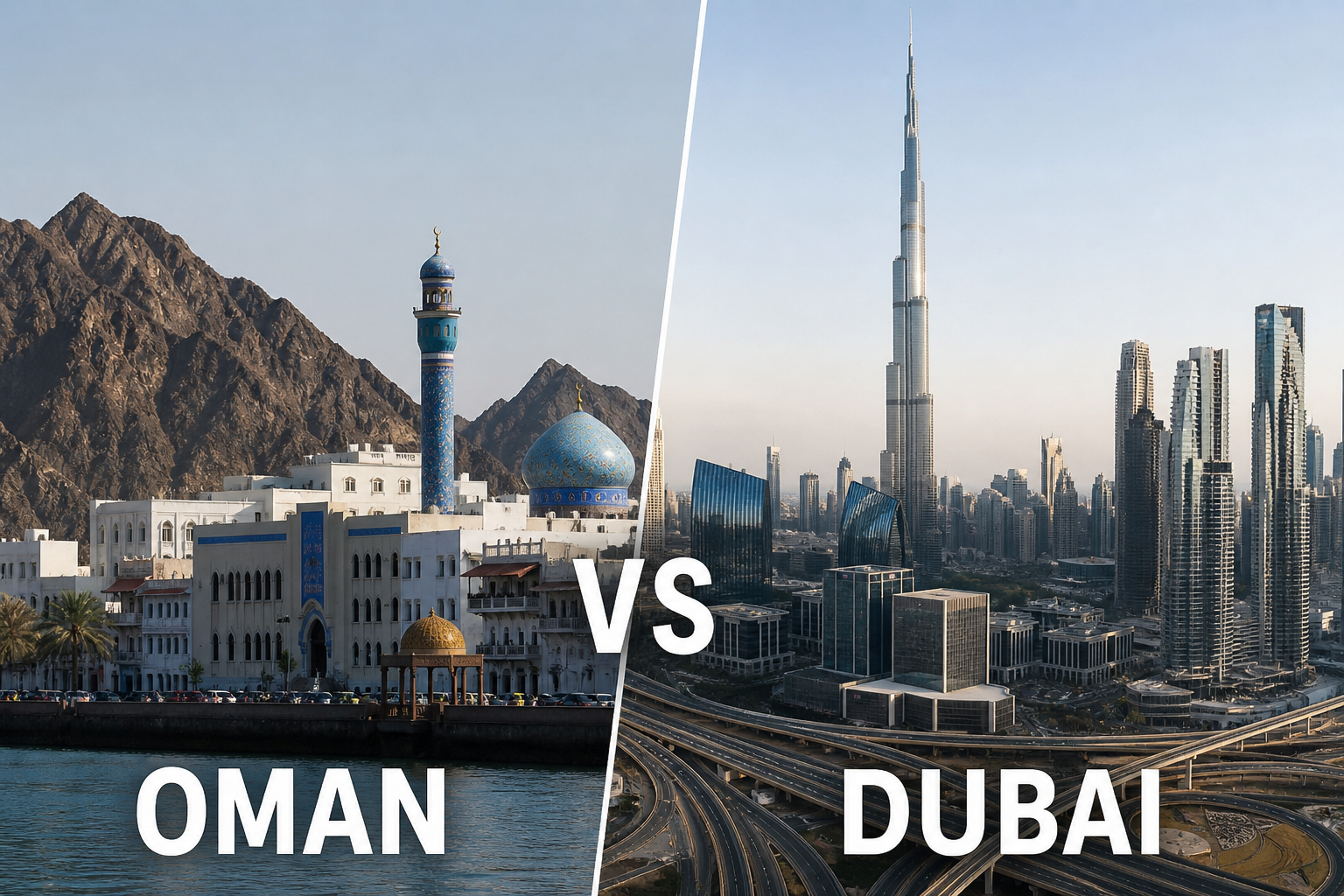
Choosing between Oman and Dubai is not only a licence-price decision. It is a choice about customers, premises, staff, tax, residence, banking and the place where the company will really work.
This guide compares Oman mainland and selected Oman zones with Dubai mainland and representative Dubai free-zone models. Dubai is one emirate of the United Arab Emirates. UAE federal rules, Dubai mainland rules and each free zone’s rules are not the same.
The evidence date is 2 August 2026. Fees, activity rules, visa conditions and free-zone packages can change. Ask each authority for a written quotation based on the same activity, owners, premises and visa count before paying.
Quick decision logic
- Choose Oman mainland when the company needs direct Oman-market work, Oman contracts or a local operating team.
- Review an Oman zone when the project needs port access, industrial land, storage, production or export facilities. Check the selected zone, not a general promise.
- Choose Dubai mainland when direct UAE onshore sales, Dubai clients and a local commercial presence are central.
- Review a Dubai free zone when its exact activity, workspace, visa capacity and market-access rules match the business.
- Use two entities only when each company has a real and separate commercial role. Two licences also mean two sets of compliance costs.
Oman, Dubai mainland or a Dubai free zone?
Start with the paying customer. Choose the location that reduces the distance between the company and the person who pays it. A consultancy selling to Dubai companies has a different need from a logistics operator using Sohar or Duqm. A free-zone licence can be useful, but it does not automatically provide unrestricted access to the mainland market.
Then test operational readiness. Registration is only the first legal step. The company may still need an investment licence, premises, municipality or sector approval, tax registration, immigration and labour files, a bank account, insurance and working capital.
At-a-glance comparison
| Decision point | Oman mainland | Oman zone | Dubai mainland | Dubai free zone |
|---|---|---|---|---|
| Best starting question | Do we need to trade and operate in Oman? | Does the project fit this named zone? | Do we need direct Dubai or UAE onshore access? | Does this named zone fit the activity and customers? |
| Foreign ownership | 100% is available for many activities; restrictions and approvals still apply | 100% is offered in OPAZ zones, subject to project and zone rules | 100% is available in many sectors; strategic-impact activities are treated separately | 100% is generally available under the selected zone’s rules |
| Corporate tax | 15% standard rate on net taxable income | Zone incentives may apply to qualifying projects and periods | UAE federal corporate tax rules apply | 0% is not automatic; qualifying free-zone rules apply |
| Standard VAT | 5% | Treatment depends on the supply and zone rules | 5% | Treatment depends on the supply and designated-zone rules |
| Premises | Depends on activity, licence and later approvals | Land, warehouse, office or facility terms are zone-specific | Premises and local licensing requirements must be confirmed | Flexi-desk or office options and visa capacity are zone-specific |
| Main commercial strength | Direct Oman operations and local contracts | Ports, industry, logistics and export projects | UAE customers and onshore commercial access | Specialised clusters, regional services and international trade |
| Main risk | Choosing Oman without enough local demand | Choosing incentives without checking project eligibility | Paying higher fixed costs without proven customers | Buying a package that does not fit mainland trade or staff needs |
Matched business scenarios
The following scenarios use the same business assumptions in every column. They do not give universal totals because official fees, rent, approvals and zone packages change. They show what must be priced in each written quotation.
| Matched scenario | Oman test | Dubai test | Likely decision driver |
|---|---|---|---|
| Solo consultancy: one foreign owner, no employee at launch, one owner residence, compliant small workspace | Check the activity, investment licence, address, owner residence and the rule requiring an Omani employee after one year | Compare Dubai mainland with one named free zone. Check the normal renewal price, workspace, establishment file and one residence permit | Location of paying clients, year-two staff duty, total renewal cost and banking |
| General trading: one owner, broad product mix, one residence, office and import activity | Check every product activity, customs, storage, municipality and any restricted activity | Compare mainland access with one named trading free zone such as DMCC. Confirm activity scope, customs path and mainland sales route | Where goods enter, where buyers are, inventory space and customs handling |
| Logistics: one owner and three employees, warehouse or yard, freight-related approvals | Compare Oman mainland with a named port-linked option such as Sohar Free Zone or Duqm SEZ | Compare Dubai mainland with a named logistics zone such as JAFZA or Dubai South | Port and airport route, land cost, customer contracts, employee approvals and facility terms |
Matched-quote rule: request the same activity, legal form, owner count, visa count, employee count, premises type and service scope. Ask for both the first-year total and the normal renewal-year total. Exclude refundable deposits and share capital from operating cost, but show them separately as cash requirements.
Company structures and foreign ownership
Oman mainland and Oman zones
Oman’s Foreign Capital Investment Law allows full foreign ownership in many sectors. This does not mean every activity is open. Reserved activities, sector rules and external approvals still matter. The legal form may be an LLC, a one-person company, a branch or another permitted form.
An Oman mainland company is normally reviewed when the business needs direct Oman operations. A company in Sohar Free Zone, Salalah Free Zone, Al Mazunah Free Zone or Duqm Special Economic Zone follows the selected zone’s rules. OPAZ advertises 100% foreign ownership and tax incentives, but the exact benefit depends on the project, zone agreement and current approval. Use Oman free-zone selection advisory when land, port access, customs or an industrial facility is central.
Dubai mainland and named Dubai free zones
UAE rules allow full foreign ownership in many commercial sectors. Activities with strategic impact can follow separate controls. A Dubai mainland company is licensed through Dubai’s local economic authority and can be the direct route for onshore work, subject to its activity and other approvals.
A Dubai free-zone company is licensed by its own free-zone authority. DMCC, JAFZA, Dubai South and DIFC are different systems. They do not have one common package, licence scope or legal environment. UAE government guidance states that local mainland sales from a free-zone company are regulated and may require a mainland distributor, branch, company, licence or approval. Check the rule for the exact transaction.
Registration is not operational readiness
| Layer | What it answers | Why it can stop the business |
|---|---|---|
| Legal eligibility | Can this owner use this activity and legal form? | Ownership or activity restrictions may apply |
| Registration | Does the company legally exist? | A commercial record alone may not permit operation |
| Operational licence | Can it carry out the exact activity at this place? | Sector, municipality, customs or facility approval may be missing |
| Immigration and labour | Can the owner and staff live and work legally? | Visa and work approvals are separate decisions |
| Banking | Can the company receive and send funds? | Each bank conducts its own KYC and risk review |
| Commercial readiness | Can the company serve customers profitably? | No customers, margin, premises or working capital may exist |
For an Oman mainland plan, Oman company setup advisory can help map the local company, investment-licence and post-registration sequence. Authority, immigration and bank approval remain independent.
First-year and annual cost comparison
There is no reliable single price for “Oman” or “Dubai.” An advertising package may exclude premises, immigration files, residence, external approvals, tax work or normal renewal. A logistics licence cannot be compared with a one-person consulting package.
| Cost layer | First year | Renewal years | Comparison check |
|---|---|---|---|
| Company and licence | Incorporation, licence and initial authority files | Licence and commercial-record renewal | Use the exact activity and legal form |
| Premises | Deposit, rent, fit-out, registration and approvals | Rent, service fees and any facility renewal | Match flexi-desk with flexi-desk, office with office, warehouse with warehouse |
| Owner and staff | Immigration, medical, ID and work-permit steps | Residence, ID and work-permit renewals | Use the same number and type of people |
| Localisation | May start immediately or after a defined period | Payroll and statutory contributions can become a major fixed cost | Check current Omanisation or Emiratisation scope for the exact employer |
| Professional compliance | Tax registration, accounting setup, contracts and UBO records | Bookkeeping, returns, audit where required and corporate records | Do not omit year-two work |
| Commercial spend | Market testing, travel, insurance, equipment and working capital | Sales, delivery, staffing, inventory and cash cycle | Licence cost is not total business cost |
Use the Oman company setup cost calculator for a first-stage Oman mainland estimate. It covers general Oman mainland company and investor-residence costs only. It does not calculate Dubai, land, factories, equipment, inventory, professional licences, environmental studies or sector approvals.
Important cost warning: do not treat share capital or a refundable deposit as a fee. It may still be a real cash requirement. Ask whether it must be paid, blocked, maintained or only stated in company documents.
Corporate tax and VAT
| Tax point | Oman | Dubai / UAE |
|---|---|---|
| Standard corporate income tax | 15% of net taxable income | 0% on taxable income up to AED 375,000 and 9% above that amount |
| Free-zone position | Incentives depend on the named zone, qualifying project, approval and period | A Qualifying Free Zone Person may receive 0% on Qualifying Income; conditions and 9% treatment for other taxable income apply |
| Standard VAT | 5% | 5% |
| Mandatory VAT threshold | OMR 38,500 of taxable supplies under the official threshold rules | AED 375,000 under the official threshold rules |
| Personal income tax | A 5% law with an OMR 42,000 threshold starts in 2028, subject to the law’s detailed scope | Not a company tax; check the individual’s full tax residence position |
Dubai free-zone status does not create a universal 0% corporate tax result. The company must meet the Qualifying Free Zone Person rules, including the conditions for qualifying income and adequate substance. A permanent establishment outside the free zone and non-qualifying income can change the result.
Oman zone incentives also need project-level confirmation. OPAZ states that tax exemption can reach up to 30 years, while its Sohar Free Zone page states up to 25 years for that zone. “Up to” is not a promise for every licence.
Office, staffing and localisation
Premises must fit the activity. A consulting company may be able to use an approved small workspace. Trading, logistics, food, health, education and industrial activities may need a shop, warehouse, yard, office or regulated facility. A cheap address can fail later at the licence, labour, bank or visa stage.
Oman’s authorities announced a rule requiring firms and companies that have completed one year from establishment to employ at least one Omani. Sector-specific Omanisation rates and occupation restrictions can also apply. Confirm the live position for the activity, company age and workforce.
In the UAE, the main Emiratisation target covers private companies with 50 or more employees. Selected establishments with 20–49 workers in specified activities also have duties. A three-employee scenario is not the same as a larger employer, but this does not remove the need to check the company’s current classification and the rules of the selected free zone.
Residence and family options
A company licence and a residence permit are separate approvals. Oman has a company-linked investor visa service based on a certificate from the competent authority. It also has separate long-term investor routes. The UAE has company-linked residence routes and separate Golden Residency categories for eligible investors, entrepreneurs and other applicants.
Check the residence category, duration, medical and identity steps, family sponsorship, renewal, time outside the country and what happens if the company closes. Residency services for company owners can support the Oman sequence where the company comparison points to Oman. No residence approval is automatic.
Corporate banking
Dubai offers a wide mix of local, international and digital banking services. Oman also offers corporate accounts, international transfers and trade products. More bank choice does not mean easier approval for every founder.
Banks in both markets review the owners, beneficial owners, source of funds, business model, address, customers, expected countries, contracts and transaction pattern. They can request more evidence or refuse the application. A licence provider cannot guarantee the result.
If Oman is selected, business banking preparation support can help organise the application file. Final approval, timing, product access and account conditions belong to the bank.
Customers, competition and fundraising
Dubai has a dense international business network. This can help a company selling technology, finance, premium services, regional trade or corporate solutions. It also creates stronger competition, higher customer-acquisition pressure and a need for clear positioning.
Dubai also has public and private startup-capital initiatives. The Dubai Future District Fund, for example, was launched with an initial AED 1 billion commitment. Access to a larger ecosystem does not guarantee investment. Founders still need a strong company, product, traction and investor fit.
Oman’s domestic market is smaller. That can limit a mass-market model, but it may suit a specialist provider, contractor, industrial project or business with clear Oman demand. Fewer visible competitors do not prove there are enough customers. Interview buyers before registration.
Where the paying customer is
- UAE consumers or Dubai companies: a Dubai base may make meetings, delivery, local contracting and customer confidence easier.
- Oman consumers, companies or projects: an Oman base may be needed for local licences, staff, premises and contracts.
- International online customers: compare banking, payment tools, tax residence, staff and the founder’s real location. The domestic market may matter less.
- Production in Oman and regional sales through Dubai: this can work when each entity has a real role, but it requires two-country tax, customs, banking and legal planning.
A company in one country does not automatically have the right to trade on the mainland of the other. Plan cross-border goods and services before the first invoice.
Ports, flights and regional reach
Dubai combines Jebel Ali Port with major air links, logistics zones and a large trading community. DP World reported that Jebel Ali handled 15.5 million TEUs in 2024. This scale can help time-sensitive trade, regional distribution and meetings with customers and partners.
Oman’s Sohar, Duqm and Salalah ports support industrial, logistics and export models. OPAZ and Asyad describe access to Gulf, Indian, East African and wider maritime routes. Sohar and Duqm are outside the Strait of Hormuz. This can be important for route design, but freight cost and transit time must be quoted for the exact origin, destination, cargo and season.
Neither an Oman licence nor a Dubai licence gives automatic retail or regulated-service rights across the GCC. Customs, product registration, VAT, local licensing and distributor rules must be checked in every destination market.
Founder lifestyle and personal operating costs
Lifestyle becomes a business cost when the owner or family must live in the chosen market. Housing, schools, transport, travel time, insurance and daily spending affect how much cash remains inside the company.
Dubai offers a large international community, frequent events and strong global connections. It can also create higher personal spending. Muscat is smaller and often calmer. It may reduce some living costs, but it has fewer large business events and a smaller network in some sectors.
If the founder will manage the company from another country, check management, substance, banking and tax-residence rules. A low-cost licence is not useful when the company cannot meet its real operating duties.
Founder cash-flow test: compare the company cost and the founder’s personal cost together. A location that is cheaper to register can still be more expensive to sustain.
When Oman may win
- The first customers or contracts are in Oman.
- The project needs industrial land, storage, processing or port-linked operations.
- The supply chain benefits from Sohar, Duqm or Salalah.
- The founder has tested a clear gap in the Omani market.
- The business can meet Omanisation, premises and compliance duties.
When Dubai may win
- The company needs frequent access to Dubai and wider UAE customers.
- The founder needs a dense network of events, advisers, investors or regional headquarters.
- A named Dubai free zone clearly fits the activity and trade route.
- The margins can support stronger rent, marketing and renewal costs.
- International flights and a regional client-facing base are operational priorities.
Dubai may be the wrong choice when the company has little cash after setup, no proven UAE customer, a weak marketing plan or a low-margin offer. A large market cannot repair a business model with no clear demand.
When an Oman–Dubai two-entity model works
A dual structure can work when the Dubai entity has a real sales, investment or regional-management role and the Oman entity has real production, logistics or local-service operations. Contracts, people, assets and decision-making should match those roles.
It should not be used only to place profit in the lower-tax location. The group must plan transfer pricing, related-party agreements, permanent establishment, customs, VAT, beneficial ownership, banking and substance. It also pays two sets of setup, renewal, accounting and governance costs.
Use one entity when possible. Add the second company only when the commercial benefit is greater than the extra legal, tax, banking and management work.
Tools and advisory pathway
- Define the exact activity, products, customers and countries.
- Use search Oman commercial activity codes as a first research step. The tool does not prove foreign-ownership eligibility, licence approval or regulator acceptance.
- Request matched written quotations from the Oman authority or zone and the exact Dubai mainland or free-zone authority.
- Model tax, staff, premises, residence, banking and working capital before paying.
- Get activity-specific legal or tax advice for regulated or cross-border structures.
Common mistakes
- Comparing Oman mainland with a short-term promotional Dubai package.
- Assuming every activity allows full foreign ownership without approval.
- Treating registration as permission to operate, hire or open a bank account.
- Believing every free-zone company receives 0% corporate tax.
- Ignoring normal renewal, premises, accounting and staff costs.
- Choosing a city before testing real customers.
- Using two entities without clear contracts, substance and transfer-pricing work.
Practical decision checklist
- List the first 20 possible paying customers in each market.
- Confirm the exact activity and every external approval.
- Choose mainland or one named zone for each country.
- Use the same owners, visas, staff and premises in each quotation.
- Separate fees, refundable deposits, share capital and working capital.
- Check first-year and normal renewal-year totals.
- Confirm tax, VAT, bookkeeping, audit and transfer-pricing duties.
- Confirm Omanisation or Emiratisation for the exact employer.
- Plan residence and family needs separately from the licence.
- Prepare the bank file and accept that approval is not guaranteed.
- Model at least 12 months of operating cash needs.
- Add a second entity only after pricing its full compliance burden.
Frequently asked questions
Is Oman cheaper than Dubai for business setup?
Sometimes, but not for every model. Premises may cost less in some Oman cases, while staff duties can change the result. Dubai can have higher fixed costs but may offer closer access to more customers. Compare the same complete first-year and renewal-year scope.
Does a Dubai free-zone company pay 0% corporate tax?
Not automatically. A Qualifying Free Zone Person may receive 0% on Qualifying Income when all conditions are met. Other taxable income can be subject to 9%.
Can a foreign investor own 100% of an Oman company?
Full foreign ownership is available for many activities. Reserved activities, sector restrictions and external approvals still apply. Confirm the exact activity in the live authority system.
Can one Oman company sell directly across the UAE?
An Oman licence does not give automatic UAE mainland rights. The company must follow UAE customs, VAT, product, activity and local-licensing rules for the exact goods or services.
Is a Dubai mainland company always better for UAE customers?
It can provide a clearer route for onshore activity, but the answer depends on the licence, customer, activity and delivery model. Some free-zone structures can also work with the correct mainland arrangements and approvals.
Does company setup guarantee residence or a bank account?
No. Residence and banking are separate processes. Immigration authorities and banks make their own decisions after reviewing eligibility and documents.
When should a founder use both Oman and Dubai entities?
Use two entities only when each has a real role, such as Dubai sales and regional management plus Oman production or logistics. The model must justify the extra tax, accounting, banking, customs and governance work.
Is Dubai better for a startup?
Dubai may offer a larger network of investors, events, skilled people and regional customers. This can help some startups, but the company still needs enough budget, a clear market, traction and a structure that fits its work.
Is Oman better for manufacturing and logistics?
Oman can be a strong option because of its ports, industrial areas and special zones. The final choice depends on the supply chain, energy, land, facility terms, staff, customers, export route and project approvals.
Will Oman have personal income tax?
Oman’s Personal Income Tax Law takes effect at the start of 2028. The official information cited in this guide states a 5% rate and an OMR 42,000 threshold, subject to the law’s detailed scope, deductions and exemptions.
Related Oman Verified guides
Check the Oman fit
Review whether Oman fits the investor’s real objective before choosing a structure.
Understand the risks
Review the limits and risks of company registration in Oman before committing.
Plan an Oman setup
Use Oman company setup advisory when the comparison already points to Oman.
Price the founder’s life
Use the detailed cost of living in Oman when the owner or family will move to Muscat.
Conclusion
Oman may fit a company that needs Oman customers, industrial space, ports, production or a long-term local operating base. Dubai may fit a company that needs UAE customers, a dense international network, regional sales, fundraising contacts or specialised service clusters.
Neither is best for everyone. Choose the place that supports the first customers and the real operation. Compare matched written quotations, then confirm tax, staff, residence and banking before paying.
International client support: Oman Verified works from Muscat with founders, investors and companies comparing Oman with other markets. For a specific case, we can coordinate the relevant Oman-side company setup, tax, banking, customs, immigration and specialist work with the appropriate authorities, banks and licensed professionals.
Official sources
- Dubai Government: Starting a Business
- Oman Ministry of Commerce, Industry and Investment Promotion: Foreign ownership and investment framework
- Gov.om: Get Investment License
- Gov.om: Get Investor Visa
- Oman Business Platform
- Oman Tax Authority: Tax rates
- Oman Tax Authority: Personal Income Tax Law starts in 2028
- Oman News Agency: One-Omani employment rule after one year
- OPAZ: Special economic zones and free-zone incentives
- OPAZ: Sohar Free Zone incentives
- Oman Golden Residency Portal
- UAE Ministry of Economy and Tourism: Company registrars and foreign ownership
- UAE Government: Running a business in a free zone
- UAE Government: Corporate tax
- UAE Federal Tax Authority: Corporate Tax Guide on Free Zone Persons
- UAE Federal Tax Authority: VAT registration thresholds
- UAE Ministry of Human Resources and Emiratisation: Employer targets
- GDRFA Dubai: Green Residence for Investor or Partner
- UAE ICP: Golden Residency categories
- Dubai Future Foundation: Dubai Future District Fund
- DP World: Jebel Ali Port 2024 cargo volumes
- Asyad Group: Oman ports and free-zone connectivity
Official public information reviewed on 2 August 2026. Confirm the current requirements in the live government systems before submission.