
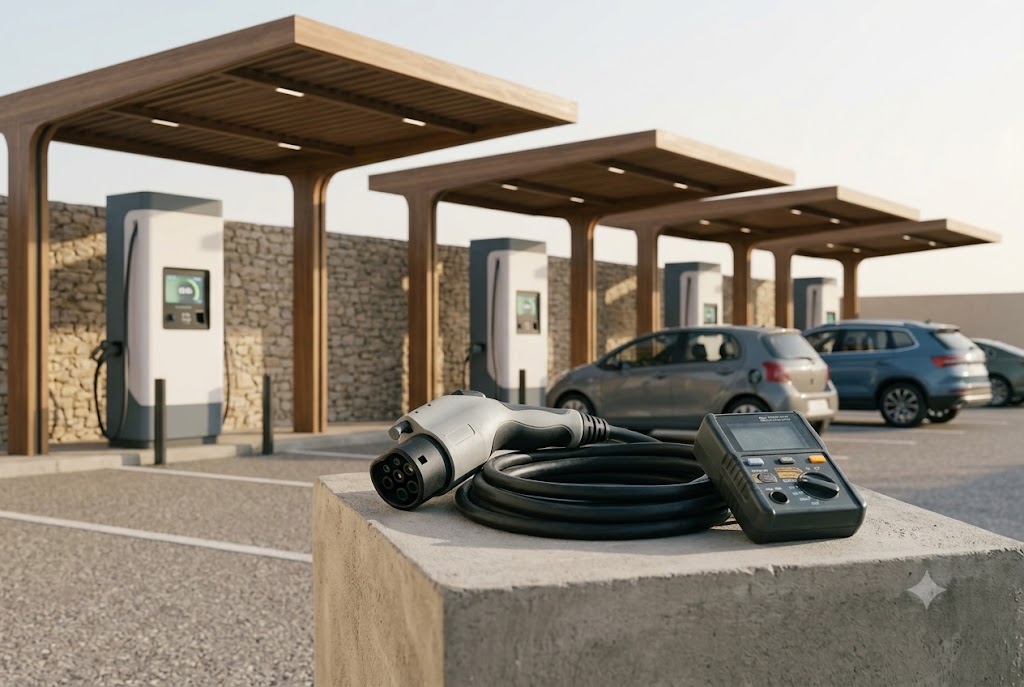
An electric vehicle charging business in Oman can take several forms. It may sell chargers, install equipment, maintain stations, operate a public network, provide software, or support an electric fleet.
These models do not have the same approvals. Selling a charger is different from connecting it to the electricity network. Writing charging software is also different from carrying out electrical work or operating a public charging point.
The safest way to start is to define the exact service model first. Then confirm the commercial activities, site rights, utility process, technical design and operating responsibilities before buying equipment.
Choose the EV-Service Model Before Registration
- Equipment supplier: imports or sells AC and DC chargers.
- Installation coordinator: plans projects and works with an approved electrical contractor.
- Charge point operator: owns or operates public charging points.
- Maintenance provider: tests, repairs and maintains charging equipment.
- Software provider: supplies apps, charger management, user accounts, reporting or payment tools.
- Fleet-service provider: supports company vehicles, depot charging, route planning and energy management.
A company may combine several models. Its Commercial Registration, contracts, staff and approvals must cover the work it actually performs.
EV Charging Business Models at a Glance
| Business model | Main customer | Main regulatory question | Typical responsibility |
|---|---|---|---|
| Charger sales | Homes, developers, hotels, fleets and station operators | Are the products compliant and correctly imported? | Supply, warranty and technical documents |
| Private-site installation | Homeowner, landlord, office, hotel or mall | Who owns the site and who approves the connection? | Design, landlord consent, utility process and installation |
| Public charging operation | Drivers and site hosts | Is the point classified and connected as a public commercial charger? | Metering, uptime, pricing, maintenance and user support |
| Maintenance | Owners and operators | Is the company qualified for the electrical work it performs? | Inspection, testing, repairs and records |
| Software and payments | Operators, fleets and property owners | Does the company only provide software, or also operate the physical network? | Accounts, charger control, reporting and payment flow |
| Fleet services | Delivery, rental, logistics and corporate fleets | How is the depot classified and what grid capacity is available? | Depot charging, load management and fleet support |
1. Selling EV Chargers in Oman
A charger-sales company may supply wall boxes, AC destination chargers, DC fast chargers, cables, protection equipment, spare parts and network accessories. The selected commercial activities should match wholesale, retail, import and technical support where these services are offered.
Suppliers should obtain complete technical files from the manufacturer. Oman’s technical guidelines require compliant equipment and supporting certificates. The exact documents depend on the charger mode, connector, installation and competent authority review.
- Model and power rating
- Manufacturer datasheet
- Applicable IEC and Gulf conformity evidence
- Connector type and cable information
- Ingress-protection rating
- Operating-temperature limits
- Warranty and spare-parts plan
- Installation and maintenance instructions
- Communication protocol and cybersecurity information
Tax and customs warning: A 2023 government announcement described temporary incentives for electric vehicles and their spare parts. It said they would run for three years from 1 July 2023 and could be extended. Do not assume that these incentives still apply in August 2026. The announcement also does not provide a safe basis for claiming that every charging unit is exempt. Confirm the current tariff code, customs treatment and VAT treatment with Oman Customs and the Tax Authority before pricing an import.
Equipment sales alone do not authorise the supplier to connect a charger to a building or to the public electricity network. Installation must follow the distributor’s process and be carried out through a contractor with the required Distribution Code Review Panel registration.
2. Installing Chargers at Private and Commercial Sites
Private-site projects may include homes, apartment buildings, offices, hotels, shopping centres and private parking areas. The site type affects the connection process, metering and commercial classification.
Residential and Landlord Consent
Decision 15/2023 makes the property owner responsible for a private charging point. A tenant must obtain written approval from the property owner before installation or operation. A private charging point cannot be offered to other people for commercial use.
The distribution company may require a sub-meter, a change to the existing electricity connection agreement, or a separate connection agreement. The electrical contractor should check the property’s existing capacity, earthing, protection and wiring before work starts.
Offices, Hotels, Malls and Residential Buildings
A charger inside a commercial building is not automatically a simple private installation. The owner must decide who may use it, whether users will pay, who owns the equipment and whether the point is public or restricted to a defined group.
Projects with several chargers, chargers above 32 A, or public access normally need an initial enquiry, design submission and approval from the relevant distribution company before construction. Grid reinforcement or a new substation may be required where the existing connection is not sufficient.
3. Operating a Public EV Charging Network
A public charging point is equipment placed in a road, public parking area, fuel station, commercial centre or another place used by the public and owned for commercial purposes.
Public operation is more than installing hardware. The operator needs a clear structure for site control, electricity supply, metering, user pricing, payment collection, maintenance, fault response and customer support.
- Approval from the electricity distribution licensee
- A separate and independent electricity meter
- A site agreement with the land or property owner
- Approved technical design before construction where required
- Installation by a DCRP-registered electrical contractor of the correct grade
- Inspection, testing and energisation under the distributor’s process
- A written maintenance and emergency-response arrangement
- Clear operating and payment terms for users
Decision 15/2023 applies the cost-reflective tariff to public charging consumption without the usual minimum-consumption threshold. This is the electricity supply tariff for the charging point. It is not the same as the retail price charged to a driver.
The regulation states that the distribution licensee should study and decide a completed connection request within ten working days. This is a decision period, not a promise that construction, a transformer upgrade or final energisation will finish within ten days.
Do not rely on an unverified fuel-station mandate. The research draft referred to a 2025 decision requiring every fuel station to install EV charging. A current primary official source confirming that claim was not found during this review, so it is not treated as a rule in this guide.
4. Maintenance, Inspection and Testing
The owner of a private or public charging point must arrange the required maintenance unless a written agreement transfers that duty to the operator. Maintenance should follow the manufacturer’s instructions and the approved electrical standards.
The licensed electrical contractor should give the owner an inspection, testing and maintenance schedule. The technical guideline also refers to periodic testing under OES4 and states that residual-current devices must be tested at least every 12 months.
| Maintenance area | Examples | Useful record |
|---|---|---|
| Electrical safety | Protection devices, earthing, insulation and circuit checks | Inspection and test report |
| Physical condition | Cables, connectors, enclosure, barriers and mounting | Visual inspection log |
| Cooling and ventilation | Fans, filters and heat management for DC chargers | Preventive maintenance sheet |
| Software and communications | Connectivity, charger status, firmware and remote commands | Uptime and incident log |
| Metering and payments | Session data, meter readings and payment reconciliation | Transaction and meter report |
| Emergency response | Isolation, damaged cables, collision or overheating | Incident report |
A general building-maintenance activity does not automatically cover specialist electrical work. The installation scope and the company’s commercial activities must be checked separately.
5. Charging Software, Network Management and Payments
A software company can provide charger monitoring, user accounts, mobile apps, fleet dashboards, session records, remote support and payment integration. This work should be separated from electrical installation.
Oman’s technical guideline requires Mode 3 and Mode 4 chargers to have smart functions and to communicate with the distribution company through a standard protocol specified by that company. The guideline gives OCPP 2.0.1 or higher as an example.
- Remote charger status and fault alerts
- Energy and session reporting
- Load-management profiles
- Stop-charging instructions
- User authentication
- Tariff display and receipts
- Merchant and payment reconciliation
- Cybersecurity, access control and data retention
The Ministry of Transport, Communications and Information Technology selected the name “SHAHIN Charger” in 2025 for a planned unified national EV-charging application. The official consultation described its identity and future role. It did not provide a safe basis for claiming that every operator was already connected or that integration was already mandatory. Confirm the live platform and technical requirements before building an integration.
A software provider that also owns, controls or sells charging services through physical public points may have responsibilities beyond normal software work. Its software scope and physical operating role should be reviewed separately.
6. Electric Fleet and Depot Services
Fleet services may include depot charging, charger scheduling, vehicle assignment, route planning, energy reports, driver support and maintenance coordination. Customers may include delivery companies, rental firms, corporate fleets and logistics operators.
A closed depot is not automatically the same as a domestic private charging point. The depot supports commercial operations and may contain several high-load chargers. The operator should confirm the point classification, tariff and connection method with the distribution company.
The early feasibility study should compare the daily vehicle schedule with charging time, charger power, available connection capacity and possible transformer costs. A large charger order should not be placed before the utility confirms the site’s realistic capacity.
Battery Sales, Storage and Recycling
Battery sales, stationary storage, damaged-battery handling and recycling are linked to electric mobility but should not be merged into the main charging activity without review. These services may need separate commercial activities, storage controls, environmental permissions, transport arrangements and specialist insurance.
7. Utility, Electrical and Site-Safety Approvals
The Authority for Public Services Regulation sets the EV-charging framework. The relevant electricity distribution company manages the connection process. Electrical design and installation must be handled through a DCRP-registered contractor with the correct grade for the project.
Charging Modes Used in Oman
| Mode | Position in Oman | Typical use |
|---|---|---|
| Mode 1 | Not allowed | Standard socket without the required control and protection |
| Mode 2 | Incidental use only, generally up to 13 A for no more than two consecutive hours | Limited emergency or occasional charging |
| Mode 3 | Default for AC charging | Homes, offices, hotels, malls and destination charging |
| Mode 4 | Default for DC fast charging | Public fast charging, highways and high-use commercial sites |
The 2023 guideline does not allow vehicle-to-grid electricity export. Mode 3 and Mode 4 equipment must comply with the relevant Oman electrical rules and applicable GSO and IEC standards.
Main Technical Points
- Mode 3 and Mode 4 chargers must be permanently connected.
- External equipment should meet the required ingress-protection rating.
- Public charging consumption needs separate metering.
- Each charger needs suitable circuit protection and safe isolation.
- DC fast chargers need cooling suitable for Oman’s climate.
- Chargers should be protected from vehicle impact.
- Cables and equipment must not create trip hazards.
- Chargers must not be installed in a potentially explosive atmosphere.
- Public and larger projects need distributor review before construction.
- Inspection and testing are required before energisation.
Fire and Municipality Review
Electricity approval does not replace every site approval. A project may also need the property owner, municipality, development manager, road authority, fuel-station operator or Civil Defence and Ambulance Authority to review the work. The exact route depends on the site, civil works, parking layout and surrounding hazards.
At a fuel station or another controlled site, the charging layout must be coordinated with the site operator before equipment is ordered. The technical guideline says chargers must not be placed in a potentially explosive atmosphere.
8. Site Agreements and Operating Contracts
A charging project often involves more than one party. The landowner may own the site. A developer may control the parking. The operator may own the chargers. A contractor may install them. A software company may manage users and payments.
The written agreement should make each responsibility clear.
- Site area and parking spaces
- Term, renewal and early termination
- Rent, revenue share or service fee
- Who pays for the utility connection and grid reinforcement
- Ownership of chargers, cables, meters and civil works
- Access for installation and maintenance
- Electricity billing and payment
- Retail pricing and payment collection
- Uptime, fault response and customer support
- Insurance and liability
- Damage, collision and vandalism
- Removal or transfer of equipment at the end of the contract
A long equipment payback period should not be supported by a short or easily cancelled site agreement. The utility connection, transformer and civil works may have limited value if the operator loses access to the location.
9. Company, Residence, Banking and Workforce Pathway
The company should be registered with activities that match its real model. Charger sales, software, maintenance, electrical contracting and public operation may require different activity descriptions and external approvals.
Use the find the correct Oman CR activity tool to search possible activity codes. The tool does not prove foreign-ownership eligibility or regulator approval. Confirm the final activities in the live Oman Business Platform and with the relevant authority.
For the legal structure and registration sequence, review Oman company setup advisory. The company-registration page covers the general process, so this article does not repeat it.
Investor or employee residence is a separate process. Technical staff may also need suitable labour permissions and job classifications. Review Oman visa and residency services and labour and Omanisation support in Oman before promising a staffing timeline.
A bank will normally review the shareholders, business model, source of funds, equipment contracts, expected payments and operating locations. Prepare these records before applying for corporate bank account opening support in Oman. Bank approval is not guaranteed.
10. Main Cost Areas
The cost of an EV-charging business is not limited to company registration or the charger price. A realistic budget should separate the following items.
| Cost area | Examples | Main dependency |
|---|---|---|
| Company and licences | Commercial Registration, activity approvals and renewals | Legal form and activities |
| Equipment | AC or DC chargers, cables, protection and spare parts | Power, brand and certification |
| Import | Shipping, customs, VAT, testing and local delivery | Tariff code and current treatment |
| Electrical works | Panels, cables, earthing, protection and contractor fees | Site condition and charger load |
| Grid connection | Meter, connection upgrade, transformer or substation | Available network capacity |
| Civil works | Foundations, trenching, barriers, signs and parking work | Site layout |
| Site rights | Rent, revenue share, deposit or host fee | Location and contract |
| Software | Charger management, app, hosting and connectivity | Number of chargers and features |
| Payments | Merchant account, gateway and transaction fees | Payment model |
| Operations | Maintenance, call centre, insurance and spare stock | Service level and network size |
The Oman company setup cost calculator can estimate general mainland company and investor-residence costs. It does not calculate chargers, electrical design, grid reinforcement, transformers, land, civil works, software, fleet equipment or sector approvals.
11. Common Mistakes
- Buying chargers before grid review: the site may not have enough capacity.
- Using one activity for every service: sales, software and electrical work are not the same.
- Treating a public charger as a private point: public operation has separate metering and commercial duties.
- Letting an unapproved party carry out electrical work: the contractor must have the correct DCRP registration.
- Ignoring Oman’s heat: cooling, enclosure rating and maintenance affect charger life.
- Assuming old tax incentives still apply: confirm the live customs and VAT position.
- Using a short site agreement: the equipment and connection may take years to recover.
- Combining battery recycling with charging: waste and recycling need a separate review.
- Promising a fixed launch date: utility capacity, design review and external approvals can change the schedule.
- Assuming software integration is already mandatory: confirm the live SHAHIN and distributor requirements.
12. Practical Launch Checklist
- Define the exact service model.
- List every product and service the company will invoice.
- Confirm the commercial activities and foreign-ownership position.
- Decide whether the company will own, operate or only service chargers.
- Shortlist sites before buying equipment.
- Obtain written landlord or property-owner approval.
- Engage a DCRP-registered contractor of the correct grade.
- Request an initial utility assessment for larger or public projects.
- Confirm metering, tariff and connection costs.
- Prepare the electrical design and equipment technical file.
- Check municipality, site-manager and fire-safety requirements.
- Confirm customs and VAT treatment before import.
- Prepare site-host, maintenance and software agreements.
- Set the payment, refund and customer-support process.
- Plan spare parts, fault response and annual testing.
- Complete inspection and energisation before operation.
Frequently Asked Questions
Can a foreign investor own an EV charging company in Oman?
Many commercial activities may allow full foreign ownership, but the final position depends on the exact activities and any restricted or regulated work. Charger sales, software, electrical contracting and public operation should be checked separately in the live system.
Can I install a public charger without electricity-distributor approval?
No. Decision 15/2023 requires the distribution licensee’s approval and compliance with its technical process. Public, larger and multi-charger projects normally need an initial enquiry, design review, inspection and energisation process.
Can a normal electrician install an EV charger?
The work must be carried out through an electrical contractor registered with the Distribution Code Review Panel and holding the correct grade for the project.
Can I charge customers from a private charger?
A private charging point cannot be offered to other people for commercial use. A paid public or commercial model should be structured and connected as the correct type of charging point.
What charger modes are used in Oman?
Mode 1 is not allowed. Mode 2 is limited to incidental use. Mode 3 is the default for AC charging, and Mode 4 is the default for DC fast charging.
Does a charger-sales licence include installation?
Not automatically. Product sales and electrical installation are different scopes. The company must hold the correct activities and use the required approved contractor for connection work.
Is SHAHIN Charger already mandatory for every operator?
The Ministry selected SHAHIN Charger as the name for a planned unified national application in 2025. Confirm the current launch status and integration rules before treating connection to it as a mandatory requirement.
Does the Oman company cost estimator include charger and grid costs?
No. It covers general mainland company and investor-residence costs. Charger hardware, installation, utility connection, transformers, civil works, software and site costs need a separate project budget.
Related Oman Verified Guides and Services
Engineering Design
Understand the difference between engineering design, consultancy and physical electrical installation.
Site and Civil Work
Review the scope of general construction, maintenance and specialist contracting activities.
Charging Software
Compare software development and digital services with the physical charger-operator role.
Workforce Duties
Learn how company activity, workforce size and occupation rules can affect employment planning.
Conclusion
An EV charging and mobility company in Oman should not start with the charger catalogue. It should start with the service model, commercial activities, site rights and utility feasibility.
The practical order is: define the model, confirm the activities, secure the site, check grid capacity, complete the design, buy compliant equipment, install through the correct contractor, pass inspection and then begin operation.
International setup support: Oman Verified supports international founders and mobility companies with Oman-side EV-charging setup, including licensing, utility coordination, municipality, civil-defence, customs, tax and banking steps. APSR, electricity distribution companies, municipalities, CDAA, Oman Customs, the Tax Authority and other competent institutions complete their respective official and technical decisions.
Official Sources
- Authority for Public Services Regulation — Charging of Electric Vehicles in Oman: Technical Requirements Guidelines
- Nama Electricity Distribution — EV Charger applications, manual and application form
- Oman News Agency — Bylaw Issued to Regulate Charging of Electric Vehicles
- Authority for Public Services Regulation — Permitted Tariffs
- Ministry of Transport, Communications and Information Technology — SHAHIN Charger consultation result
- Ministry of Commerce, Industry and Investment Promotion — Oman Business Platform and service directory
Official public information reviewed on 1 August 2026. Confirm the current requirements in the live government systems before submission.