
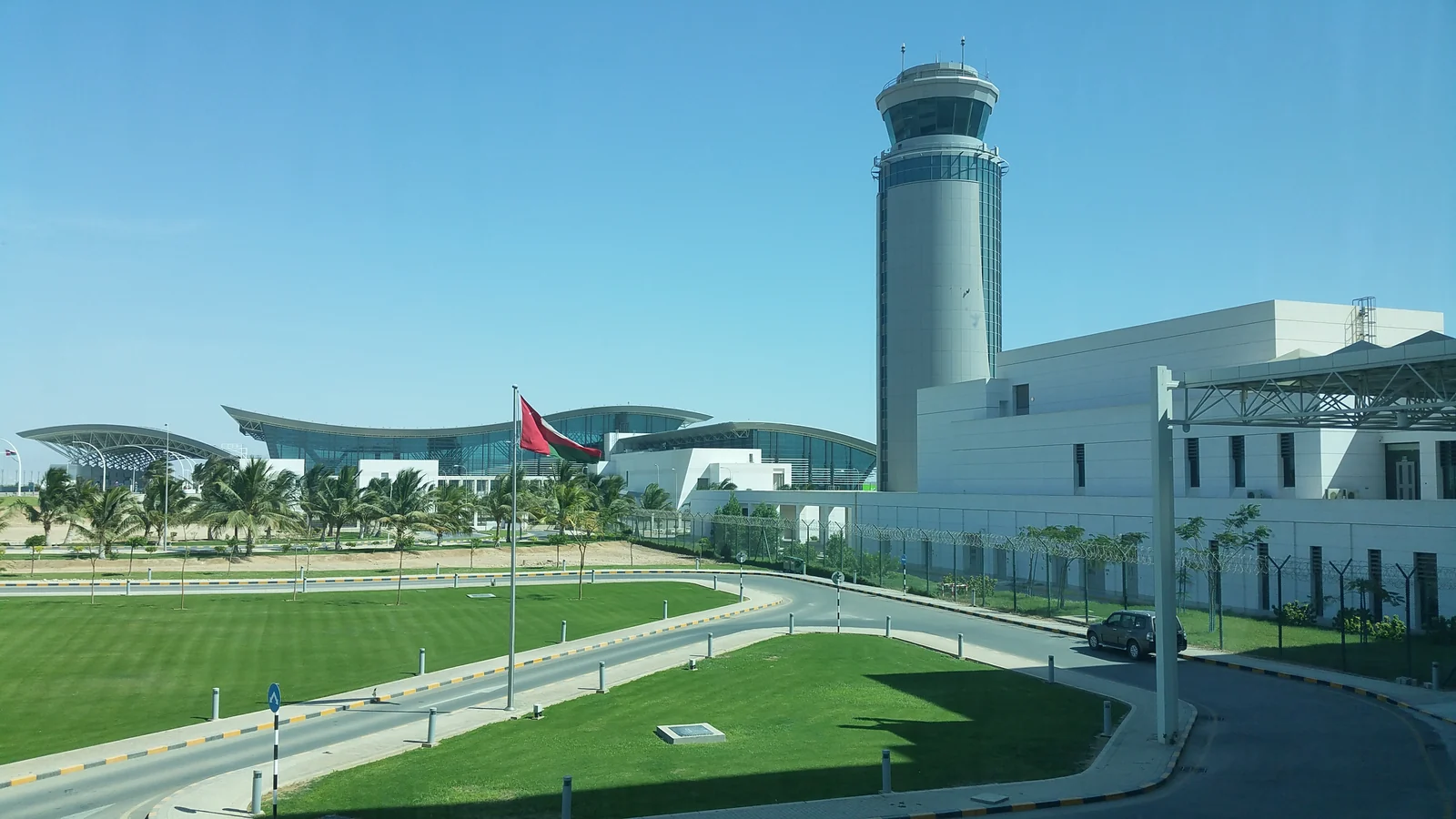
Featured photograph: Salalah Airport tower and terminal in daylight Photo: Baden65 · CC BY-SA 4.0 · Cropped/resized and converted to WebP.
A free-zone lease or usufruct agreement can shape the project for years. The right question is not only “What is the rent?” but also what the site can legally be used for, who pays for utilities and fit-out, what milestones apply, and what happens if the project changes or closes.
This checklist is for pre-signature due diligence. It is not a substitute for legal review of a specific contract. Terms can differ by zone, project, premises type and negotiated agreement. Overseas investors can use it to coordinate questions from management, technical teams and legal advisers before the Oman agreement is signed.
Before signing: confirm the licence, the property right and the technical project all describe the same real business. A cheap lease can become expensive if the activity, utilities or approvals do not fit.
1. First identify what you are actually signing
Royal Decree 38/2025 allows project land and real estate in zones to be allocated through lease or usufruct. Free-zone operators can also lease land and facilities under their operating framework.
| Document or right | What to understand | Do not assume |
|---|---|---|
| Office / warehouse lease | Premises, use, term, rent, services and fit-out rights. | That every activity can operate there. |
| Property Right Agreement | Operator-specific rights and obligations linked to a plot or premises. | That it is only a simple rent contract. |
| Land lease | Right to use land under the agreed conditions. | That construction permission is included. |
| Usufruct | Long-term right to use/develop land under the applicable law and agreement. | That transfer, mortgage or change of use is unrestricted. |
| Ready-built industrial-unit lease | Use of an existing shell/facility. | That utilities and technical approvals already fit your process. |
2. Confirm the permitted use before the commercial terms
The premises must support the licensed activity. SOHAR’s published rules, for example, require leased premises or plots to be used only for the activities stated in the licence and relevant property agreement.
A warehouse leased for general storage should not be assumed to permit food processing, chemical handling, manufacturing or another regulated activity. The contract, licence and technical approvals need to align.
Check three views of the same project.
The activity, property right and technical project should describe the same real business.
Licensed activity
What the company is permitted to do.
Property agreement
The exact site, permitted use and rights being granted.
Technical project
The process, fit-out, utilities and applicable approvals.
Read the licence, property agreement and technical approvals together before commitment.
- exact activity and activity code;
- storage versus processing versus manufacturing;
- customer-facing or retail use;
- hazardous or controlled goods;
- temperature-controlled activity;
- outdoor yard or open-storage use;
- office/head-office use;
- future additional activities.
3. Define the premises exactly
Do not sign around a marketing description. Confirm the exact unit, plot, boundaries, access and handover condition.
| Item | Due-diligence question |
|---|---|
| Plot/unit identification | What drawing, coordinates, unit number or cadastral plan defines the premises? |
| Area | Is the charge based on gross, net, built-up or land area? |
| Access | Which roads, gates, loading areas and shared areas can be used? |
| Parking/yard | Are they included, shared or separately charged? |
| Handover | Shell, fitted, serviced, cleared or as-is? |
| Existing defects | Who records and fixes them before handover? |
| Common infrastructure | What is shared with other tenants and who maintains it? |
4. Check the term, renewal and start date
The contract term should match the investment. A service office and a custom factory do not need the same commitment horizon.
For land projects, the legal right can be long-term, but the contract can also contain development milestones. Duqm’s current process, for example, gives an allocated investor time to inspect the site and review the usufruct agreement before signing.
| Term issue | What to confirm |
|---|---|
| Effective date | When do rent, obligations and access begin? |
| Handover date | Is it the same as the rent-start date? |
| Fit-out period | Is there a grace period and what charges still apply? |
| Renewal | Automatic, optional, negotiated or subject to performance? |
| Renewal price | Fixed formula, review, indexation or new quotation? |
| Early exit | Is termination possible before expiry and at what cost? |
| Holdover | What happens if the company stays after expiry? |
5. Rent is only one part of the premises cost
A project should build the full occupancy cost, not only the headline rent or land consideration.
Budget beyond the headline rent.
Group project-dependent costs by what they support.
Securing the site
Rent or usufruct consideration, deposits or guarantees and service charges.
Making it usable
Utility connections, fit-out, construction and technical or environmental work.
Running the site
Utility use, insurance, maintenance, waste, cleaning and security.
Handing it back
Removal, restoration and reinstatement where applicable.
- rent or usufruct consideration;
- security deposit or bank guarantee;
- service charges;
- utility connection and deposits;
- electricity, water, gas, wastewater and telecom usage;
- fit-out and construction;
- Civil Defence and technical work;
- environmental studies and permits;
- insurance;
- maintenance and repairs;
- waste management and cleaning;
- security/access cards;
- restoration or reinstatement at exit.
Cost rule: if a number is not in a current official tariff or your live quotation, treat it as a quotation or project-dependent cost. Do not use an old brochure to sign a present-day budget.
6. Utilities: put capacity and responsibility in writing
The most expensive lease problem can be a missing utility rather than a high rent. Confirm what exists at the boundary or unit and who pays to make it usable.
| Utility question | What to document |
|---|---|
| Electricity | Available capacity, voltage, connection point, upgrade scope and lead time. |
| Water | Potable/process capacity, pressure, storage and connection. |
| Wastewater | Connection, discharge standard, treatment and industrial effluent. |
| Gas/fuel | Availability, pressure, delivery model and safety requirements. |
| Telecom | Fiber/provider options, redundancy and connection. |
| Fire water | Who provides infrastructure and what the tenant must install. |
| Temporary utilities | Construction-period supply and cost. |
| Expansion capacity | Whether future additional load is reserved or only subject to new approval. |
A statement that a zone has infrastructure does not prove that a specific plot has the required project capacity.
7. Fit-out and construction rights
For a ready-built unit, confirm what changes are allowed. For land, confirm the development route. A lease or usufruct is not a construction permit.
- approved consultant requirements;
- design submission and review;
- building permit;
- Civil Defence approval;
- environmental permit or EIA;
- utility design and connection;
- signage and external works;
- machinery foundations and structural loads;
- completion/occupancy or commissioning approvals;
- as-built drawings and handover records.
Salalah Free Zone’s current FAQ explicitly states that an investor planning to build must obtain a Construction Permit. The same principle should be checked for every project location.
8. Sublease, sharing and 3PL use
Do not assume you can share a warehouse, sublease part of a unit or let another company operate from the premises.
SOHAR’s published property rules state that a tenant may not share leased premises or a plot with another person unless the sharing arrangement is covered by a previously approved sublease. Other zones can use different rules.
| Arrangement | Question before signing |
|---|---|
| Sublease | Is it prohibited, allowed with approval, or permitted under stated conditions? |
| Shared warehouse | Can another legal entity store or operate in the space? |
| 3PL | Can a licensed logistics company hold stock on behalf of the business? |
| Contract manufacturing | Can another company perform activity at the site? |
| Group companies | Does common ownership change the approval requirement? |
| Temporary contractor space | What site-access and operating permissions apply? |
9. Project milestones and commencement obligations
Land can come with a development obligation. Royal Decree 38/2025 also requires an enterprise to follow its approved timetable for starting activity, subject to the applicable grace-period process.
A contract may therefore contain milestones for design, construction, investment, commercial operation or minimum use. Missing them can create contractual and licensing consequences.
- date to accept the plot;
- date to sign the agreement;
- design submission deadline;
- construction start;
- minimum investment or development obligation;
- commercial-operation date;
- phased expansion dates;
- conditions for a grace-period request.
Photo: Robert Haandrikman · CC BY 2.0 · Cropped/resized and converted to WebP.
10. Insurance, risk and responsibility
Clarify which risks sit with the operator, landlord, tenant and contractor. SOHAR’s published rules, for example, require insurance in line with the relevant Property Right Agreement and construction-risk coverage for contractors.
| Risk | Questions |
|---|---|
| Property damage | Who insures the building, fixtures, machinery and stock? |
| Public liability | What limit and parties must be covered? |
| Construction | Is CAR insurance required and who carries it? |
| Business interruption | Is it commercially necessary even if not contractually required? |
| Environmental incident | Who bears cleanup and remediation responsibility? |
| Cargo/inventory | Does the premises insurance cover goods in storage or transit? |
| Natural events | What exclusions and deductibles apply? |
11. Default, cure and termination
Royal Decree 38/2025 includes legal protection around licence cancellation and termination of allocated land/real-estate lease or usufruct. Article 32 says a licence cannot be cancelled or suspended without warning, hearing the enterprise and giving an appropriate grace period to remedy the violation. It also restricts termination of lease/usufruct to cases prescribed by law or judicial ruling.
That protection should not be rewritten as “the tenant cannot default.” The agreement can still contain obligations, payment terms, development requirements and legal consequences.
| Default topic | What to review |
|---|---|
| Late payment | Grace period, notice, penalty and enforcement. |
| Activity breach | What happens if the premises is used outside the approved licence? |
| Development delay | What milestones can trigger action or reallocation? |
| Safety/environment breach | Immediate controls, suspension and remediation. |
| Insolvency | Contract and legal treatment of the premises/right. |
| Abandonment | What happens to buildings, equipment and stock? |
| Dispute | Notice, governing law, court/arbitration and escalation route. |
12. Exit and reinstatement
The exit obligation should be costed before entry. Article 17 of the zone law states that after cancellation of the establishment licence, allocated land must be delivered free of occupancies, and assets/facilities may need removal at the enterprise’s cost within the period set by the authority/operator, subject to environmental requirements and any decision to retain assets.
- remove machinery and temporary structures;
- close utility accounts and connections;
- clear customs-controlled goods;
- dispose of waste legally;
- remediate contamination if required;
- repair or reinstate the unit;
- hand back keys, drawings and permits;
- close insurance and service contracts;
- settle outstanding rent, tax and authority charges.
13. Red flags before signing
- The activity is not written clearly. The premises may not support the actual business.
- Utility capacity is verbal only. Large projects should have documented assumptions.
- The lease starts before the unit can be used. Check handover and fit-out timing.
- Sublease is assumed but not permitted. This can break a shared-space or 3PL model.
- Expansion is important but not reserved. Adjacent space may not be available later.
- The project needs construction but the permit path is unclear. Lease signature is not construction approval.
- Exit restoration is ignored. Reinstatement can be material for industrial projects.
- Old published pricing is treated as the contract price. Only the live offer/agreement controls the commercial commitment.
14. Pre-signature checklist
| Area | Confirm before commitment |
|---|---|
| Business | Licensed activity and operating model match the premises. |
| Property | Exact unit/plot, area, boundaries and legal right. |
| Commercial | Rent/consideration, escalation, deposits, services and payment dates. |
| Term | Start, handover, fit-out, expiry, renewal and early exit. |
| Utilities | Capacity, connection, responsibility, lead time and cost. |
| Technical | Fit-out, construction, Civil Defence, environment and commissioning. |
| Sharing | Sublease, 3PL, contractors and group-company use. |
| Milestones | Design, construction, investment and operation deadlines. |
| Risk | Insurance, maintenance, damage, environment and liability. |
| Default | Notice, cure, suspension, termination and dispute. |
| Exit | Asset removal, reinstatement, contamination, customs and final settlement. |
| Evidence | Keep the signed agreement, annexes, drawings, approvals and live quotation together. |
15. Frequently asked questions
Should I sign a free-zone lease before the activity is approved?
Avoid committing on the assumption that the activity will be accepted. Confirm the activity, premises fit and any conditions in the offer or agreement before committing funds.
Does a land lease or usufruct let me start construction immediately?
No. The project can still need design, construction, environmental, Civil Defence, utility and sector approvals.
Can I sublease part of a free-zone warehouse?
Do not assume it. SOHAR, for example, requires prior approval for a sublease/sharing arrangement. Other zones may have different rules.
Can I rely on a verbal utility promise?
For a project where power, water, gas or wastewater is critical, obtain documented project-specific confirmation before machinery or long-term commitments.
What happens if my project is delayed?
Check the agreement and approved project timetable. Royal Decree 38/2025 provides for commencement obligations and possible grace-period procedures, but the project-specific contract still matters.
Can the zone terminate my lease at any time?
Royal Decree 38/2025 contains protections around licence suspension and termination of allocated land/real-estate rights, but this is not a substitute for reading the contract, default clauses and applicable law.
What should I budget besides rent?
Deposits, utility connections, fit-out, permits, insurance, maintenance, services, construction, environmental work and exit/reinstatement can all matter.
Is a long lease always better?
No. The term should match the project’s capital investment, demand certainty and expansion plan. A long commitment can increase risk for a business that has not validated its operating model.
Do I need a lawyer to review the agreement?
For a material long-term land, industrial or project commitment, professional legal review can be appropriate. This article is a due-diligence framework, not legal advice on one contract.
16. Choose the premises before reviewing the contract
If you have not yet decided between office, warehouse, industrial unit and land, first use the Oman free-zone premises guide.
For the wider location decision, use the Oman Free Zones guide.
17. Official sources
- OPAZ: Royal Decree 38/2025
- OPAZ: Regulation 81/2026 implementation summary
- SOHAR Port and Freezone: Property Rights rules
- Salalah Free Zone: current lease/facility FAQ
- Duqm: plot allocation and usufruct process
- Duqm: investor FAQ
Official public information reviewed on September 29, 2026. Review the current contract, annexes, live operator rules and applicable law before signing.
Image sources and licences
- Baden65 – https://commons.wikimedia.org/wiki/File:Neuer_Tower.jpg
CC BY-SA 4.0 – https://creativecommons.org/licenses/by-sa/4.0/ - Robert Haandrikman – https://commons.wikimedia.org/wiki/File:Khor_Ash_Sham_(25467060307).jpg
CC BY 2.0 – https://creativecommons.org/licenses/by/2.0