
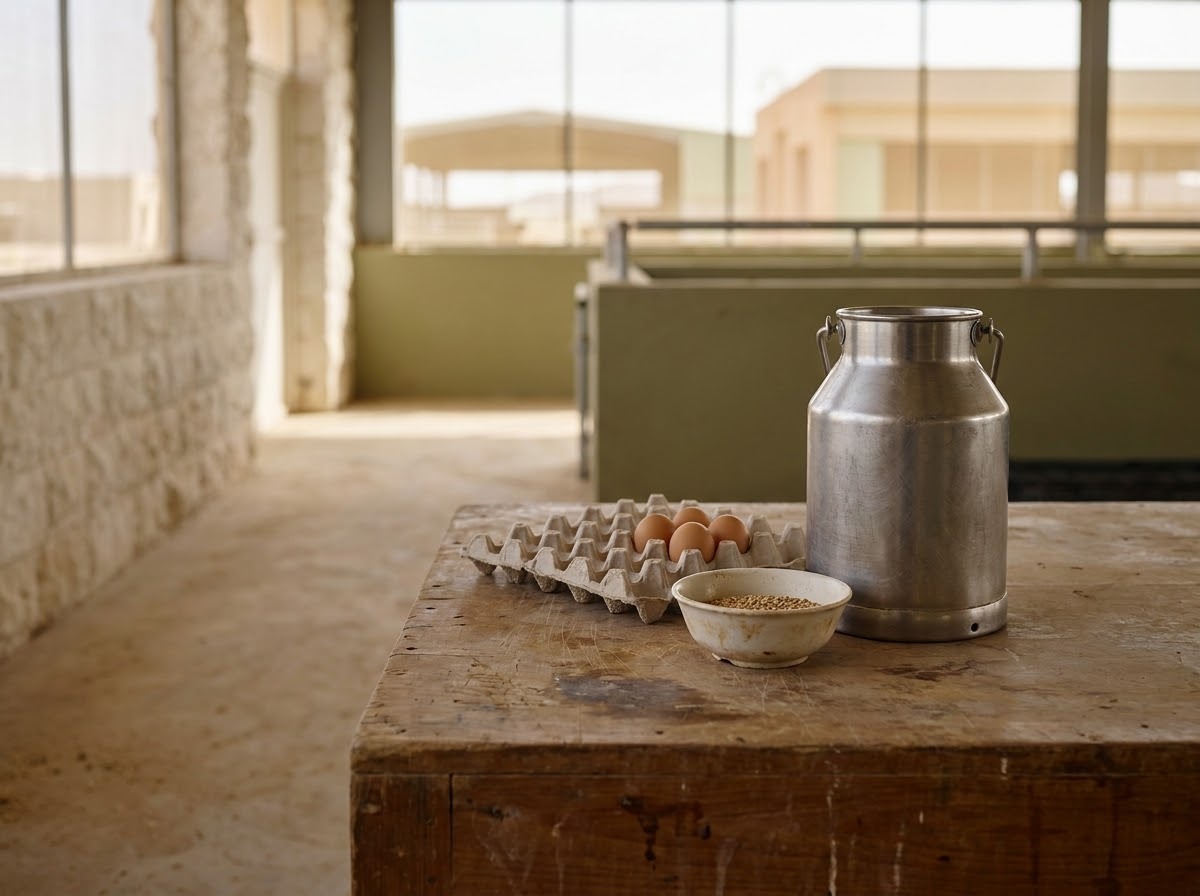
A poultry, livestock or dairy business in Oman can include several different activities. It may raise animals, produce eggs or milk, make feed, process dairy products, slaughter animals, pack meat or distribute finished food.
These activities do not normally sit under one simple farm licence. A farm, feed mill, dairy plant and slaughterhouse have different sites, risks and approval paths. The correct plan starts by defining exactly what the project will do.
This guide explains the main decisions for a poultry, livestock and dairy business in Oman. It focuses on production, veterinary control, land, water, biosecurity, processing and market access. It keeps general company and residence steps short.
Define the project before you apply
- Choose the animal and production model.
- Separate farming from processing, slaughter, feed and distribution.
- Confirm the activity, ownership position and regulator for each part.
- Check the site, water source and biosecurity distance before signing a long lease.
- Design housing, waste, mortality and cold-chain systems before construction.
Main rule: a commercial registration gives the company a legal identity. It does not replace the farm, environmental, food, industrial, veterinary, municipality or safety approvals that may apply.
Choose the exact business model
The word “animal business” is too broad for licensing or budgeting. A useful business model should state the species, production stage, site, output and buyer.
| Activity | Main output | Main approval focus |
|---|---|---|
| Broiler poultry farm | Birds for meat | Farm licence, housing, biosecurity, veterinary plan and mortality control |
| Layer farm | Table eggs | Farm licence, flock health, egg handling, packing and food controls |
| Cattle, goat or sheep farm | Breeding stock, milk or animals for meat | Land, livestock records, veterinary care, feed, water and waste |
| Dairy farm | Raw milk | Animal health, milking hygiene, rapid cooling and approved buyer route |
| Dairy plant | Pasteurised milk, yoghurt, cheese or other products | Industrial and food approvals, plant hygiene, testing, packaging and product registration |
| Feed mill | Compound feed or feed ingredients | Separate manufacturing activity, formula control, storage, environmental and import approvals |
| Slaughterhouse | Dressed carcasses | Special site, veterinary inspection, animal welfare, hygiene, waste and municipality controls |
| Meat packing plant | Cut, chilled, frozen or packed meat | Food-processing activity, separation, temperature, traceability and product control |
A project may combine some parts, but each part must appear in the technical design and approved activity scope. Do not assume that adding “animal production” to a commercial registration automatically permits a feed mill, slaughter line or dairy factory.
Poultry and egg production
Broiler production
A broiler project raises birds for meat. Its plan should cover chick supply, flock size, number of production cycles, feed storage, water, climate control, vaccination, veterinary support, catching, transport and the approved slaughter route.
Heat control is critical in Oman. The building design should include suitable insulation, ventilation, cooling, alarms and backup power. The final design must match the bird density, local climate, equipment and authority requirements. Do not copy a temperature or stocking figure from another country without technical review.
Layer and egg production
A layer farm keeps birds for egg production. The operating file should cover flock replacement, lighting, nest or cage systems, shell quality, dirty or cracked eggs, collection, grading, packing, date marking, storage and delivery.
Egg production and egg packing can create separate food-handling needs. Confirm whether the packing room, brand and finished product need additional food or municipality approval. Keep clean eggs, rejected eggs, packing materials and waste in controlled areas.
Biosecurity warning: The current Gov.om farm-licence service requires a biosecurity distance between the project, main roads, residential areas and other animal-production farms. Medium and large farms must also have a veterinarian and an animal-production technician. Confirm the exact distance and staffing standard for the proposed project before choosing the land.
Cattle, goats and sheep
A ruminant project may focus on breeding, milk, young-stock rearing or fattening. These models need different buildings, feed plans, veterinary routines and sales contracts.
| Model | Key operating questions |
|---|---|
| Breeding herd | Genetics, mating plan, pregnancy checks, birth records, young-stock care and replacement policy |
| Dairy herd | Milking system, udder health, raw-milk testing, cooling, collection and rejected milk |
| Fattening unit | Animal source, arrival quarantine, ration, weight records, treatment withdrawal and slaughter route |
| Goat or sheep milk | Seasonal supply, milking hygiene, small-volume cooling and processing or collection contract |
Each animal should be linked to clear purchase, health, treatment and movement records. New animals should not enter the main herd without an arrival check and a controlled isolation process. The veterinarian should set the vaccination, testing, parasite-control and treatment plan for the species and source.
Breeding stock should be selected for health, fertility and suitability for Oman’s conditions. A high-output animal may also need more cooling, water, feed quality and veterinary care. The business plan should use realistic local input costs and not rely only on the animal’s advertised production level.
Milk production and dairy processing
A dairy farm produces raw milk. A dairy plant changes raw milk into a food product. These are connected activities, but they are not the same licence.
Raw-milk controls
- Use clean milking equipment and an approved cleaning programme.
- Cool milk quickly under a documented process.
- Record the animal group, milking time, tank and collection load.
- Separate milk from treated animals until the medicine withdrawal period is complete.
- Create a written rule for abnormal, contaminated or rejected milk.
Dairy processing
A plant making pasteurised milk, yoghurt, cheese, butter or another dairy product needs a suitable manufacturing activity and approved food premises. The plan should show product flow from raw-milk reception to processing, filling, packing, finished-product storage and dispatch.
Raw and finished areas should be separated. The plant needs cleaning and sanitation controls, pest control, water-quality checks, temperature records, laboratory testing, traceability and a recall plan. Packaging and labels must match the approved product file.
The current Gov.om food-product service covers products made in Oman as well as imported products. It asks for one product per application and may require a product image, label, nutrition report and laboratory report. Confirm the final file for every dairy product before sale.
Animal feed and feed mills
Feed is often the largest continuing input in an animal project. The plan should separate roughage, grains, protein sources, minerals, premixes and complete compound feed. It should also record supplier approval, batch numbers, expiry dates and storage conditions.
A farm that stores purchased feed is different from a factory that manufactures feed for sale. A feed mill needs a separate manufacturing scope. Its design may include raw-material silos, weighing, grinding, mixing, pelleting, cooling, bagging, dust control, finished-feed storage and a quality laboratory.
Imported animal feed and feed components need a veterinary import permit before shipment. Oman Customs currently states that the application should include the chemical composition, ingredients, intended species, production and expiry dates, and country of origin or export. The authority may add conditions or select the entry port.
Feed risk: Do not buy a site or production line before confirming raw-material access, dust and fire controls, power demand, storage volume and the authority path. A feed mill can be better suited to an industrial location than to a livestock farm.
Slaughter and meat packing
A slaughterhouse is a specialist facility. It is not an automatic extension of a livestock farm. The site and design must support animal arrival, holding, veterinary inspection, slaughter, dressing, chilling, waste handling and dispatch without unsafe crossing between dirty and clean areas.
The project team should confirm animal-welfare requirements, halal controls, official veterinary inspection, water supply, drainage, blood and offal handling, condemned material, odour control, pest control, cleaning and worker hygiene. Municipality, food-safety, environment and safety authorities may all be involved.
A meat-packing plant may receive approved carcasses or meat and then cut, debone, mince, pack, chill or freeze the product. This needs its own food-processing workflow. Raw meat, ready-to-eat products, packing material, cleaning chemicals and rejected stock must remain controlled and separated.
Land, water and farm infrastructure
Do not choose land by price alone
The farm site must fit the activity. Check permitted land use, road access, biosecurity distance, nearby farms and homes, electricity capacity, water rights, drainage, flood exposure, waste route and future expansion.
Government land opportunities may be offered through the Tatwir platform. However, company ownership and land eligibility are separate questions. The current Gov.om service for bidding on government investment land states capital-participation conditions for that service. Each opportunity can also have its own technical and financial terms. A foreign-owned company should confirm eligibility for the exact plot before paying or designing the project.
Water
Animal drinking, cooling, cleaning, milk processing and slaughter can use large amounts of water. Test the source for quantity and quality before final commitment. Include storage tanks, treatment, pumps, backup supply and separate meters in the design.
A new well needs a separate licence. The current Gov.om service asks for a site cadastral drawing and proof of site ownership, and states that the beneficiary must be the property owner. A lease or project approval should not be treated as automatic permission to drill or extract groundwater.
Housing and utilities
- Insulated and ventilated housing suitable for the species
- Cooling with alarms and emergency response
- Backup power for ventilation, water, milking and cold storage
- Clean feed and bedding storage
- Isolation space for new or sick animals
- Wash points, drainage and controlled wastewater
- Secure medicine, chemical and equipment rooms
- Staff hygiene and changing facilities where required
Veterinary health and biosecurity
Biosecurity is the system used to stop disease entering, moving through or leaving the site. It should be designed before animals arrive.
| Control area | Practical requirement |
|---|---|
| Entry | Controlled gate, visitor record, clean clothing and vehicle rules |
| New stock | Source checks, health documents, isolation and veterinary release |
| Daily health | Feed, water, behaviour, symptoms, production and mortality records |
| Vaccination | Veterinarian-approved programme, cold storage, batch and administration records |
| Medicines | Secure storage, prescription control, treatment records and withdrawal periods |
| Sick animals | Isolation, examination, sampling and controlled movement |
| Mortality | Fast removal, protected temporary holding, cause review and approved disposal |
| Cleaning | Written cleaning, disinfection, pest-control and verification programme |
Imported cattle, sheep, goats, camels or poultry need a veterinary import permit. The current official service asks for the commercial registration, local farm or facility licence and health documents that depend on the shipment. The application is made through Bayan. Incoming shipments also need inspection and may undergo laboratory examination and veterinary quarantine.
Disease conditions can change quickly. A permit issued in an earlier month does not prove that the same origin is accepted today. Check current bans, certificates, tests, vaccination evidence and approved source requirements before the animals are shipped.
Mortality, manure and wastewater
A farm must plan for normal waste and emergency events. The site file should cover manure, used bedding, wastewater, veterinary waste, spoiled feed, rejected milk, blood, offal and dead animals where relevant.
- Estimate daily and peak waste volumes.
- Keep clean rainwater away from dirty production water.
- Use leak-resistant storage and controlled collection points.
- Prevent access by pests, wild birds and stray animals.
- Use approved transport, treatment, reuse or disposal routes.
- Record mortality numbers, likely cause and final disposal.
The Environment Authority decides the environmental category and technical conditions. Category A activities require an environmental impact assessment by an approved environmental consultancy office. Do not assume that every farm has the same category or that a small environmental permit covers a large processing plant.
Cold chain and market access
Production is only useful when the product can reach an approved buyer safely. The route should be planned before construction.
| Product | Market route to plan |
|---|---|
| Live birds or livestock | Approved buyer, suitable vehicle, movement documents and destination controls |
| Eggs | Collection, grading or packing, stock rotation, clean transport and retailer requirements |
| Raw milk | Rapid cooling, collection schedule, tanker hygiene, testing and processor acceptance |
| Dairy products | Registered products, approved labels, chilled storage where required and distributor agreements |
| Fresh meat | Approved slaughter source, rapid chilling, hygienic cutting, refrigerated transport and traceability |
| Frozen meat | Freezing capacity, stable frozen storage, alarms, backup power and controlled delivery |
| Animal feed | Batch release, dry storage, pest control, expiry management and farm delivery |
A buyer may ask for more than a licence. Supermarkets, hotels, processors and institutional buyers can require product specifications, test reports, insurance, barcodes, delivery windows, recall procedures and agreed credit terms.
If the project will sell through wholesalers or retailers, plan the storage, delivery and sales route after production. The related distribution guide is listed below.
Short company, residence and banking pathway
First define every activity and check its ownership and external-approval position. The search Oman commercial activity codes tool can help find possible CR activities. It does not prove foreign-ownership eligibility or regulatory approval.
After the scope is clear, use Oman company setup advisory for the legal-company path. A registered company must still complete the farm, industrial, environmental, municipality, food, veterinary and location approvals that apply.
Prepare the project profile, capital plan, owners, suppliers and expected transactions for business banking preparation support. No company or adviser can guarantee final bank approval.
Farm and factory staffing should be planned early. Use labour and Omanisation support in Oman to review the company’s current workforce position, job titles and Ministry of Labour steps. Medium and large animal-production farms should also plan for the veterinarian and animal-production technician stated in the official farm-licence service.
Where eligible, owners and specialist workers can use employee visa coordination in Oman after the company, labour and job-position requirements are checked. Residence and work permissions are separate approvals.
A feed mill, dairy plant or meat-packing facility may need industrial land. Use factory location assessment in Oman to compare access, utilities, logistics and operator conditions. Primary animal farming may need a different land route.
Imported stock, feed ingredients, equipment or packaging may need Bayan preparation, permits and inspection. For this part, use customs documentation support in Oman to prepare the commercial shipment file. The responsible authority decides permit and release outcomes.
Costs and planning tools
The main project cost is usually not the commercial registration. Land, buildings, climate control, power, water, animals, feed, processing equipment, cold storage, vehicles, laboratory work, staff and working capital can be much larger.
| Cost group | What to include |
|---|---|
| Company and activity | Registration, activity scope, licence renewals and professional work |
| Land and site | Bid or lease costs, surveys, design, roads, fencing and utility connection |
| Farm buildings | Housing, isolation, feed stores, cooling, ventilation, drainage and backup power |
| Biological stock | Animals or chicks, health documents, transport, quarantine and early losses |
| Processing | Milking, dairy, feed, slaughter or meat-packing equipment and fit-out |
| Environmental control | Assessment, wastewater, manure, mortality, odour, dust and waste systems |
| Cold chain | Milk tanks, chillers, cold rooms, alarms, maintenance and refrigerated vehicles |
| Working capital | Feed, medicine, payroll, utilities, maintenance and customer credit before payment |
Published official service fees
The official pages reviewed on 29 July 2026 publish the following service fees. These are not complete project costs and can change:
- Animal-production farm licence: OMR 25 for small farms and small breeders, OMR 50 for medium farms, and OMR 100 for large farms. The official page also states that Agricultural and Fisheries Development Fund contribution fees apply.
- Veterinary import permit: OMR 5 for live cattle, sheep, goats and camels; OMR 5 for poultry.
- Incoming animal-shipment inspection request: OMR 100, with the official service showing a varying total cost.
- Animal-feed import permit: Oman Customs currently publishes an OMR 20 application fee.
- Category A environmental permit: the current Gov.om service publishes an OMR 900 permit fee. The project category must be confirmed by the Environment Authority.
- Food-product registration: the current service lists OMR 30 for a product subject to conformity procedures and OMR 0 for a product not subject to them. It requires one product per application.
The mainland company registration cost estimator covers general mainland company and investor-residence costs only. It does not calculate agricultural land, buildings, utilities, animals, feed, equipment, factory fit-out, environmental studies, sector approvals, cold chain or stock.
Common mistakes
- Using one broad activity. Farming, processing, feed, slaughter and distribution may need different activities and approvals.
- Signing the land too early. A low-cost site may fail land-use, water, access, biosecurity or environmental checks.
- Assuming 100% company ownership gives access to every plot. Land-opportunity conditions must be checked separately.
- Starting construction before layout approval. Moving drains, clean zones or waste systems later can be expensive.
- Ignoring Oman’s heat. Cooling, ventilation, alarms and backup power are operating essentials.
- Importing stock before permits are ready. Health conditions and country restrictions can change.
- Using a generic vaccination schedule. The plan must match the species, source, disease risk and veterinary direction.
- No mortality or waste route. Dead animals, manure, wastewater and rejected products need approved handling.
- No confirmed buyer. A farm can produce successfully and still lose money through weak collection, cold chain or credit terms.
- Under-budgeting feed and working capital. The company must pay for inputs before many buyers pay their invoices.
Practical checklist
- State the species, output, annual scale and buyer.
- Separate farm, hatchery, dairy, feed, slaughter, packing and distribution activities.
- Check every activity and its foreign-ownership position.
- Confirm land use and plot eligibility.
- Check biosecurity distances before signing.
- Test water quantity and quality.
- Confirm electricity load and backup power.
- Prepare the animal health, vaccination and treatment plan.
- Design arrival isolation and sick-animal areas.
- Prepare mortality, manure, wastewater and rejected-product procedures.
- Confirm feed supply and safe storage.
- Map the cold chain from production to customer.
- Prepare traceability, testing and recall records.
- Confirm staff, veterinarian and technician needs.
- Build a full capital and working-capital budget.
- Get regulator feedback before construction or shipment.
Frequently asked questions
Can one Oman company operate a farm, feed mill and dairy plant?
It may be possible to place several compatible activities in one company, but each activity, site and external approval must be checked. One farm licence does not automatically approve feed manufacturing or dairy processing.
Can a foreign investor own an animal-production company in Oman?
Many company activities may allow foreign ownership, but the exact activity, current restricted list, sector approval and land route must be checked. Company ownership does not automatically make the company eligible for every government agricultural plot. Review the related ownership guide below and confirm the live authority result.
What documents are listed for an animal-production farm licence?
The current Gov.om service lists land ownership or lease, a survey drawing, ID, a valid livestock possession card and a feasibility study for large farms. The authority may request more information for the exact project.
Does a medium or large farm need a veterinarian?
The current official farm-licence service states that medium and large animal-production farms must have a veterinarian and an animal-production technician. Confirm the employment, professional and project-specific requirements before hiring.
Can I import cattle, sheep, goats or poultry after registering the company?
Company registration alone is not enough. A veterinary import permit, an appropriate local farm or facility licence, health documents, inspection and possible quarantine are required. Current country or disease restrictions must be checked before shipment.
Does every animal project need an environmental impact assessment?
The Environment Authority classifies the project. Category A activities need an environmental impact assessment by an approved consultant. Other categories follow their own requirements. Confirm the category for the exact scale, process and location.
Can a farm drill its own water well?
Not without the correct water approval. The current new-well service requires a separate licence and states that the beneficiary must be the site owner. Confirm the water right before relying on a well in the business plan.
Does the Oman company cost tool calculate the full farm budget?
No. It covers only general mainland company and investor-residence costs. Land, buildings, animals, feed, utilities, equipment, environmental work, sector licences, processing, vehicles, cold chain and working capital are outside the tool.
Related Oman Verified guides and services
Distribution after production
Plan wholesale channels, storage, delivery, stock records and buyer terms in the guide to food distribution and wholesale in Oman.
Ownership and activity risk
Check the current list of restricted activities for foreign investors in Oman and the live activity result before choosing owners or land.
Conclusion
A poultry, livestock or dairy business in Oman should begin with a precise operating model. The animals, farm, processing stage, land, water, waste system, cold chain and buyer must support the same plan.
The safest sequence is to confirm activities and site eligibility, prepare the technical and biosecurity design, identify every separate approval, and only then commit to construction, imported stock or processing equipment.
International setup support
This article is a practical planning resource for poultry, livestock and dairy investors. Activity, ownership, land, water, environmental, farm, veterinary, food, labour, banking, customs and immigration matters are completed through the responsible authorities and institutions, with Oman Verified able to coordinate the wider Oman-side setup and follow-up.
Official sources
- Gov.om — Get Animal Production Farm Licences
- Gov.om — Get a Veterinary Permit to Import an Animal Shipment
- Gov.om — Request Inspection of an Incoming Animal Shipment
- Oman Customs — Veterinary Permit to Import Animal Feed and Its Components
- Gov.om — Apply for a Food Product Registration Certificate
- Gov.om — Get an Environmental Permit for Category A Activities
- Gov.om — Get a Licence to Drill a New Well
- Gov.om — Get a Usufruct Contract for Investment Opportunities
- Gov.om — Ministry of Agriculture, Fisheries Wealth and Water Resources
Official public information reviewed on 29 July 2026. Confirm the current requirements in the live government systems before submission.