
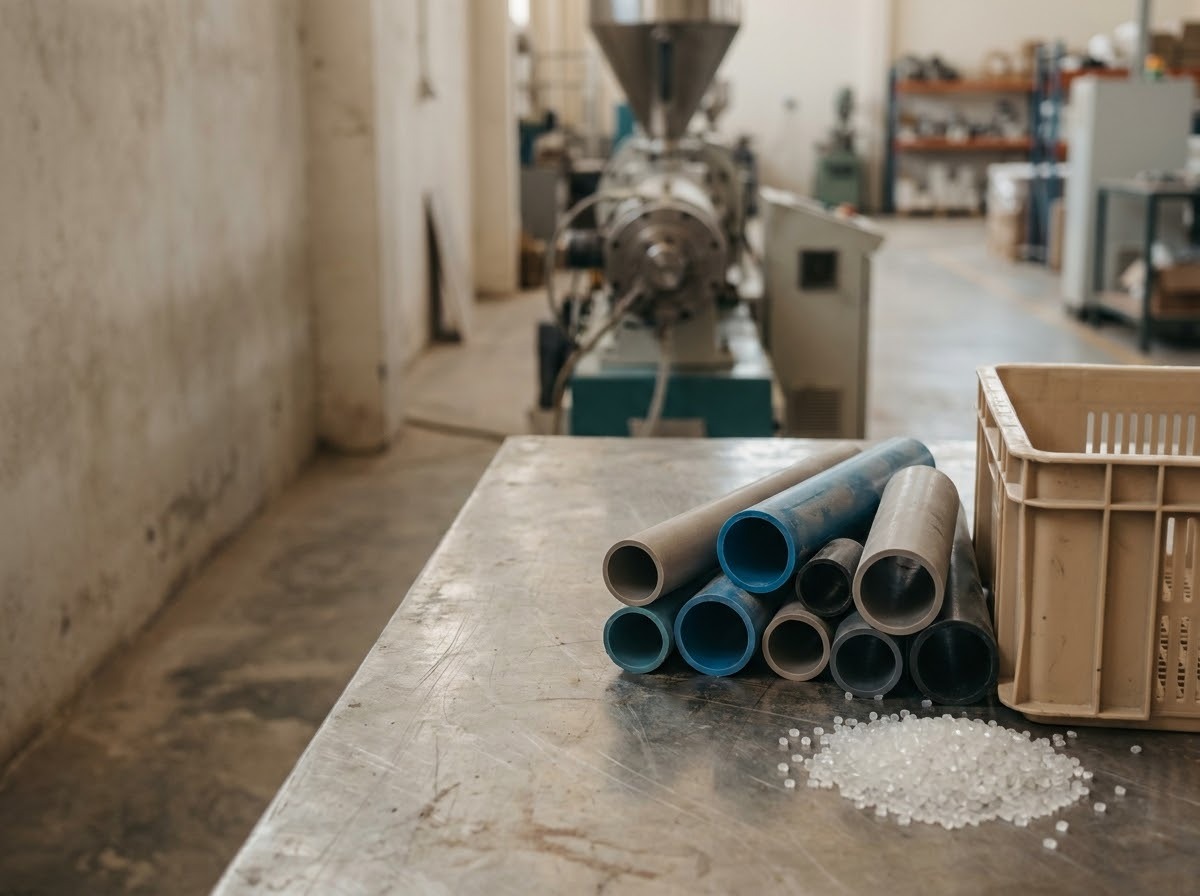
A plastics factory in Oman can make very different products. It may produce pressure pipes, drainage pipes, bottles, containers, films, pallets, crates or heavy industrial packaging. Each product needs its own raw material, machine, mould, test plan and customer approval.
The first decision is not the company name. It is the factory model. You must define the exact products, sizes, materials, annual output, customer group and quality standard before choosing land or ordering machinery.
This guide explains the main planning points for a plastics, pipes and industrial packaging factory in Oman. It does not guarantee demand, land allocation, finance, licences or product approval.
Factory decision logic
- Define the product: pipe, fitting, bottle, film, sack, pallet, crate or another item.
- Define the use: water, drainage, construction, food contact, chemicals, agriculture, logistics or export.
- Find the standard: identify the current Omani, Gulf, ISO or buyer specification for that exact use.
- Design the process: resin, additives, recycled content, machine, mould, cooling, air, power and laboratory.
- Choose the site: compare raw-material access, customers, utilities, transport, port access and licence conditions.
- Confirm approvals: commercial activity, investment licence where applicable, industrial licence, land approval, environmental permit, building approval and civil protection.
1. Define the factory model
A mixed plastics project can become too wide. One extrusion line cannot make every pipe. One blow-moulding line cannot make every bottle. A pallet mould is different from a crate mould. Film production also needs different equipment from rigid packaging.
Start with a narrow product list. Write the material, dimensions, wall thickness, colour, weight, pressure class, food-contact status, expected annual output and target buyer for every product.
| Factory model | Typical products | Main process | Important first question |
|---|---|---|---|
| Pipe and fitting plant | PE, PVC-U or PP-R pipes and fittings | Extrusion and injection moulding | Which service, pressure class and buyer standard? |
| Rigid packaging plant | Bottles, jars, drums, caps and containers | Blow moulding and injection moulding | Is the package for food, water, chemicals or general use? |
| Flexible packaging plant | Film, liners, heavy-duty bags and stretch film | Blown or cast film, printing and converting | What layer structure, thickness and barrier level? |
| Industrial handling products | Pallets, crates, bins and trays | Large injection moulding or rotational moulding | What load, dimensions, racking method and reuse cycle? |
| Woven packaging plant | PP sacks and industrial bags | Tape extrusion, weaving, coating and bag conversion | What product will the sack carry and what test is required? |
Packaging manufacture is not the same as food-packing service. Making empty bottles, films, trays or sacks is a manufacturing activity. Filling them with food, water or another product is a separate operation and may need food-establishment, product-registration, hygiene and sector approvals.
2. Products at a glance
| Product | Common material | Possible customers | Main quality focus |
|---|---|---|---|
| Pressure water pipe | PE or other approved pipe compound | Utilities, contractors and distributors | Dimensions, material grade, hydrostatic performance and traceability |
| Drainage and sewer pipe | PVC-U or PE, depending on design | Construction and infrastructure suppliers | Ring stiffness, impact, dimensions and joint fit |
| Hot and cold water pipe | PP-R or another approved system | Building-services suppliers | Pressure-temperature class, fittings and joint performance |
| Bottles and containers | HDPE, PP, PET or another suitable resin | Water, food, chemical and household-product businesses | Weight, wall balance, leak resistance and material suitability |
| Film and liners | LDPE, LLDPE, HDPE or multilayer structures | Food, construction, agriculture and logistics users | Thickness, tensile strength, seal strength and barrier needs |
| Woven sacks | Polypropylene | Food, feed, minerals, chemicals and construction-material suppliers | Fabric strength, seam strength, coating and safe intended use |
| Pallets and crates | HDPE or PP | Factories, warehouses, farms and logistics operators | Static, dynamic and racking load; impact; dimensions |
3. Pipes and fittings
PE pipes
PE pipe is used for water, irrigation, drainage, industrial service and other applications. The exact compound and test plan depend on the use. A pipe made for general drainage should not be sold as a pressure-water pipe without the correct design, compound, tests and approvals.
A PE pipe line normally includes resin handling, gravimetric dosing, extrusion, die head, vacuum sizing, cooling tanks, haul-off, printing, cutting or coiling, and scrap handling. Large diameters need more floor space, cooling capacity and lifting equipment.
PVC-U pipes
PVC-U pipe production uses resin, stabilisers, processing aids, pigments and other approved ingredients. The line normally needs high-speed mixing, controlled feeding, extrusion, calibration, cooling, haul-off, cutting and socketing where required.
PVC dust control is important. Mixing and feeding areas should reduce dust release. Raw-material storage should also protect bags and additives from heat, moisture, contamination and damage.
PP-R and fittings
A PP-R system may include pipes, elbows, tees, sockets, valves and transition fittings. The pipe and fitting must work as one system. The project should plan extrusion, injection moulding, mould maintenance, dimensional inspection and joint testing together.
Buyer approval may be separate from legal licensing. A government utility, oil and gas operator, consultant or main contractor may have its own approved-vendor, factory-audit, sample-test and project-qualification process. A valid factory licence does not automatically place a product on an approved supplier list.
4. Bottles, containers and films
Rigid bottles and containers
Rigid packaging may be made by extrusion blow moulding, injection blow moulding, stretch blow moulding or injection moulding. The correct process depends on the resin, neck design, container size, wall thickness, output and end use.
A chemical container needs different resistance and closure checks from a water bottle. A food-contact container also needs suitable raw materials and a compliance file for its intended food, temperature and storage period.
Films and bags
Film projects can include blown film, cast film, printing, lamination, slitting and bag making. A simple single-layer liner is different from a printed multilayer food package. More layers and printing steps create more controls for resin, inks, adhesives, solvents, curing and traceability.
- Stretch film needs stable thickness, cling and load-holding performance.
- Heavy-duty bags need puncture, drop and seal performance.
- Agricultural film needs a defined outdoor life and suitable UV package.
- Food packaging needs suitable contact materials and the required migration or safety evidence.
- Printed film needs colour control, print adhesion and controlled ink or solvent use.
5. Pallets, crates and industrial packaging
Plastic pallets, crates, bins and industrial trays are used in warehouses, factories, farms, fisheries and distribution networks. Their value depends on repeat use, dimensions, handling safety and load performance.
Large injection-moulded products need high clamping force, heavy moulds, strong foundations, cranes or lifting systems, chilled water and stable electricity. Rotational moulding may suit some large hollow products, but it has a different cycle, mould and quality-control method.
| Product | Design checks | Factory checks |
|---|---|---|
| Pallet | Static, dynamic and racking load; fork entry; deck type | Weight, dimensions, flatness, impact and load tests |
| Crate | Stacking, ventilation, hand grip and product protection | Drop, compression, dimensions and repeated-use inspection |
| Industrial bin | Volume, lid, wheels, chemical contact and cleaning | Leak, impact, wheel attachment and material consistency |
| Woven sack | Fill weight, liner, coating, printing and closure | Fabric, seam, drop, print and contamination controls |
6. Raw materials and recycled content
Oman has local polyethylene and polypropylene production. OQ states that its Liwa Plastics Industries Complex in Sohar produces HDPE and LLDPE, while its wider polymer business also supplies polypropylene. Local supply can be useful, but every project must still confirm the available grade, technical data, order size, commercial terms and delivery plan directly with the supplier.
| Input | Purpose | Control point |
|---|---|---|
| Virgin resin | Main polymer structure | Correct grade, certificate of analysis, storage and lot traceability |
| Masterbatch | Colour or concentrated additive | Carrier compatibility, dosing rate and dispersion |
| UV stabiliser | Outdoor-life support | Use level and proof against the product specification |
| Processing aid | Improve processing or surface quality | Approved formulation and controlled dosing |
| Recycled feedstock | Reduce virgin material use in suitable products | Source, sorting, contamination, melt behaviour and permitted use |
| Ink, adhesive or solvent | Printing and lamination | Safety data, storage, ventilation, curing and intended contact use |
Using recycled plastic
Clean in-house scrap can often be collected, ground and returned to a suitable process under a controlled formula. External post-industrial or post-consumer material needs stronger controls for source, sorting, washing, odour, contamination and batch consistency.
Recycled content is not suitable for every product. Pressure pipes, potable-water products and food-contact packaging can have strict material rules. Do not add recycled resin only to reduce cost. First confirm the product standard, customer specification and regulator position.
A factory that buys controlled recycled pellets as a raw material is different from a business that collects, transports, sorts, washes or treats waste. Waste collection, treatment, reuse, storage, import or disposal may need separate Environment Authority permissions and a different activity scope. Importing non-hazardous waste for recycling also has a separate approval route.
7. Production lines and utilities
The machinery list should come after the product specification. Ask suppliers to size the full system, not only the main machine.
Main production equipment
- Extruders, moulding machines or weaving equipment
- Dies, heads and moulds
- Material dryers, mixers and dosing systems
- Cooling tanks, chillers and cooling towers
- Air compressors and receivers
- Printers, cutters, slitters and bag makers
- Grinders and controlled scrap systems
- Material handling and finished-goods equipment
Supporting systems
- Electrical load and transformer planning
- Power-quality and power-factor controls
- Closed or controlled cooling-water system
- Ventilation and local extraction
- Dust control for powder handling
- Fire-water and emergency systems
- Laboratory and sample-retention area
- Maintenance workshop and spare-parts store
Prepare a machine-by-machine utility schedule. It should show connected load, normal load, starting load, chilled-water demand, compressed air, process water, ventilation, exhaust, floor loading and maintenance space. Use this schedule when comparing plots and buildings.
Do not order machinery before utility confirmation. A low-cost building can become unusable if the electrical capacity, cooling, height, floor, loading access, fire system or environmental conditions cannot support the line.
8. Standards and testing
Plastic products do not use one common standard. The correct standard depends on the material, end use, pressure, temperature, contact product and buyer. Oman’s Directorate General for Standards and Metrology gives access to Omani, Gulf and international standards through its standards store.
Examples in the current standards system include standards for polyethylene pipes, PE pressure-water systems, PVC-U underground drainage, woven PP sacks for foodstuffs, drinking-water bottles and plastic pallets for petrochemical use. These examples do not prove which standard applies to your product. Confirm the current edition and any mandatory Omani or Gulf technical regulation before production.
| Product group | Typical laboratory controls | Possible external evidence |
|---|---|---|
| Pipes and fittings | Dimensions, density, melt flow, tensile, impact, pressure or stiffness tests, joint checks | Accredited laboratory reports, customer qualification and product certification where required |
| Bottles and containers | Weight, dimensions, wall balance, leak, drop, top load, closure fit | Material declarations, chemical-resistance or food-contact tests as applicable |
| Films and bags | Thickness, tensile, elongation, tear, puncture, seal and coefficient of friction | Migration, barrier or transport tests where required |
| Pallets and crates | Dimensions, weight, impact, compression and load performance | Buyer test protocol or recognised pallet standard |
| Woven sacks | Fabric mass, tensile, seam, drop, coating and print | Food, feed, chemical or customer-specific compliance evidence |
The factory quality plan should include incoming-material inspection, batch identification, machine settings, in-process checks, final testing, calibration, non-conforming product control, complaint records and sample retention.
9. Site, fire and environmental controls
Industrial location
Manufacturing normally needs an approved industrial location. Madayn industrial cities offer industrial plots and infrastructure in several governorates. The current OPAZ information also lists long lease periods and developed land with services. Final plot availability, rent, infrastructure charges and project acceptance must be confirmed for the selected site.
Suhar Industrial City includes Ladayn Polymer Park. Madayn describes it as a polymer-focused cluster with active and developing plastic projects. This may help a project that values polymer-industry proximity and Sohar logistics. It does not guarantee resin allocation, a special resin price or a customer contract.
For a structured comparison of plots, access and operating conditions, review factory location assessment in Oman.
Mainland industrial city or free zone?
| Question | Mainland industrial city | Free zone or special zone |
|---|---|---|
| Main customer | Useful when direct Omani-market access is central | Useful when export, port or zone-based operations are central |
| Raw materials | Compare local and imported supply with normal customs planning | Compare zone import, storage and re-export procedures |
| Sale into Oman | Normally more direct, subject to activity and product rules | May create mainland customs and local-market procedures |
| Land and building | Madayn or another approved industrial site | Zone-specific allocation, design and operating rules |
| Best decision method | Model the full supply chain, not only tax or rent | |
An export-led project can also request a free-zone investment assessment in Oman before choosing the legal and physical location.
Environmental permit
The Environment Authority classifies projects by activity, location and environmental impact. Do not assume that every plastics factory receives the same permit class. A basic converting plant, a printing and lamination plant, a chemical-heavy process and a recycling plant may have different documents and studies.
- Describe all resins, powders, additives, inks, solvents and cleaning chemicals.
- Show air emissions, dust, noise, wastewater, cooling water and solid scrap.
- Explain how off-spec product, purge material, filters, oily waste and chemical containers will be managed.
- Include storage, spill control, drainage and emergency response.
- Use an approved environmental consultant when the authority requires a study.
Civil protection and fire safety
Factory plans should pass the required civil-protection review before construction or fit-out. Gov.om provides separate routes for preliminary approval of facility plans and final civil-protection licensing after completion and inspection.
The fire design depends on the building, stored materials, process, height, area and fire load. Resin bags, film rolls, pallets, inks and solvents should be shown clearly in the design. Do not copy a standard warehouse layout without a qualified fire and building review.
10. Domestic and export markets
Possible Omani customers include construction suppliers, infrastructure contractors, water and drainage projects, farms, food producers, chemical companies, fisheries, warehouses, ports and logistics operators. These are market groups, not demand guarantees.
Before investing, build a product-level customer list. Ask buyers about approved standards, current suppliers, annual volume, order size, payment terms, colour, printing, delivery method, vendor registration and sample approval.
Export markets can include nearby GCC countries, East Africa, South Asia or other destinations. The real opportunity depends on freight, duty, rules of origin, destination standards, certificates, distributor margins and payment risk.
Machinery, resin, additives and exported finished products need correct tariff codes, invoices, origin documents and permits where applicable. Oman Customs provides Bayan services and a search service for import and export requirements. For operational help, use customs documentation support in Oman.
Industrial customs exemption is an application, not an automatic result. Oman Customs states that a company with a valid industrial licence and production plan may apply for exemption for eligible production machinery, equipment, spare parts, raw materials and packaging inputs. The competent authorities decide the application and its conditions.
11. Short company, residence and banking pathway
The company pathway should stay short and product-specific:
- Define the manufacturing activities and confirm that they match the real products.
- Check the ownership position, external approvals and live Oman Business Platform records.
- Register the legal entity and complete the investment-licence step where it applies.
- Obtain the industrial site, environmental route, construction approvals and industrial licence.
- Complete customs, tax, labour, banking and operating registrations needed for the project.
The search Oman commercial activity codes tool can help you find possible CR activities. It does not prove that an activity is open to foreign ownership or that a regulator will approve it.
For the wider legal structure and submission plan, use Oman company setup advisory. Keep pipe manufacture, packaging manufacture, printing, recycling, trading and food-packing services separate unless the approved activity scope covers each one.
Owner and technical workforce
Investor residence and employee permits are separate from factory licensing. Technical roles, permitted job titles and workforce approvals depend on current immigration and labour rules. Where needed, review employee visa coordination in Oman.
The factory should prepare a staffing plan for production, maintenance, quality, laboratory, warehouse, sales, safety and administration. Omanisation rules can change by sector, occupation, company status and government decision. Use workforce compliance support in Oman before fixing the foreign-worker plan.
Equipment finance and payments
A bank may ask for the feasibility study, shareholder records, source of funds, machinery quotations, supplier contracts, expected customers, site documents and transaction plan. Company registration does not guarantee bank approval or equipment finance. Prepare the file through business banking preparation support.
12. Costs and planning tools
A factory budget is much larger than the commercial-registration cost. Do not use a simple company package as the total project budget.
| Cost group | Examples |
|---|---|
| Legal and licensing | Company, investment licence, industrial licence, environmental work, building and civil-protection approvals |
| Site | Land or building, deposit, design, civil work, floor, drainage, roads and loading area |
| Machinery | Main line, moulds, dies, auxiliaries, laboratory, installation, commissioning and spares |
| Utilities | Electrical connection, transformer, cooling, air, water, ventilation and fire systems |
| Working capital | Resin, additives, packaging, staff, rent, energy, transport and customer credit |
| Market entry | Product tests, certifications, samples, buyer audits, vendor registration and export documents |
The mainland company registration cost estimator covers only general mainland company and investor-residence costs. It does not calculate industrial land, construction, machinery, utilities, fleets, inventory, professional licences, environmental studies or product approvals.
13. Common mistakes
Buying a line before defining standards
The machine may not hold the required dimensions, pressure class, layer structure or output.
Treating all plastic products as one activity
Pipe, bottle, film, woven sack, pallet, printing and recycling activities can have different licences and controls.
Using recycled resin without a rule
Uncontrolled recycled content can cause failure, odour, contamination, rejected tests and customer claims.
Choosing land only by rent
Power, cooling, height, loading, fire design, expansion and logistics can matter more than rent.
Assuming local resin means guaranteed supply
Grade, quantity, contract, credit, price and delivery still need supplier confirmation.
Ignoring buyer qualification
A licensed factory can still be unable to supply a utility, main contractor or food customer without product and vendor approval.
14. Practical checklist
- Final product list with material, size, weight and use
- Current standard and test plan for every product
- Target customer list and buyer interviews
- Annual output and machine-capacity model
- Raw-material grades and supplier confirmation
- Controlled recycled-content policy, if used
- Machinery, mould, die and auxiliary quotations
- Electrical, cooling, air, water and ventilation schedule
- Plot or building comparison
- Environmental classification and document route
- Preliminary civil-protection plan review
- Laboratory equipment and calibration plan
- Quality system and traceability design
- Commercial activity and ownership check
- Industrial, customs, labour and banking pathway
- Full capital and working-capital budget
- Domestic and export logistics model
- Risk plan for resin price, downtime, rejected product and slow customer payment
15. Frequently asked questions
Can one factory make PVC pipes, PE pipes and packaging?
It is possible to place different lines in one approved industrial project, but the processes, raw materials, utilities, dust controls, laboratories and activities must be designed separately. A mixed factory needs more capital and stronger technical management.
Is recycled plastic allowed in pipes and packaging?
It depends on the product standard, intended use, customer specification and regulator. Recycled material may be suitable for some non-critical products or layers. It may be restricted or unsuitable for pressure, potable-water or food-contact uses. Confirm before production.
Does Oman produce plastic raw materials?
Yes. OQ states that its Sohar polymer operations produce HDPE, LLDPE and polypropylene. A factory must still confirm the exact grade, quantity, price, credit and delivery terms directly with the supplier.
Is Ladayn Polymer Park required for a plastics factory?
No. It is one possible industrial location in Suhar. The best site depends on customers, resin supply, transport, utilities, plot availability, workforce and export plan.
Does every plastics plant need an environmental impact assessment?
Not necessarily in the same form. The Environment Authority decides the permit category and required documents based on the activity, site and impact. Some projects may need a study by an approved consultant. Confirm the classification before committing to the site or design.
Can a free-zone factory sell products in Oman?
It may be possible, but mainland customs, product, tax and local-market procedures can apply. The zone and Oman Customs should confirm the route for the exact product and transaction.
How much does a plastics factory cost in Oman?
There is no reliable single figure. Cost depends on the product, output, machine origin, moulds, land, building, power connection, cooling, laboratory, approvals, raw-material stock and working capital. Obtain a full technical and financial model before investing.
How long does factory setup take?
There is no guaranteed timeline. A small project in a ready building can move faster than a new plant that needs land, construction, high electrical capacity, environmental studies, imported machinery and product qualification. Build the schedule from confirmed dependencies.
16. Related Oman Verified guides
Trade access
Review Oman’s trade agreements before using tariff savings in an export model.
US exports
Check the Oman–US Free Trade Agreement, including origin rules and product-specific limits.
Foreign ownership
Compare the exact activity with restricted activities for foreign investors in Oman.
Workforce planning
Understand Omanisation requirements for companies before setting the staffing budget.
17. Conclusion
A plastics, pipes and industrial packaging factory in Oman should start with one clear product model. The product standard, buyer, raw material, machine, laboratory, utility load and site must fit together.
Oman offers polymer production, industrial cities, ports and export routes. These advantages do not replace technical planning. Confirm every activity, permit, standard, utility and customer condition before buying land or machinery.
International setup support
Oman Verified supports international manufacturers with Oman-side company setup, industrial-zone coordination, standards, environmental, laboratory, banking and licensing workflows. Government authorities, industrial-zone operators, standards bodies, licensed consultants, laboratories and banks complete their respective official, technical and financial functions. Requirements depend on the exact product, activity, ownership, site, process and materials.
18. Official sources
- Gov.om — Apply for an Industrial License
- Gov.om — Get Investment License
- Gov.om — Get a License to Practice an Activity in a Madayn location
- OPAZ — Industrial Estates (Madayn)
- Madayn — Suhar Industrial City and Ladayn Polymer Park update
- OQ — Polyethylene solutions and Sohar production
- Directorate General for Standards and Metrology — Standards Store
- Environment Authority — Environmental permit service for Class B activities in approved industrial locations
- Environment Authority — Waste Management License
- Environment Authority — Import of non-hazardous waste for recycling or treatment
- Gov.om — Preliminary Civil Defense License for Facility Plans
- Gov.om — Final Civil Protection License for Establishment
- Oman Customs — Request for Industrial Exemption
- Oman Customs — Search Import and Export Requirements
Official public information reviewed on 30 July 2026. Confirm the current requirements in the live government systems before submission.