
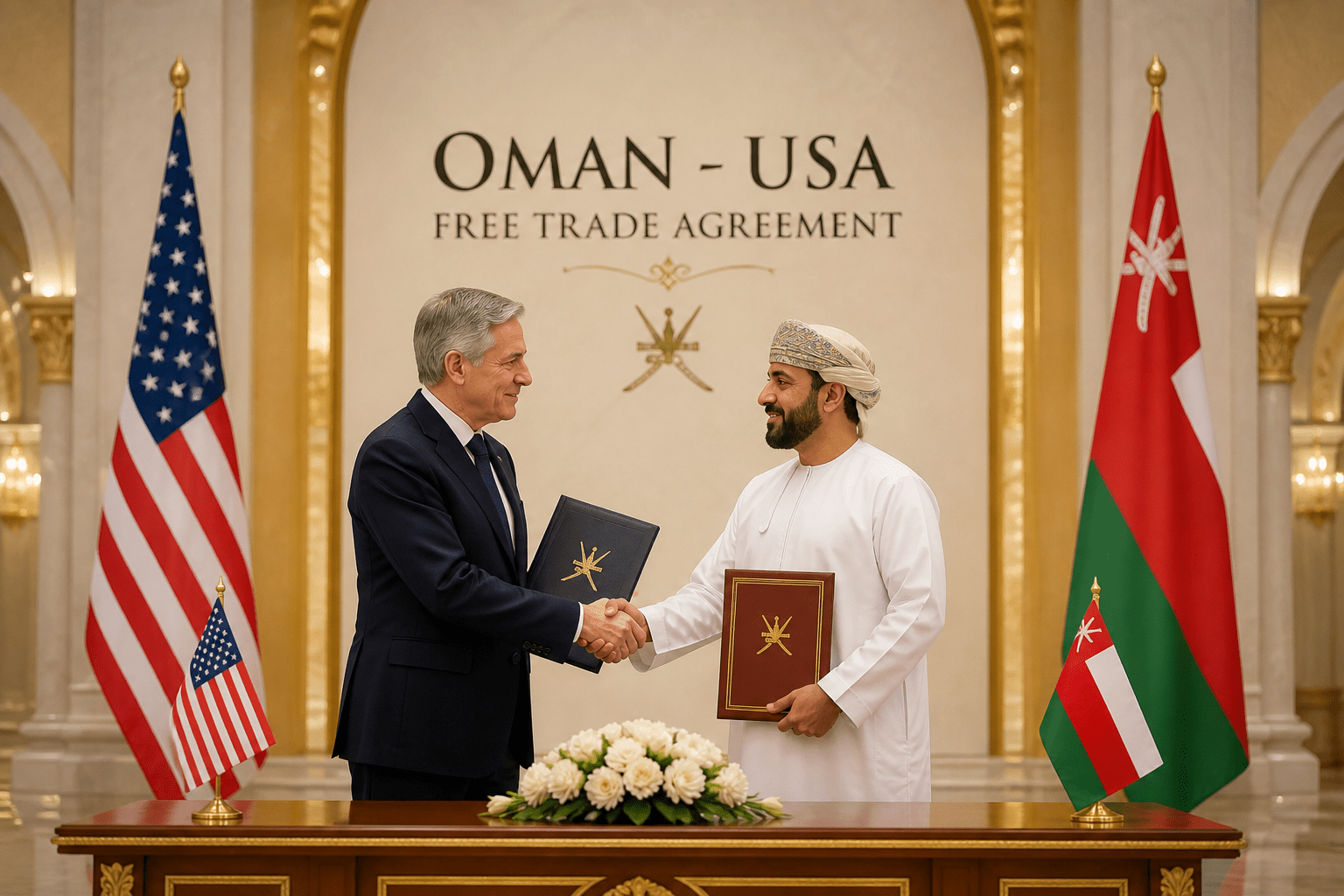
The Oman–US Free Trade Agreement may reduce the US customs duty on some goods made in Oman. The agreement entered into force on January 1, 2009.
The result depends on the product, its tariff code, its materials, the work done in Oman and the records kept by the business.
An Oman company, an Oman address or shipment from an Oman port does not create automatic duty-free access. The goods must meet the correct origin rule.
Basic decision path
- Find the correct US tariff code.
- Check the current US duty rate for goods from Oman.
- Find the origin rule for that product.
- Review every material and production step.
- Calculate qualifying value where the 35% rule applies.
- Prepare the production, cost and shipping records.
- Ask the US importer to make the correct FTA claim.
What is the Oman–US Free Trade Agreement?
The Oman–US Free Trade Agreement is a legal agreement between the Sultanate of Oman and the United States. It covers trade in goods and services, investment, customs procedures and several other areas.
For manufacturers and exporters, the main benefit is possible preferential tariff treatment. This means an eligible Omani product may receive a lower customs duty or a duty-free rate when it enters the United States.
The agreement is often called the US–Oman FTA or UOFTA. This guide focuses on goods made or processed in Oman and exported to the United States.
Oman–US FTA at a glance
| Subject | Current position |
|---|---|
| Entry into force | January 1, 2009 |
| Main possible benefit | Lower or zero US customs duty for eligible originating goods |
| Where to check the duty | The current US Harmonized Tariff Schedule, or HTS |
| General origin route | A new or different article of commerce and at least 35% qualifying value |
| Special origin rules | Some goods and textile products follow separate product-specific rules |
| Who makes the US claim | The US importer |
| Direct shipment rule | The goods must be imported directly, subject to permitted transit operations |
| Record period | The importer must keep the supporting origin information for five years from import |
| Late claim | An eligible importer may normally apply within one year after import |
The table gives the general position. The exact rule must be checked for the product’s current tariff classification.
Who may benefit from the agreement?
The agreement may be useful when real production or processing takes place in Oman and the finished goods are sold to the US market.
- Manufacturers using Omani or US materials
- Factories that change imported materials into a new product
- Industrial assembly projects with a clear production process
- Food, chemical or consumer-product processors that meet the relevant product rule
- Exporters with full material, cost and production records
- Businesses able to prove direct shipment from Oman to the United States
A trading company may also use the agreement. It must still prove that the goods qualify. Buying foreign goods, storing them in Oman and sending them to the United States will normally not change their origin.
How tariff treatment works
Every product entering the United States is classified under the US Harmonized Tariff Schedule. Each tariff line has its own description and duty rate.
The Special rate column may show the symbol OM for preferential treatment under the Oman agreement. Many eligible goods can receive a duty-free rate. The exact result must be checked under the current tariff line.
The normal duty rate still applies when the importer does not claim the preference or cannot prove that the product meets the origin rule.
FTA treatment does not remove every import cost or legal requirement. Separate trade-remedy duties, quotas, product standards, permits, taxes or rules from US agencies may still apply.
| Question | What to check |
|---|---|
| What is the product? | Its full description, use, material and technical features |
| What is its tariff code? | The current US HTS classification |
| Is an OM rate shown? | The Special duty column for the tariff line |
| Does the product qualify? | The general origin rule or the relevant product-specific rule |
| Are other duties possible? | Trade-remedy measures, quotas and other product rules |
Rules of origin under the agreement
Rules of origin decide whether a product legally qualifies as a good of Oman or the United States for FTA purposes.
The place of shipment is not enough. The product must meet one of the origin routes in the agreement.
Goods wholly obtained or produced
Some goods qualify because they are wholly grown, extracted, raised or produced in Oman, the United States or both countries.
Examples can include minerals extracted in Oman, crops harvested in Oman and goods made only from qualifying materials. The full legal definition must still be reviewed.
The general 35% origin route
For many goods that do not have a separate product-specific rule, two main conditions apply:
- The work in Oman or the United States must create a new or different article of commerce.
- Qualifying materials and direct processing costs must equal at least 35% of the product’s appraised value when it enters the importing country.
General calculation
(Value of qualifying Oman or US materials + qualifying direct processing costs) ÷ appraised value at import × 100
The result must be at least 35% where this general rule applies.
Materials and processing from Oman and the United States can be counted together. This is called cumulation.
The 35% test is not a general permission to add any business expense. Only qualifying materials and direct processing costs can be used.
Product-specific rules
Some products listed in Annex 4-A use a tariff-classification change or another special rule. Textiles and apparel also have separate rules under Chapter Three of the agreement.
For these products, the general 35% test may not be the correct test. The exporter must start with the exact tariff code and then read the rule linked to that code.
Direct shipment and transit
The goods must be imported directly from Oman into the United States to use the agreement.
Transit through another country can be accepted when the goods only undergo unloading, reloading, preservation or transport operations. Further production outside Oman or the United States can break the direct-import condition.
Transport records should show where the goods moved and what happened during transit.
Manufacturing and substantial transformation
A new or different article of commerce is a product with a new name, character or use after manufacturing or processing.
The change must come from a real operation. The agreement says that simple combining, simple packaging and mere dilution do not create a new or different article.
A product may be substantially transformed when the process changes its physical properties, changes a material with many uses into a product with limited uses, or uses complex work that causes the original materials to lose their separate identity.
| Operation | Possible origin effect |
|---|---|
| Full production from qualifying Oman materials | May qualify as wholly produced |
| Complex manufacturing from foreign materials | May create a new or different article |
| Machining, moulding or chemical processing | May qualify when the product and origin rule are satisfied |
| Testing and quality control | May support direct processing costs but normally cannot replace manufacturing |
| Simple bolting, gluing or soldering of a few parts | May be treated as simple combining |
| Changing boxes or labels | Does not normally change origin |
| Simple repacking | Does not create a new product |
| Adding “Made in Oman” to foreign goods | Does not prove Omani origin |
| Storing or moving goods through an Oman port | Does not change legal origin |
Costs that may be included
Direct processing costs can include costs directly used for making the specific product. The agreement gives examples such as:
- Production labour and related benefits
- Engineering, supervision and quality-control staff
- Tools, dies, moulds and allocable machinery depreciation
- Product-related research, design and engineering
- Inspection and testing of the specific product
- Packaging the product for export to the other FTA country
Profit and general expenses that are not linked to the product cannot be included. Examples include unrelated administration, advertising, sales commissions and general business insurance.
Customs documents and evidence
The exporter, producer and US importer should build one connected evidence file. The figures in the origin calculation should match the invoices, production records and customs documents.
Documents for export from Oman
The exact documents depend on the product and export method. An Oman export file may include:
- Commercial invoice
- Oman customs export declaration through the Bayan system
- Country-of-origin document
- Packing list where used
- Bill of lading, air waybill or road transport document
- Product permits, test reports or approvals where required
Evidence for the US FTA claim
The US importer makes the preferential claim. The importer is treated as certifying that the goods qualify and must be ready to provide a declaration when US Customs and Border Protection asks for it.
The supporting file may include:
- Product description, quantity and invoice numbers
- US tariff classification
- Bills of lading and shipment records
- Bill of materials for the finished product
- Origin and value of each material
- Supplier invoices and origin statements
- Description of the work completed in Oman
- Production orders and factory records
- Labour, testing and direct processing costs
- The 35% calculation where applicable
- Evidence of permitted transit through any third country
A general certificate of origin is useful, but it is not enough by itself. Customs may review the materials, production process, cost data and transport route before accepting the FTA claim.
The importer must keep the information needed for the origin declaration for five years from the date of import.
When an eligible product entered the United States without an FTA claim, the importer may normally submit a later claim within one year after import and request a refund of excess customs duty.
Company and location considerations in Oman
A business normally needs a legal Oman structure, the correct activities and the required operating licences before it can manufacture and export from Oman.
This structure supports the operation, but it does not decide the product’s origin. Origin is based on the goods, materials, processing, value calculation and documents.
A manufacturer may operate on the mainland, in a free zone or in another industrial location. The choice should match the factory, land, port, labour, customs and market needs of the project.
| Location question | Why it matters |
|---|---|
| Will the company sell inside Oman? | Domestic sales can affect the preferred legal and customs structure |
| Does the project need industrial land? | Land, utilities and environmental approvals may guide the location |
| Which port will be used? | Distance, shipping routes and container services affect cost |
| Where will materials enter Oman? | The import and storage route should connect with production |
| Where will manufacturing happen? | The real production site must match the origin records |
| Is a free zone required? | No. It is one location option and does not create FTA origin by itself |
Limits and common mistakes
| Common mistake | Correct position |
|---|---|
| Registering an Oman company creates duty-free access | The product must meet its origin rule |
| Every product uses the 35% rule | Some goods follow product-specific or textile rules |
| 35% value alone is enough | The general rule also requires a new or different article of commerce |
| Any company expense can be counted | Only qualifying materials and direct processing costs can be included |
| A certificate of origin proves everything | Customs can request full production and cost evidence |
| Simple packing changes origin | Simple packaging is a non-qualifying operation |
| An Oman port makes the goods Omani | The shipping point does not decide origin |
| A free-zone licence creates FTA eligibility | Real production and the product rule decide eligibility |
| The FTA removes every US import charge | Other duties, taxes, permits and product rules may remain |
| Records can be prepared after a customs question | Material and production records should be kept from the start |
Practical checklist before exporting
- Write a complete technical description of the product.
- Confirm the current US tariff classification.
- Check the current OM preferential rate.
- Check for product-specific or textile origin rules.
- List every raw material and component.
- Record the country of origin and value of each material.
- Describe every production step completed in Oman.
- Confirm that the operation is more than simple combining or packaging.
- Calculate qualifying value when the 35% rule applies.
- Separate direct production costs from general business expenses.
- Check US product permits, standards and separate duties.
- Prepare Oman customs and export documents.
- Keep transport evidence for any third-country transit.
- Give the US importer the full origin support file.
- Keep the records in a clear system for at least five years.
Frequently asked questions
When did the Oman–US Free Trade Agreement start?
The agreement entered into force on January 1, 2009.
Does an Oman company make exports duty-free?
No. The company gives the business a legal structure. The goods must separately meet the correct origin rule and customs requirements.
Do all products need 35% Omani value?
No. The general rule uses qualifying Oman and US materials plus direct processing costs. Some products follow separate tariff-change or textile rules.
Is reaching 35% enough for the general rule?
No. The manufacturing must also create a new or different article of commerce. The direct-import and other agreement conditions must also be met.
Can a product contain foreign materials?
Yes. Foreign materials can be used when the final product meets its applicable origin rule. Their origin, value and processing must be recorded.
Does simple assembly qualify?
Very simple combining may not qualify. The agreement gives examples such as fitting together a small number of parts by bolting, gluing or soldering. The complete production process must be reviewed.
Is an Oman free zone required?
No. A free zone can support land, logistics or customs needs, but it is not required by the FTA and does not create origin by itself.
Who claims the FTA benefit in the United States?
The US importer makes the preferential claim and must be able to support it with the required origin information.
Is there one fixed UOFTA certificate form?
The agreement treats the importer’s claim as a certification. Customs may request a declaration with detailed information about the product, materials, production, value and shipment.
How long must the origin records be kept?
The importer must keep the information needed for the origin declaration for five years from the import date.
Can the importer claim the benefit after import?
An eligible importer may normally file a later claim within one year after import and request a refund of excess duty.
Related Oman Verified guides and services
Business structure in Oman
A manufacturer needs a structure that matches its real activities, licences and operating plan. See our Oman company setup advisory.
Export customs file
Export declarations and supporting records should match the commercial and origin file. Review our customs documentation support in Oman.
Mainland or free-zone location
Location should follow the project’s land, port, customs and sales needs. See our Oman free-zone selection advisory.
Other trade agreements
The US agreement is one part of Oman’s wider trade-agreement network. Each agreement has its own origin and customs rules.
Conclusion
The Oman–US Free Trade Agreement can support manufacturing and exports from Oman when the finished goods meet the correct origin rule.
The product classification, production process, qualifying value, direct shipment and supporting documents should be checked before the first export. Company registration, a free-zone address or an Oman certificate alone cannot create FTA eligibility.
Practical implementation note: Oman Verified works with founders and companies in Oman and internationally, connecting practical analysis with Oman-side setup and implementation support when required. It is not part of the Government of Oman, the United States Government, US Customs and Border Protection or any customs authority. This guide gives general public information. It is not a customs ruling, legal opinion or guarantee of tariff treatment.
Official sources
- United States Trade Representative — Oman Free Trade Agreement
- United States Trade Representative — Chapter Four: Rules of Origin
- International Trade Administration — US–Oman Free Trade Agreement guide
- US Customs and Border Protection — Oman FTA implementation instructions
- United States International Trade Commission — current Harmonized Tariff Schedule
- Oman Customs — customs declaration service and required documents
Official public information reviewed on July 24, 2026. Confirm the current requirements in the live government systems before submission.