
OMAN COMPANY ACQUISITION GUIDE
Buying an Existing Company in Oman: Due Diligence and Share Transfer Guide
This guide explains how to assess and buy an existing company in Oman, from choosing a share or asset purchase through corporate, financial, tax and operational due diligence, ownership transfer, bank KYC and the first 90 days after closing.
The guide follows the acquisition decision from initial screening to post-closing control.
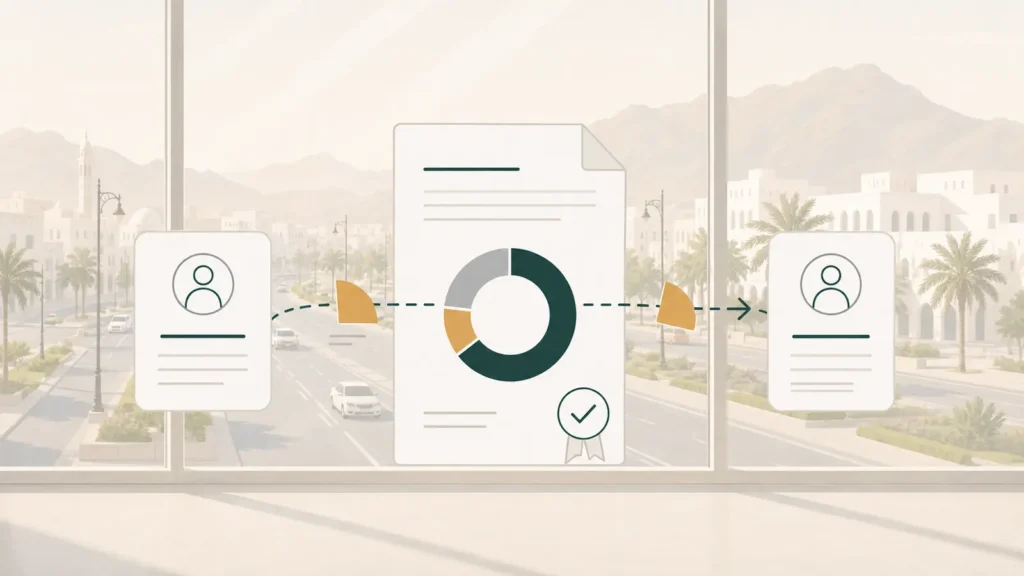
TRANSACTION ROUTE
Share or Asset Purchase
DUE DILIGENCE
Corporate, Financial, Tax & Operational
OWNERSHIP CHANGE
Share Transfer & Bank KYC
POST-CLOSING
90-Day Compliance Plan
QUICK ANSWER
Can a Foreign Investor Buy an Existing Company in Oman?
Yes, a foreign investor may acquire an existing Omani company or selected business assets when the legal form, business activity, ownership rules, company documents and required approvals permit it. The safest route is to review the target first, then choose between a share purchase and an asset purchase based on liabilities, licences, contracts, employees, tax and banking continuity.
At a Glance
- A CR extract alone is not due diligence
- Ownership transfer does not erase historic company risk
- Licences and contracts may contain consent conditions
- Bank access is subject to the bank’s updated KYC approval
- Independent legal, tax and financial review may be required
Share Purchase or Asset Purchase?
The transaction route changes what the buyer receives, what liabilities may remain, and which consents or transfers are required.
| Decision Point | Share Purchase | Asset Purchase |
|---|---|---|
| What changes | Ownership of the existing legal entity changes. | Selected assets, rights or business components move to the buyer. |
| Historic liabilities | The company remains the same entity, so historic exposure stays within it. | Liabilities can be more selectively allocated, subject to law and contract. |
| Licences and contracts | May continue, but change-of-control clauses and authority approvals must be checked. | Often require separate assignment, consent, reissue or new registration. |
| Employees | Remain with the company, but accrued obligations must be reviewed. | Transfer arrangements and employee obligations require separate analysis. |
| Best fit | A functioning company with valuable licences, contracts, staff and operating history. | A buyer who wants selected assets and stronger separation from historic company risk. |
Practical rule: Choose the route only after reviewing liabilities, licences, contracts, tax history, workforce and bank requirements—not only the purchase price.
Detailed Comparison
This table is an initial decision tool; its conclusions should be confirmed against the target company and current professional advice.
| Issue | Share Purchase | Asset Purchase |
|---|---|---|
| What the buyer acquires | Shares in the existing company | Selected assets, rights or business components |
| Historic liabilities | Remain within the acquired company | Usually remain with seller unless assumed or transferred by law/agreement |
| Licences | May remain with the entity, subject to approvals and conditions | Often require transfer, consent, reissue or a new licence |
| Contracts | Remain with the entity, subject to change-of-control clauses | Usually require assignment or counterparty consent |
| Employees | Remain employed by the company; accrued obligations stay relevant | Transfer or new employment arrangements require separate planning |
| Banking | Existing account remains the company’s, but KYC and signatory approval are renewed | Buyer normally uses its own banking structure; acquired facilities do not automatically transfer |
| Tax and accounting | Historic tax position and records remain with the company | Tax treatment and allocation depend on the assets and transaction structure |
| Operational continuity | Often stronger when the company is clean and approvals remain valid | Can be slower because business components move separately |
| Main risk | Unknown historic exposure | Failure to transfer the business elements that create value |
A Practical Decision Framework
The decision framework starts with three questions.
1. What Creates the Value?
- Licences or government approvals
- Customer and supplier contracts
- Employees and technical managers
- Brand, IP, equipment or location
- Operating history or bank relationships
2. What Creates the Risk?
- Tax and VAT history
- Employee and gratuity exposure
- Debt, guarantees or security interests
- Litigation and contractual claims
- Ownership, UBO or regulatory issues
3. What Can Actually Transfer?
- Contract assignment rights
- Licence and lease transferability
- Employee and visa arrangements
- IP, data and system access
- Bank facilities and payment continuity
When an Existing-Company Acquisition May or May Not Fit
Common Acquisition Scenarios
- Foreign investors evaluating an operating company in Oman
- Buyers acquiring shares, selected assets or a business line
- International companies entering Oman through acquisition
- Transactions requiring input from several licensed specialists
- Buyers comparing proceed, renegotiate, or stop outcomes
Warning Signs and Limits
- Buyers looking only for a low-cost shelf company without business value
- Transactions where the seller refuses document access
- Buyers expecting bank accounts, licences or customers to transfer automatically
- Cases requiring a licensed legal opinion need a qualified lawyer
- Independent verification should be budgeted separately
Due Diligence Scope
A due diligence review should answer what is verified, what remains unverified, how serious each issue is, and what the buyer should do next.
| Review Area | Typical Evidence | Decision Question |
|---|---|---|
| Corporate & ownership | CR, constitutive documents, shareholder register, UBO, resolutions | Does the seller have the authority and clean title to transfer? |
| Financial quality | Audited statements, ledgers, bank statements, receivables, debt | Are earnings, cash flow and working capital reliable? |
| Tax & VAT | Tax card, VAT records, returns, payment status, clearance evidence | Are there unpaid taxes, late filings or assessment risks? |
| Labour & workforce | Employee register, payroll, WPS, contracts, leave and gratuity | What employee obligations will remain with the company? |
| Licences & premises | Sector licences, municipality approvals, lease, technical approvals | Can the business continue after ownership changes? |
| Contracts & claims | Customer, supplier, finance, agency, litigation and insurance records | Can key contracts terminate or require consent? |
| Banking & security | Facilities, guarantees, pledges, signatories and KYC records | Are assets or shares encumbered, and can banking continue? |
| IP, data & systems | Trademark records, software licences, domains, data and access controls | Does the company own and control the assets that create value? |
Levels of Due Diligence
Not every transaction needs the same depth. The scope should match deal value, risk, complexity and document quality.
Preliminary Screening
A fast review of core corporate, tax, financial, licence and ownership records to decide whether deeper work is justified.
- Best before a non-refundable deposit
- Focuses on obvious blockers and missing records
- Not a substitute for full due diligence
Focused Due Diligence
A targeted review of the areas most relevant to the transaction, such as tax, workforce, licences, contracts or banking.
- Best when the key risk is already known
- Defined review areas and specialist workstreams
- Useful for smaller or simpler acquisitions
Full Multi-Workstream Review
A multi-workstream review with a consolidated risk report and closing-condition plan.
- Best for operating companies and material transactions
- Covers legal, financial, tax, and operational specialist work
- Informs negotiation and closing decisions
What the Transfer Process Can Involve
A complete acquisition analysis covers due diligence, ownership-change steps, and post-closing compliance. Regulated legal, audit, and valuation work belongs to appropriately licensed independent professionals.
Typical Cases
- Sale of all or part of LLC shares
- Admission of a new foreign or Omani shareholder
- Exit of an existing shareholder
- Change from one corporate shareholder to another
- Ownership restructuring within a group
Pre-Transfer Checks
- Legal form and activity restrictions
- Constitutive-document requirements
- Existing shareholder rights and consents
- Pledges, licences and external approvals
- Buyer identification and ownership documents
Post-Transfer Updates
- Updated CR and shareholder information
- UBO and authorised-signatory records
- OCCI and sector-record updates where required
- Bank KYC and signatory package
- Tax, labour, licence, and contract status updates
Bank Account and KYC After Share Transfer
A company bank account belongs to the company, but the bank must approve the new ownership, UBOs and authorised signatories under its own compliance rules.
Pre-Filing Checks
- Inform the relationship manager when appropriate
- Confirm the bank’s ownership-change checklist
- Prepare source-of-funds and business rationale
- Plan temporary payment controls and signatory changes
Typical Update Records
- Updated CR and constitutive documents
- OCCI and UBO records
- Buyer and signatory identity documents
- Corporate resolutions and signing authorities
- Tax self-certifications and bank forms
Important Limitation
- Account continuity is not guaranteed
- The bank may request more documents or restrict access
- Existing facilities and guarantees require separate review
- Do not treat the account balance as freely transferable value
The First 90 Days After Acquisition
The exact sequence varies, but the transition should be managed as a controlled programme rather than a list of disconnected amendments.
| Period | Priority Actions | Main Outcome |
|---|---|---|
| Days 1–30 | Confirm CR, UBO, signatories, bank KYC, system access, payment controls and urgent licence or contract notices. | Control and continuity |
| Days 31–60 | Reconcile tax and VAT status, payroll, employee obligations, accounting access, leases, insurance and key contracts. | Compliance baseline |
| Days 61–90 | Close due diligence actions, update SOPs, renew licences, strengthen reporting and approve a 12-month compliance calendar. | Stable operating system |
Post-Acquisition Workstreams
The transition plan should cover both official records and the practical ability to operate the business.
Corporate Control
- CR, constitutive documents and shareholder register
- UBO, managers and authorised signatories
- Board approvals and delegation of authority
- Company seals, records and official account access
Banking & Finance
- Bank KYC and signatory transition
- Facilities, guarantees and payment controls
- Accounting system and document access
- Receivables, payables and cash-flow controls
Tax & Regulatory
- Tax card, VAT and filing status
- Open assessments, penalties and tax-clearance actions
- Licences, municipality and sector approvals
- Lease, premises and insurance alignment
Workforce & Operations
- Employee records, payroll and leave balances
- Gratuity, disputes and labour compliance
- Omanisation and workforce permissions
- Key customers, suppliers and operational handover
Contracts & Assets
- Change-of-control notices and consents
- IP, domains, software and data access
- Inventory, equipment and asset registers
- Agency, distribution and service agreements
Governance & Reporting
- Risk register and unresolved due diligence items
- Monthly compliance calendar
- Management reporting and approval limits
- Document retention and responsibility matrix
Acquisition Cost Categories
Cost planning should separate authority charges, transaction expenses, and external professional costs.
Review Depth
Review costs vary with transaction size, document quality, risk level, number of entities, and required specialists.
Authority and External Costs
Possible external costs include government, notary, licensed legal, audit, valuation, translation, and bank charges; each should be verified separately.
Documents Commonly Reviewed
The exact list depends on the company and transaction. A seller’s inability to organise basic records is itself a risk signal.
Corporate Records
- CR, constitutive documents and amendments
- Shareholder and manager records
- OCCI membership and UBO information
- Board or shareholder resolutions
- Licences, permits and lease documents
Financial & Tax Records
- Audited financial statements
- Management accounts and bank statements
- Tax card, VAT certificate and returns
- Tax clearance or tax-status evidence
- Loans, guarantees and security documents
Commercial & Workforce Records
- Major customer and supplier contracts
- Employee list, payroll and leave balances
- Labour disputes and end-of-service calculations
- IP registrations and software licences
- Insurance, litigation and claims records
Common Acquisition Risks in Oman
A low purchase price can become expensive when hidden obligations or non-transferable business value appear after closing.
Hidden Liabilities
Tax, employee, supplier, loan, guarantee or legal obligations may not be obvious from a simple CR extract.
Licence Dependence
A licence may depend on the location, technical manager, shareholder profile or external authority approval.
Contract Fragility
Key customers, agencies or suppliers may have termination or consent rights when ownership changes.
Banking Disruption
Banks may require a full KYC and signatory refresh before allowing the new owners to operate the account.
Unreliable Earnings
Reported sales may not equal sustainable earnings, collectible receivables or transferable customer relationships.
Incomplete Ownership Records
Pledges, nominee arrangements, UBO inconsistencies or shareholder disputes can block or delay the transaction.
How the Process Works
A staged process protects the buyer from committing too early and keeps responsibilities clear.
1. Initial Screening
Define the target, transaction route, decision criteria, known risks, and any deadline before collecting detailed records.
2. Document Collection
Use a structured document list to track missing, inconsistent, or outdated records.
3. Specialist Review
Corporate, legal, financial, tax, labour, licence, contract, and banking issues may require appropriately licensed specialists.
4. Decision & Deal Conditions
Findings are converted into a risk matrix, negotiation points, conditions before closing and post-closing actions.
5. Transfer & Post-Closing Records
After the ownership or asset transfer, update UBO, banking, tax, labour, licence, and other affected records.
Official Reference Points
These links help buyers verify the official systems that may affect a transaction. They do not replace case-specific legal or tax advice.
Oman Business Platform
Commercial-registration and company-amendment procedures use the official Oman Business Platform. Official business platform →
Commercial Companies Law
The legal form, constitutive documents and shareholder rights affect how ownership can be transferred. Commercial Companies Law PDF →
Oman Tax Authority
Tax registration, VAT validation, returns and clearance status should be checked against official records. Oman Tax Authority portal →
Frequently Asked Questions
Direct answers about buying, reviewing, transferring and taking control of an existing company in Oman.
Can a foreign investor buy an existing company in Oman?
It may be possible, including full foreign ownership for many activities, but the result depends on the company’s activity, legal form, licences, ownership restrictions, buyer profile and any required approvals.
Is buying an existing company faster than registering a new company?
It can be faster when the target is active, compliant and properly documented. A company with hidden liabilities, incomplete records, licence problems or banking issues can take longer and cost more than a new registration.
What is the difference between a share purchase and an asset purchase?
A share purchase changes ownership of the existing legal entity, so the company’s historical exposure remains within it. An asset purchase transfers selected assets or business components, but licences, contracts, employees, leases and registrations may require separate consent or transfer.
Does the buyer inherit old debts and liabilities?
In a share purchase, the company remains the same legal entity and its historical liabilities remain within it. Due diligence, warranties, indemnities, price adjustments, retention or escrow can reduce risk, but they do not erase the company’s past.
What does business due diligence review?
The review can cover corporate ownership, financial quality, tax and VAT, contracts, licences, employees, litigation, banking, assets, intellectual property, operational dependencies and compliance evidence. The appropriate review depth depends on the target and transaction value.
Will the company bank account continue after the ownership change?
Not automatically. The account remains in the company’s name, but the bank may require refreshed KYC for new shareholders, ultimate beneficial owners, authorised signatories, source of funds, expected activity and supporting corporate documents.
Do all licences and contracts continue after a share transfer?
Not always. Some may continue with the legal entity, while others contain change-of-control, notification, consent, technical-person or ownership conditions. Each material licence and contract should be checked before closing.
What must be updated after buying the company?
Typical post-closing work includes corporate records, UBO information, signatories, bank KYC, system access, tax and VAT status, labour and payroll records, licences, leases, insurance, key contracts, accounting control and a compliance calendar.
Can the acquisition process be managed remotely?
Many document-review and sequencing tasks can be completed remotely. Identity verification, signatures, notarisation, foreign-document attestation, authority procedures and banking may still require an authorised representative or physical presence.
How long does a company acquisition in Oman take?
There is no reliable universal timeline. Timing depends on document quality, negotiation, legal form, due diligence depth, shareholder procedures, approvals, financing, notarisation, foreign documents and bank compliance.
Which acquisition costs should be budgeted?
Budget categories may include authority and notary fees, licensed legal, financial, tax, audit or valuation work, translation, document preparation, banking, and post-closing updates. Each category should be verified separately.