
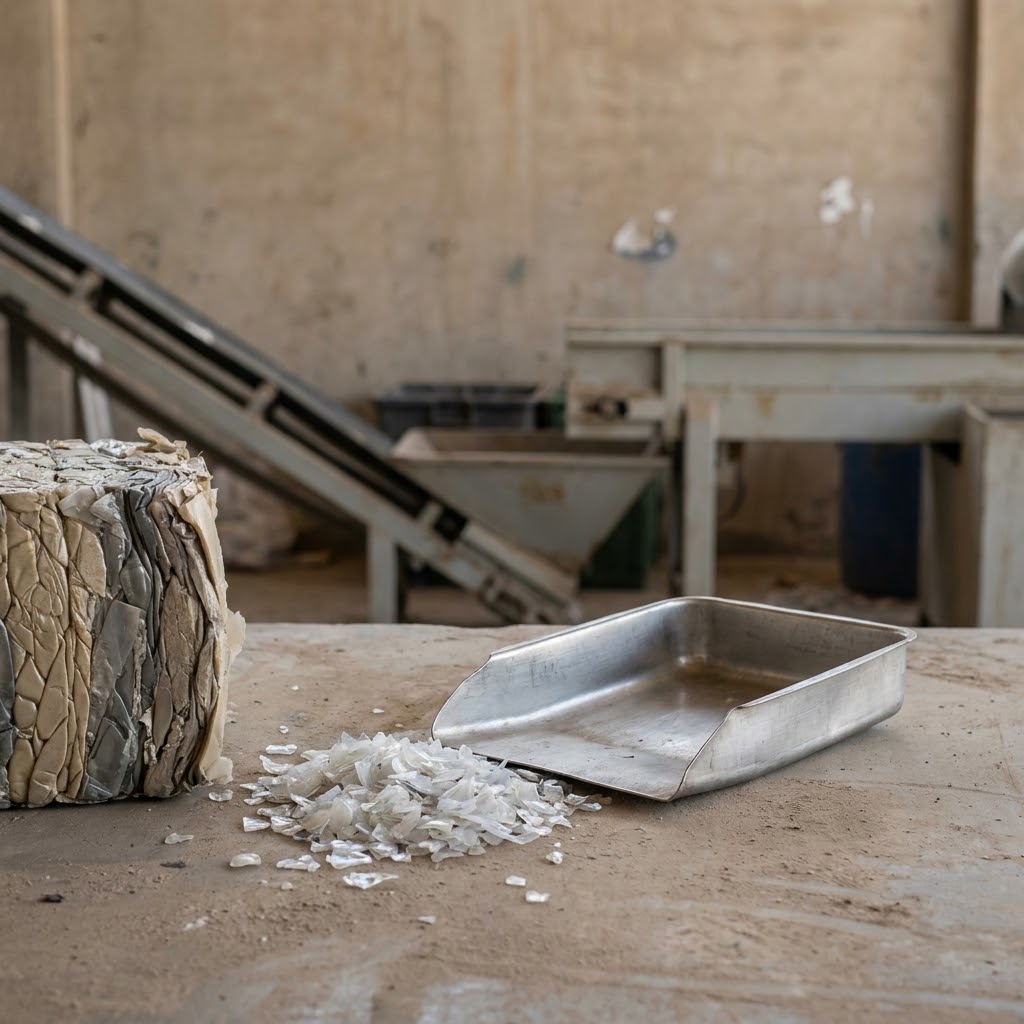
A recycling and waste management company in Oman can operate at several very different levels. It may collect separated cardboard from shops, recover plastic or metal, manage used cooking oil, process electronic waste, sort industrial material, or develop a large treatment project. Each model has a different site, licence, safety and capital requirement.
The first decision is not the company name or the vehicle type. It is the exact waste stream and the work the company will perform. Collection, transport, storage, sorting, treatment, reuse, recycling and final disposal are separate functions. A commercial registration alone does not authorise every function.
This guide explains the practical structure of the sector. It does not give hazardous-waste handling instructions and does not promise that a proposed activity, location or technology will be approved.
The core business logic
- Define the waste stream: paper, plastic, metal, glass, electronic waste, used cooking oil, organic waste, industrial waste or hazardous waste.
- Define the function: collect, transport, store, sort, process, recycle, reuse, export or dispose.
- Confirm the legal route: commercial activity, foreign-ownership position, environmental classification, waste-management licence and location approvals.
- Secure supply and sale: obtain feedstock contracts and a realistic buyer or disposal route before buying equipment.
- Build the operating system: site controls, vehicles, fire safety, worker safety, records, insurance and waste traceability.
What counts as a waste or recycling business?
A waste business takes responsibility for material after it is discarded or transferred by a waste generator. The company may move the material, keep it temporarily, separate it, change it into a secondary raw material, send it to another licensed facility or arrange final disposal.
A recycling business normally creates value from a defined material. It may bale cardboard, grade scrap metal, wash and pelletise plastic, crush glass, recover selected electronic components, aggregate used cooking oil or process organic material. The commercial model depends on clean feedstock, controlled contamination and a buyer for the recovered output.
Ordinary cleaning is not the same activity
A cleaning company may clean a building and place ordinary rubbish in the customer’s authorised bins. This does not automatically allow the company to operate a waste collection fleet, store waste at another site, handle hazardous material or dispose of waste independently.
Once a business takes waste away, stores it, combines loads, treats it or chooses the final destination, the activity and environmental requirements must be checked again. Never assume that a cleaning, transport or general-trading activity covers regulated waste services.
Waste categories at a glance
| Waste stream | Possible business model | Main control point |
|---|---|---|
| Mixed municipal waste | Public contract, subcontract or approved facility service | Municipal waste services are managed through the national system; do not create an unauthorised public collection network. |
| Separated commercial recyclables | B2B collection, aggregation, sorting and sale | Confirm the activity, collection route, site, records and approved destination. |
| Plastic, paper, metal and glass | Sorting, baling, crushing, washing or material production | Processing changes the site, utility, environmental and fire-safety requirements. |
| Electronic waste | Collection, testing, reuse, dismantling or recovery | Batteries, lamps, refrigerants and some components may create hazardous-waste duties. |
| Used cooking oil | Collection and supply to an approved processor | Traceability, contamination control, safe storage and a confirmed off-take route. |
| Organic waste | Composting, feedstock preparation or biogas | Odour, leachate, pests, gas safety and digestate or compost quality. |
| Industrial non-hazardous waste | Recovery, reuse, treatment or approved disposal | The generator must identify the stream and the receiving route must be accepted. |
| Hazardous waste | Specialised collection, storage, treatment or export | High regulatory control, specialist plans, licensed movement and approved facilities. |
Collection and transport
Collection is often the easiest business model to understand, but it is not only a vehicle operation. The company must know what it is collecting, who owns it, where it will go and what happens when a load is contaminated or rejected.
A basic commercial collection system should include
- A written contract with each waste generator.
- A clear description of accepted and rejected materials.
- Suitable containers, labels and collection frequency.
- Vehicles appropriate for the load and accepted by the relevant authorities.
- Route, weight, source and destination records.
- A receiving agreement with a recycling, treatment or disposal facility.
- A process for spills, rejected loads, vehicle incidents and customer complaints.
The Environment Authority’s public waste-management service specifically lists regulated functions for hazardous waste and final disposal of non-hazardous solid waste. Its Sahl National Waste Register also covers waste generators, collectors, transporters, recycling plants, storage and treatment facilities. The exact registration and licence route must therefore be confirmed for the planned stream and function before operations begin.
Important: Never mix hazardous and non-hazardous material to simplify transport. Do not accept an unknown industrial load only because the customer calls it “scrap.” The waste must be identified and matched to an approved route.
Sorting and material recovery
A sorting business receives mixed or separated material and produces saleable grades. A small facility may inspect, separate and bale dry recyclables. A larger material recovery facility may use conveyors, screens, magnets, optical sorting and compactors.
The commercial risk is contamination. A plant can receive large volumes and still lose money if the material is wet, mixed, unsafe or unsuitable for the buyer. Before selecting machinery, test real samples and agree the buyer’s specifications for moisture, colour, grade, bale size and contamination.
Site needs for sorting and recycling plants
- Industrial or otherwise approved land use.
- Safe access for collection vehicles and trailers.
- Covered storage where rain, heat or contamination can damage material.
- Separated incoming, processing, rejected and finished-product areas.
- Fire detection, firefighting access and emergency routes.
- Controls for dust, noise, wastewater, odour, pests and stormwater.
- Power, water and drainage capacity suitable for the machinery.
- Enough space for rejected material and maintenance without blocking operations.
For location planning, review factory location assessment in Oman. Madayn industrial cities can provide industrial plots and infrastructure, but the selected city, plot and activity must still be accepted. Export-oriented projects may also compare a free-zone investment assessment in Oman, especially where port access and imported machinery are important.
Plastic, metal, glass and paper recycling
Plastic
Plastic collection is not one market. PET bottles, HDPE containers, film, rigid mixed plastic and industrial production scrap have different buyers and processing needs. Simple sorting and baling has lower technical complexity than washing, shredding and pellet production.
A washing line creates wastewater, sludge and rejected material. A pelletising line adds heat, emissions, energy use and product-quality controls. Confirm the final product specification and utility cost before buying a complete line.
Metal
Metal recovery may include grading, cutting, baling, shredding or preparing scrap for a foundry. The business needs strong source records, theft-risk controls, safe vehicle movement and clear rules for closed containers, pressurised items, batteries and contaminated industrial equipment.
Glass
Glass is heavy and can have a low value compared with transport cost. Colour separation, contamination, breakage safety and distance to the buyer are important. A local off-take agreement should be tested before investing in bins or crushing equipment.
Paper and cardboard
Dry commercial cardboard can be a practical entry stream because shops, warehouses and offices produce regular volumes. Moisture, food contamination and fire are the main operating risks. Covered storage and fast stock rotation are more important than collecting volume without a buyer.
E-waste and used cooking oil
Electronic waste
An e-waste company must define whether it collects whole devices, tests products for reuse, removes data-bearing equipment, dismantles devices, recovers materials or exports approved fractions. These are not the same operation.
Batteries, lamps, display components, refrigerants and contaminated parts can create hazardous-waste and fire risks. Data destruction may also be a contractual and security duty. The facility should not begin dismantling until its activity, environmental route, worker controls and downstream receivers are confirmed.
Used cooking oil
Used cooking oil can be collected from restaurants, hotels, caterers and food factories and supplied to an approved processor. The business needs sealed containers, scheduled collections, source records, contamination checks, controlled storage and a clear buyer.
The final product may be used as feedstock for biodiesel or other approved industrial processes. A collection company should not advertise a fuel or chemical product unless the processing, product and sale route has the required approvals.
Industrial and hazardous waste
Industrial waste must be assessed by its actual composition, not only by the industry name. Two factories can produce very different waste. A material may be recyclable, non-hazardous, hazardous or subject to a special return programme.
Hazardous waste is a specialist business. Oman’s official waste-management licence covers transport, collection, treatment, storage, reuse and final disposal of hazardous waste. The service lists a waste-management plan and additional documents according to the function. Treatment and some disposal routes also require an environmental permit.
A new company should obtain a written description of the waste, confirm the authority’s classification and use an approved receiving route. This guide does not provide instructions for packing, neutralising, mixing, burning or treating hazardous material.
Cross-border movement
Import and export rules depend on the material and destination. The Environment Authority states that non-hazardous waste may be imported strictly for recycling or treatment and requires the Chairman’s approval through the Bayan route. Hazardous-waste movements are controlled under the Basel Convention and require the relevant notification and approval process.
Use customs documentation support in Oman when the business will import processing feedstock, import machinery or export recovered material. Customs clearance does not replace environmental approval.
Biogas, biofuel and waste-to-energy
These terms are often grouped together, but the project scales are very different.
| Model | Commercial reality | Key approvals and risks |
|---|---|---|
| Used-oil aggregation | Can begin as a collection and supply model | Storage, traceability, buyer approval and contamination control |
| Biofuel production | Industrial processing with product and feedstock controls | Chemicals, emissions, fire safety, product standards and off-take |
| Composting | Possible at small or medium scale with clean organic feedstock | Odour, leachate, pests, contamination and product quality |
| Biogas | Needs reliable organic feedstock and stable plant operation | Gas safety, digestate, odour, utilities and energy off-take |
| Waste-to-energy | Normally a large infrastructure or utility project | Feedstock commitment, emissions, grid or heat off-take, finance and public-sector coordination |
A waste-to-energy proposal should not be treated as a simple small-company licence. It normally needs long-term feedstock rights, detailed environmental studies, proven technology, major finance and a bankable energy or heat buyer.
Site and environmental approvals
The site should be checked before a binding lease or equipment order. The authority may consider land use, nearby receptors, waste type, capacity, emissions, noise, traffic, water use, drainage, fire risk and the proposed treatment process.
Mainland projects
Mainland environmental permits are handled through the Environment Authority. The final category and study requirement are decided from the real activity and project details. A light storage or sorting proposal should not be self-declared as a low-risk project, and a high-impact process should not be described as simple recycling to avoid review.
Special economic zones and free zones
Projects inside OPAZ-supervised zones follow the zone’s environmental procedure. OPAZ describes three environmental categories: high-risk projects needing an environmental and social impact assessment, medium-risk projects needing an environmental management plan and low-risk projects subject to general environmental conditions. The zone operator and OPAZ determine the route.
Approvals commonly checked
- Commercial registration with the correct activity.
- Foreign-investment licence where applicable.
- Approved land use, lease or usufruct.
- Environmental permit and required study.
- Waste-management licence for the applicable function.
- Sahl National Waste Register registration and records.
- Municipality or industrial-city activity licence.
- Civil Defence and fire-safety approvals.
- Vehicle, customs, labour, tax and product approvals where relevant.
Contracts, safety and off-take
A recycling plant is not commercially complete when it can process material. It is complete when it can obtain suitable feedstock, produce an accepted output and manage rejects legally.
Core contracts
- Waste-supply agreement: volume, quality, collection schedule, ownership, contamination and price.
- Receiving or disposal agreement: accepted material, rejection rules, records and emergency arrangements.
- Off-take agreement: product specification, quantity, price formula, testing, delivery and rejection.
- Site agreement: approved activity, utilities, access, expansion and environmental responsibilities.
- Transport agreement: authorised vehicle, route, insurance, records and incident responsibility.
- Equipment agreement: capacity test, warranty, spare parts, training, maintenance and commissioning.
Equipment suppliers may request deposits, and customers may pay after collection or delivery. Prepare the bank file, contracts, source-of-funds evidence and working-capital plan early. Oman Verified provides business banking preparation support, but account approval remains the bank’s decision.
Worker and fire safety
- Separate pedestrians, forklifts, loaders and collection vehicles.
- Control sharp glass, metal edges, dust, moving machinery and falling bales.
- Keep batteries, oils and ignition sources away from dry combustible stock.
- Provide suitable personal protective equipment and task training.
- Maintain emergency access, fire separation and clear evacuation routes.
- Create incident, near-miss, spill and rejected-load procedures.
- Train workers in the languages they understand.
Work permits, reserved occupations, Omanisation duties and employment planning can affect the operating model. Review workforce compliance support in Oman before fixing the staffing plan or promising positions to foreign workers.
Short legal-company pathway
- Describe the business precisely. List each waste stream and each function. Use the search Oman commercial activity codes tool as a starting point only. It does not prove foreign-ownership eligibility or regulatory approval.
- Check ownership and restrictions. Many activities may allow full foreign ownership, but the exact activity must be checked against current restricted activities for foreign investors in Oman and any sector conditions.
- Register the legal entity. Select the structure, shareholders and activities. For a complete registration review, use Oman company setup advisory.
- Apply for the investment licence where required. The current Gov.om service lists a feasibility study, experience evidence, a three-month bank statement and a lease contract among the documents.
- Secure a suitable site. Make the lease conditional where possible on activity, environmental and fire-safety acceptance.
- Complete environmental and waste approvals. Obtain the assigned permit, waste-management licence and Sahl registration that apply to the project.
- Complete operating registrations. These may include industrial-city or municipality licensing, tax, labour, customs, vehicle, insurance and banking steps.
Income-tax registration and accounting should start from the beginning of business activity. VAT registration depends on the current threshold and the company’s taxable supplies. Review Oman tax rules for companies for the separate tax pathway.
Costs and financial planning
There is no reliable single price for starting a recycling and waste management company in Oman. A collection company with a small dry-storage yard is different from a plastic washing plant, hazardous-waste facility or waste-to-energy project.
| Cost area | Examples | Main driver |
|---|---|---|
| Company and licensing | Commercial registration, investment licence, activity and local licences | Ownership, activities and location |
| Environmental work | Study, consultant, permit, monitoring and reporting | Risk category, capacity and technology |
| Site | Lease, deposit, fit-out, roads, drainage and fire systems | Area, zoning and utility condition |
| Vehicles | Collection trucks, containers, insurance and maintenance | Waste type, payload and route |
| Machinery | Baler, shredder, washer, crusher, conveyor or treatment line | Capacity, automation and product quality |
| Utilities | Power, water, wastewater and fuel | Process intensity and operating hours |
| Safety and compliance | PPE, fire systems, training, inspections and testing | Material hazards and site design |
| Working capital | Feedstock, salaries, fuel, spare parts and customer credit | Payment cycle and stock turnover |
| Rejects and disposal | Transport and fees for non-recyclable output | Contamination and process yield |
The mainland company registration cost estimator can estimate only general mainland company and investor-residence costs. It does not calculate industrial land, environmental studies, vehicles, machinery, utilities, waste licences, fire systems, testing, stock or project finance.
Commercial test before capital spending
- Obtain sample feedstock from real generators.
- Measure contamination and usable yield.
- Obtain buyer specifications and trial pricing.
- Calculate transport cost per tonne.
- Price rejects and final disposal.
- Test the model at low volume before ordering a full line.
Common mistakes
Choosing a broad activity and planning the details later
Waste functions are not interchangeable. The company may need different activities and approvals for collection, transport, storage, processing and final disposal.
Buying machinery before securing feedstock
A technical line cannot solve an unreliable supply problem. Confirm material volume, quality and contract term first.
No buyer for the recovered material
Recovered output is not automatically a marketable product. Obtain specifications, trial acceptance and price logic from the buyer.
Treating municipal waste as an open private market
Municipal waste services are managed through the national system. Private participation normally requires an approved contract, tender, subcontract or specific authorised route.
Using an unsuitable warehouse
A cheap warehouse may fail land-use, access, fire, drainage, environmental or neighbour-impact checks.
Ignoring rejects
Every recycling process creates material that cannot be sold. Its storage, transport and approved disposal must be included in the operating model.
Calling hazardous material ordinary scrap
A customer description does not determine the legal classification. Confirm the material and receiving route before accepting it.
Practical launch checklist
- Define every waste stream and function.
- Confirm who generates the waste and how much is available.
- Collect and test representative samples.
- Confirm the commercial activity and ownership position.
- Identify the environmental authority for the selected location.
- Obtain an initial site and zoning view before signing a long lease.
- Map the environmental permit, waste licence and Sahl requirements.
- Prepare a waste-management and operational plan.
- Confirm vehicle, Civil Defence and fire-safety requirements.
- Secure receiving, disposal and off-take routes.
- Calculate contamination, reject and transport costs.
- Prepare equipment specifications from real feedstock data.
- Plan labour, training, insurance and emergency procedures.
- Prepare working capital for slow customer payments and stock.
- Do not start regulated operations before final approvals are active.
Frequently asked questions
Can a foreign investor own a recycling company in Oman?
Many activities in Oman may allow full foreign ownership. The final position depends on the exact commercial activity, the current restricted list, location rules and any sector approval. Check the live Oman Business Platform before registration.
Can a cleaning company collect and transport waste?
Not automatically. Cleaning a customer’s premises is different from taking responsibility for waste, moving it to another site, storing it or selecting its destination. The activity and Environment Authority route must be checked for the exact service.
Does every non-hazardous recycling collector need the same waste licence?
No single answer covers every stream and function. The official waste-management service clearly regulates hazardous-waste functions and final disposal of non-hazardous solid waste, while the Sahl register covers collectors, transporters and recycling facilities. Confirm the planned collection, storage, processing and destination directly with the Environment Authority.
Can a company import waste into Oman for recycling?
The Environment Authority states that non-hazardous waste may be imported strictly for recycling or treatment and only with the required approval through Bayan. Hazardous-waste movement follows the Basel Convention route. Do not ship material before receiving the applicable approvals.
Is e-waste recycling a simple collection business?
It can begin with controlled collection, but testing, data destruction, dismantling, battery handling, refrigerant handling, recovery and export create different duties. Define the scope before choosing the licence and site.
Can a small investor start a waste-to-energy plant?
Waste-to-energy is normally a large infrastructure project rather than a simple small-business activity. It usually needs long-term feedstock rights, detailed environmental review, proven technology, major finance and a secure energy or heat off-taker.
What is the best location for a recycling plant?
The best site balances approved zoning, distance to feedstock, distance to buyers, vehicle access, utilities, fire safety, environmental impact and expansion space. Industrial cities and special economic zones can be suitable, but the activity and plot must be accepted.
How long does setup take?
There is no reliable general timeline. A dry-recyclables collection model may be much simpler than a washing plant, hazardous-waste facility or energy project. Timing depends on company documents, site acceptance, environmental studies, external approvals, construction, equipment and inspection.
Related Oman Verified guides and services
The most relevant next steps are the activity check, company route, industrial location, environmental approval, banking preparation, labour planning, customs route and tax setup linked in the sections above. Use only the pages relevant to the planned waste stream and operating model.
Conclusion
A recycling and waste management company in Oman should be designed around one clear material flow: where the waste comes from, who is authorised to move it, where it is stored, how it is processed, who buys the output and where rejects go.
The strongest starting point is usually a defined B2B stream with measurable supply and a confirmed receiving or off-take agreement. Larger treatment, hazardous-waste, biogas and waste-to-energy projects need deeper technical, environmental and financial preparation.
Official sources
- Environment Authority — Waste Management License
- Environment Authority — Sahl National Waste Register
- Environment Authority — Licence to Import Non-Hazardous Waste
- Gov.om — Environmental Permit for Category C Activities
- OPAZ — Environmental Permit Categories and Process
- be’ah — Municipal Waste Management Services in Oman
- Gov.om — Investment Licence
- Madayn — Suhar Industrial City
- Oman Tax Authority — Business and VAT Registration
Official public information reviewed on 30 July 2026. Confirm the current requirements in the live government systems before submission.