
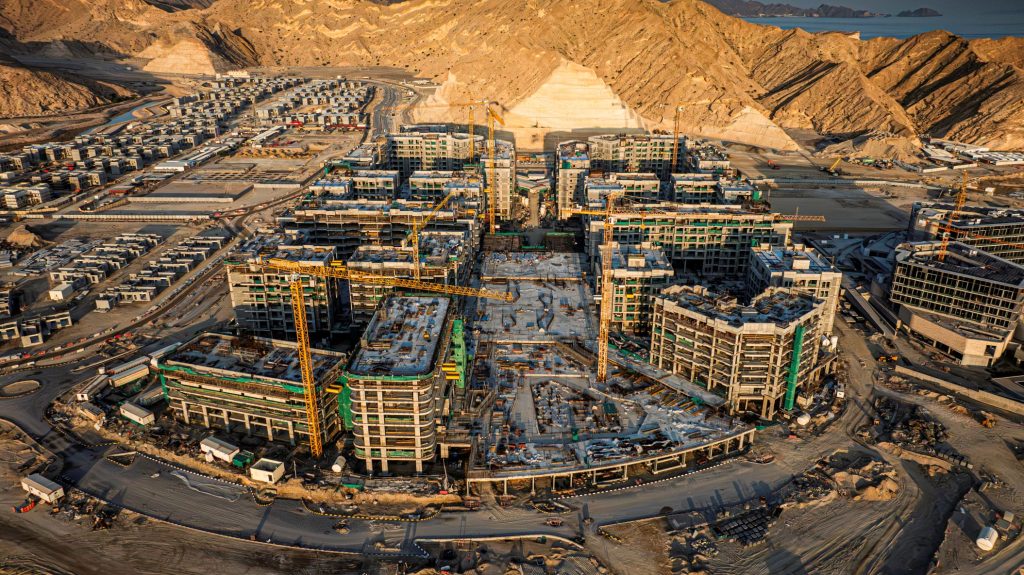
The Sustainable City – Yiti is an active but still developing coastal community in Muscat. It is not failed, cancelled or abandoned, but it is delayed against its original public completion target. The developer now gives December 2027 as the handover for The Plaza and describes the wider community as phased. Its renewable energy, water, waste, food and mobility figures are mainly design targets. Buyers should not treat them as proven operating results today.
The Sustainable City – Yiti at a glance
| Topic | Independent summary |
|---|---|
| Current status | Active, developing and delayed against the original public programme. |
| Failure status | Not failed, cancelled or abandoned. Construction and sales activity continue. |
| Location | Yiti coast in Muscat Governorate, within a wider tourism-development area. |
| Project boundary | One development of about one million square metres; it is not the whole Yiti area and is not AIDA. |
| Main neighbourhoods | Sustainable District, The Plaza and The Arc within one master plan. |
| Original schedule | Launch material said completion in 2025. Later updates moved full operation to 2026. |
| Current schedule | The current project site gives December 2027 for The Plaza handover and says delivery is phased. |
| Foreign ownership | Possible in an approved ITC unit, but exact-unit title and registration must be verified. |
| Residence | Property-owner residence and ten-year Golden Residency are separate application routes. |
| Work and business | Property and residence do not by themselves authorise work, freelancing or business operation. |
What is The Sustainable City – Yiti?
The Sustainable City – Yiti is a planned residential, tourism and mixed-use community on the coast south-east of central Muscat. OMRAN Group presents it as a partnership with Diamond Developers. The current project website says Diamond Developers develops the project under SEE Holding with OMRAN, Oman’s national tourism developer.
The idea is to combine homes, shops, education, health, hotels, sport and green areas with systems for renewable energy, water recycling, waste recovery and lower-carbon travel. This is an important concept, but concept and operation are different. A design target tells us what the developer plans. It does not prove that every system is complete, independently measured or available to every resident.
The project is real and construction is visible. Official updates show that infrastructure, villas and The Plaza were under construction. The present project site reports more than 25 million safe work hours and continuing sales. This supports an active development, not an abandoned one. However, the same site now refers to a December 2027 handover. Buyers must therefore treat the community as developing, with construction, delivery and community-maturity risk.
Yiti, this project and AIDA are not the same
“Yiti” can mean the older coastal settlement, the wider Yiti tourism area or a specific property project. These meanings should not be mixed. The Sustainable City – Yiti covers about one million square metres according to current developer material. The wider Yiti plan is much larger.
AIDA is another large project in the wider Yiti area. It has different partners, development phases, brands and contracts. A golf course, hotel or home promoted for AIDA is not automatically part of The Sustainable City – Yiti. In the same way, a facility shown on The Sustainable City master plan should not be presented as an AIDA facility.
Partnership and changing timetable
Diamond Developers and OMRAN announced the project as a joint development. SEE Holding is the wider group behind Diamond Developers and the Sustainable City model. OMRAN is the government-owned tourism development partner. This role structure matters because a brand, land partner, developer, contractor and unit seller may not be the same legal entity.
The public timetable has changed. The original launch announcement said the project was planned for completion in 2025. A September 2024 developer update said it was on track to become fully operational in 2026. A December 2024 construction update repeated the 2026 goal. The current project website now gives December 2027 for The Plaza handover and says communities are phased around it.
This is clear evidence of delay or schedule movement. It does not prove that every unit will be delivered in December 2027. The date may apply to one neighbourhood or sales release. The signed sale and purchase agreement, approved construction programme, grace period and handover conditions control the buyer’s position. Marketing dates are not a replacement for contract rights.
Sustainability: targets, evidence and present stage
The current project site says the community aims to reach net zero by 2040. It describes renewable energy designed to cover up to 100% of the city’s own demand, full wastewater recycling and reuse, full waste diversion from landfill and electric mobility. Earlier SEE Holding material also described a 78% reduction in per-person carbon emissions against conventional housing in Oman and an 80% food self-sufficiency target.
These are ambitious project commitments. They should not be written as completed results while homes, infrastructure and facilities are still being built. The project website itself says some figures describe the wider Sustainable City model and that Yiti-specific figures will be confirmed by the developer. Independent operating data for a mature Yiti community was not found during this review.
| Topic | Public project claim | How to read it today |
|---|---|---|
| Net zero | Target year 2040 | Future target, not present certification |
| Renewable electricity | Designed for up to 100% of own demand | Design goal; ask for unit and common-area metering |
| Water | 100% wastewater treatment and reuse for irrigation | Planned operating system; request commissioning evidence |
| Waste | 100% diversion from landfill | Operational target depending on sorting and recovery systems |
| Food | On-site farming and earlier 80% self-sufficiency target | Target; definition and measured output need proof |
| Mobility | Electric vehicles, charging and walkable routes | Planned network; access and operating rules may change |
| Emissions | Earlier 78% per-person reduction target | Modelled comparison, not an audited result for current residents |
“Zero service fees” and “up to 100% electricity savings” also appear on the current sales site for certain Sustainable District villas. These statements can have limits, exclusions and future review conditions. They may not cover private maintenance, insurance, cooling, water, internet, repairs, replacement reserves, clubs or every shared facility. Only the exact signed contract, community rules and current fee schedule can show what one owner must pay.
Neighbourhoods and facilities: built, developing or planned?
The current site groups the master plan into three neighbourhoods: Sustainable District, The Plaza and The Arc. It says the Sustainable District has more than 300 villas. The Plaza is described as a mixed-use area with more than 1,000 apartments and about 70 retail and dining outlets. The Arc is a later waterfront part with 132 branded residences in three collections.
These numbers describe the planned or marketed programme. They do not show how many homes have completed title deeds, passed inspection or are occupied. A buyer should request a completion certificate and current site evidence for the exact building or villa. “Sold out” means units were reserved or sold; it does not mean they were delivered or that all buyers completed.
| Component | Current classification | Evidence needed before reliance |
|---|---|---|
| Core roads and infrastructure | Advanced construction reported; final operation still project-specific | Authority acceptance and utility connection |
| Sustainable District villas | Under development | Exact-unit completion, defects and handover record |
| The Plaza | Under development; current site gives December 2027 handover | Building-specific programme and contract |
| The Arc | Newer development and sales phase | Licence, construction programme and unit registration |
| School and nursery | Construction reportedly started in September 2024; operation not proved | Operator, licence and opening notice |
| Four-star hotel and wellness centre | Contracts awarded in 2024; not shown as operating | Completion and opening announcement |
| Five-star resort | Planned | Final operator, construction and opening |
| SEE Lab, autism centre, equestrian and sports facilities | Planned or developing | Current completion and operating evidence |
| Retail and dining | Large future programme | Named tenants and opening dates |
| Solar, water, waste and farming systems | Part of design and construction programme | Commissioning, capacity and measured performance |
In December 2024, SEE Holding reported infrastructure at 96%, The Plaza building at 31% and villas at 33%. Those figures are useful dated evidence, not current 2026 completion figures. They should not be carried forward as if they describe today. The current site confirms continuing development but does not publish a complete, audited, building-by-building progress table.
Possible advantages and practical limits
| Possible advantage | Related limit |
|---|---|
| Coastal setting with mountain views | Construction, road access and distance from existing city services |
| Walkable mixed-use plan | Daily convenience depends on shops, school and health services opening |
| Solar, water and waste design | Performance and savings are not yet proven for a mature Yiti operation |
| Homes, hotels, retail and community facilities in one plan | Many facilities remain planned or developing |
| Recognised partners and an existing Sustainable City model | Experience elsewhere does not guarantee Yiti timing or unit quality |
| New homes and public areas | Defects, landscaping maturity, dust, noise and changing routes are normal early risks |
| Foreign-buyer ITC framework | Approval belongs to the exact unit and transaction, not the area name alone |
A full-time resident should test the drive to work, school, hospital, supermarket, airport and family. Travel times in brochures are usually based on light traffic and an unspecified starting point. Yiti may feel peaceful, but peace can also mean fewer nearby services during early years.
A coastal property also needs careful maintenance. Salt, humidity, sun and wind can affect façades, metal, glass seals, cooling equipment and outdoor furniture. Ask who maintains common systems, how reserves are funded and what happens if energy or water equipment needs replacement.
Resale and rental depth are uncertain in a young community. A future seller may compete with new developer releases and payment plans. Do not use a launch price, modelled saving or expected visitor number as proof of future value. This article gives no fixed price, yield, appreciation forecast or investment guarantee.
Can a foreign buyer own a home here?
Oman’s official title-transfer service says foreign nationals may buy property in Integrated Tourism Complexes. The Sustainable City – Yiti is publicly presented within an ITC development. This supports foreign ownership in principle, but it does not approve every plot, phase, apartment or villa.
Read the Oman Verified guide to buying property in Oman, then check the exact unit. Ask for the approved project and phase, developer and seller entity, land and unit number, preliminary registration or title route, cadastral plan, project licence, sales permission, payment-account details and any mortgage or restriction. An independent Oman lawyer should review these documents before a non-refundable payment.
An off-plan reservation form is not a title deed. A brochure statement saying “international ownership” is also not enough. Parking, garden, roof, solar equipment, furniture, branded services and use of a marina or club may be owned, shared or licensed in different ways. The contract and registered plan must explain each right.
Property-owner residence and ten-year Golden Residency
Property-owner residence
Gov.om publishes a two-year residence service for an owner of a residential unit in an Integrated Tourism Complex. The service has current document and applicant conditions and requires approval. A qualifying completed Yiti unit may support this application, but a reservation, payment plan or marketing promise does not create residence automatically.
Ten-year Golden Residency
The property route to Oman Golden Residency is a different programme. Current official guidance describes a renewable ten-year route and a minimum qualifying investment of OMR 200,000. The real-estate route focuses on qualifying completed ITC property. The amount is an investment threshold, not the government application fee and not a guarantee of approval.
A buyer can estimate Golden Residency costs, but the legal test still depends on current rules, accepted investment value, completion, title and applicant documents. Do not assume that an unfinished unit, a deposit or the full contract price is accepted before official confirmation.
Residence does not give work or business permission
Important: Owning a Yiti home, holding its title deed, property-owner residence or Golden Residency does not by itself permit employment, freelancing, providing paid services, trading, operating rentals or running a business in Oman.
An operating founder normally needs a separately registered company with the correct business activities and any required labour, immigration, municipal, premises, tourism and sector approvals. Company registration alone does not guarantee work permission, residence approval, a bank account or operational readiness.
Gov.om’s work-visa service shows a separate employer and Ministry of Labour process. Anyone who plans to work, manage short stays or provide services should review how to register a company in Oman and then check the licences needed for the exact activity.
Off-plan contract and delivery checklist
- Write the exact project, neighbourhood, phase, plot, building, unit and parking details.
- Confirm that the seller named in the contract has authority to sell that unit.
- Verify ITC status and foreign-title eligibility for the exact unit.
- Obtain the project licence, sales permission and approved off-plan registration route.
- Check where instalments are paid and what protections apply to the project account.
- Compare the contract plan, area and specification with the sales material.
- Identify what is included: solar equipment, garden, parking, storage, furniture and branded privileges.
- Read the completion date, grace period, extension rights and delay remedies.
- Define handover conditions, inspection rights, defects period and correction timetable.
- Ask which roads, utilities, retail, school, health, hotel and leisure facilities must exist at handover.
- Request every service charge, reserve contribution, utility charge and private maintenance cost.
- Ask for the legal basis and limits of any “zero service fee” or energy-saving promise.
- Check assignment, resale, rental, short-stay and management restrictions.
- Keep ownership, property residence, Golden Residency and work permission as four separate checks.
- Use independent legal, technical and financial advice before a non-refundable payment.
Common mistakes
- Calling the whole Yiti coast The Sustainable City.
- Mixing this project with AIDA and its facilities.
- Presenting the 2025 or 2026 schedule as current.
- Calling sustainability targets achieved results.
- Assuming a sold-out phase is complete and occupied.
- Using a master-plan image as proof that a school, hotel or clinic is open.
- Believing “zero service fees” means zero ownership cost.
- Accepting an estimated electricity saving as a guarantee.
- Assuming ITC marketing proves title for every unit.
- Believing an off-plan contract automatically supports Golden Residency.
- Confusing residence with permission to work or operate a business.
Frequently asked questions
Is The Sustainable City – Yiti complete?
No. It is an active developing project. The current project site gives December 2027 for The Plaza handover and describes phased delivery.
Is the project failed or abandoned?
No. Current official material shows continuing construction, sales and project updates. It is delayed against the original public schedule, not abandoned.
Is The Sustainable City – Yiti the same as AIDA?
No. They are separate developments in the wider Yiti area, with different partners, phases and contracts.
Will the city use 100% renewable electricity?
The project is designed to target up to 100% of its own demand. This is a future design and operating target, not proof of present unit savings.
Are service fees really zero?
The current site makes this claim for Sustainable District villa owners. Buyers must read the exact contract, exclusions, duration and separate private or utility costs.
Can foreign nationals buy?
Foreign ownership is possible in approved ITC property, but the exact project phase, unit, title and transfer route must be verified.
Does an off-plan unit give property-owner residence?
Do not assume so. Current official applicant, completion, title and document rules must be checked for the exact case.
Can a Yiti home qualify for ten-year Golden Residency?
Possibly, when a completed ITC property and the investment meet current programme rules. A reservation or deposit is not enough by itself.
Can a resident work or run rentals from the property?
Not from ownership or residence alone. Work and commercial activity need their own company, activity, labour, immigration, tourism, municipal and other approvals as applicable.
Conclusion
The Sustainable City – Yiti has a clear coastal concept and experienced partners. It may suit people who value a newer community, walkability and lower-impact systems and who can accept construction and early-community risk. Its sustainability programme is a reason to investigate the project, not a reason to skip technical and legal checks.
The honest status is active, developing and delayed against the original public programme. Many homes and facilities are not yet proven as fully operating. Choose the exact unit first, then verify delivery, title, total costs, sustainability obligations and the separate residence or business route.
Official sources
- The Sustainable City – Yiti official project site
- OMRAN Group: The Sustainable City – Yiti
- SEE Holding: original project launch and 2025 programme
- SEE Holding: September 2024 progress update
- SEE Holding: December 2024 construction update
- SEE Holding: The Arc launch and sustainability commitments
- Gov.om: title deed based on sale contract
- Gov.om: residence visa for property owner
- Gov.om: work visa
- MOCIIP: Golden Residency guidance
- Oman Golden Residency official portal