
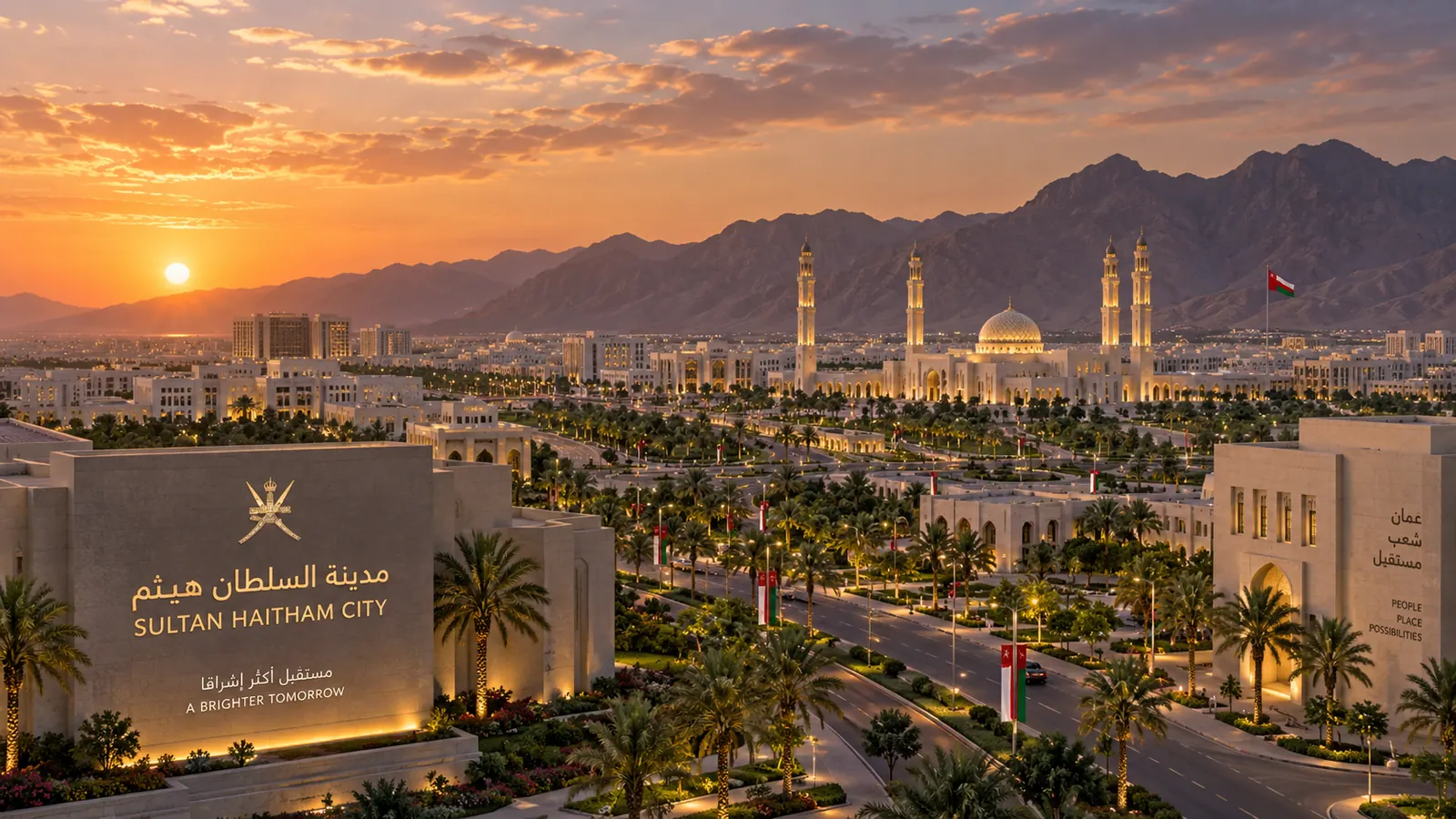
Sultan Haitham City is an active new urban development in Al Seeb, Muscat. It is under development, not a completed city. Some projects inside it are being sold, but the whole city is not one property project and it is not an Integrated Tourism Complex. A foreign buyer must confirm that the exact project, phase and unit can be registered in the buyer’s name. The clearest current public example is Hai Al Wafa, where the Ministry of Housing and Urban Planning expressly offers freehold ownership to Omanis and non-Omanis.
Sultan Haitham City at a glance
| Topic | Independent summary |
|---|---|
| Current status | Active and developing. Major roads, utilities, landscaping and neighbourhood works are in progress. |
| Completion status | Not complete or established. The city is a long master plan with different delivery programmes. |
| Failure status | Not failed, cancelled or abandoned. |
| Location | Wilayat of Al Seeb, Muscat Governorate. |
| Type | A new urban city with residential, commercial, public and cultural districts; not an ITC. |
| Foreign ownership | Possible in specifically approved projects and units. It must not be assumed across the whole city. |
| Strongest public evidence | The official Hai Al Wafa page expressly says freehold ownership is offered to Omanis and non-Omanis. |
| Current sales evidence | Oman News Agency reported sales launches for Sarooj Oasis and Hai Al Wafa Phase 2. Live inventory still needs written confirmation. |
| Residence | Ownership, property-owner residence and ten-year Golden Residency are separate questions. |
| Work and business | Property or residence does not by itself permit employment, freelancing or company operation. |
What is Sultan Haitham City?
Sultan Haitham City is a government-led future-city programme in the Wilayat of Al Seeb. The Ministry of Housing and Urban Planning presents it as a smart and sustainable city with homes, businesses, schools, healthcare, parks, cultural areas and public services. Oman News Agency has reported a master-plan area of about 14.8 million square metres, a planned population of 100,000 people, around 20,000 homes and about 2.9 million square metres of green space.
These numbers describe the intended finished city. They are not the number of homes built, occupied or for sale today. The city contains many separate neighbourhoods, developers, contracts and construction programmes. A buyer does not buy “Sultan Haitham City” as one legal product. The buyer purchases a named unit in a named project.
Status conclusion: Sultan Haitham City is active and developing. It is not failed or abandoned, but it is also not a completed city. Treat parks, schools, retail, public transport and other facilities as planned or developing unless dated evidence shows they are open.
Sultan Haitham City is not an ITC
This distinction matters. An Integrated Tourism Complex in Oman is a specific tourism-development category. It is not a general name for every project where a foreign person may buy. Sultan Haitham City is presented by the housing authority as an urban city, not as an ITC.
Foreign ownership may still be allowed under a specific project approval, title structure or government programme. But approval for one neighbourhood does not automatically cover the next neighbourhood. It also does not prove that every apartment, villa, commercial unit or future phase has the same legal status.
A buyer should ask for the official document that identifies the project, plot, phase and permitted buyer class. The sale and purchase agreement should match that document. A website sentence, agent message or city master plan is not enough.
Can foreigners buy property here?
Yes, in some approved projects and units, but not automatically across the whole city. The strongest current public statement is on the Ministry’s Hai Al Wafa page. It says the project offers freehold ownership to Omanis and non-Omanis. This supports foreign ownership in that project in principle.
The official Al Sarooj Oasis page uses different wording. It says ownership opportunities are available for citizens and residents. That does not clearly answer every case, such as a foreign buyer who is not already resident in Oman. The buyer should obtain written confirmation for the buyer’s nationality, residence status and exact unit.
| Project | Public position reviewed | Independent buyer conclusion |
|---|---|---|
| Hai Al Wafa | Official page expressly offers freehold to Omanis and non-Omanis; official Phase 2 sales launch reported. | Clearest foreign-buyer route. Exact unit, phase, title and live inventory still need confirmation. |
| Al Sarooj Oasis / Wahat Al Sarooj | Official sales launch reported; project page says ownership for citizens and residents. | Potential route, but the wording is not a blanket approval for every non-resident foreign buyer. |
| Jood | Large official project with a named developer and sales-centre address. | Developing project; foreign eligibility and live unit availability were not proved by the public page reviewed. |
| Wadi Zaha | Official neighbourhood page describes several home types. | Do not assume foreign ownership or current sale from the master-plan page alone. |
| Yenaier Residence | Official project page exists; an earlier official launch was announced. | Unit counts conflict across official dates. Current contract and approved schedule control. |
| Hai Al Nuha | Official project and earlier launch announcement exist. | Project numbers differ across official pages. Exact sale and foreign-title status require proof. |
| Al Ahlam | Official small villa neighbourhood is shown. | No blanket foreign-ownership or live-inventory conclusion from the page reviewed. |
| Retal project | A development agreement under the off-plan model was announced in May 2026. | Future/developing opportunity, not proof of units currently available to foreigners. |
This guide therefore focuses on Hai Al Wafa and Al Sarooj Oasis as the two most relevant current Sultan Haitham City options on the Oman Verified property-buying page. The other neighbourhoods give useful context, but they should not be turned into foreign-buyer listings without stronger unit-level evidence.
Hai Al Wafa
Hai Al Wafa is developed by Al Abrar Real Estate Company. The Ministry describes a site of more than one million square metres with about 1,800 homes. The planned mix includes standalone villas, attached villas, townhouses and apartments. A mosque, commercial area, green space and public school complex are also part of the plan.
Its main advantage for a foreign buyer is legal clarity at the public-information level: the official page expressly mentions freehold ownership for non-Omanis. This is more useful than a broker’s general statement about Sultan Haitham City. The official news agency also reported the launch of Phase 2 sales.
These facts do not confirm that a chosen unit remains available on 21 August 2026. They do not prove its current construction percentage, contractual handover, registration or residence eligibility. Request the phase plan, unit number, seller authority, project licence, permission to sell, preliminary registration and payment-account instructions before reserving.
Al Sarooj Oasis, also called Wahat Al Sarooj
Al Sarooj Oasis is a gated, park-centred development by Sarooj Development Company. Public material describes apartments and villas around a central park, with walking routes and mixed residential and commercial uses. Oman News Agency reported a sales launch for the neighbourhood.
Names can create confusion. Al Sarooj Oasis, Sarooj Oasis and Wahat Al Sarooj are English forms used for the same project. The contract must still show the official Arabic and English project name, plot and unit. Do not confuse this neighbourhood with another project that happens to use “Sarooj”.
There is also a public data conflict. The current Ministry page says more than 350 residential units, while the earlier official sales-launch report said 278 units. This may reflect a changed plan, a wider project count or different launch scope. It should not be silently corrected by an agent. Ask the developer for the current approved master plan and the schedule that applies to the exact phase.
The official ownership sentence refers to citizens and residents. A resident foreign buyer should still confirm title eligibility. A non-resident foreign buyer needs even clearer written confirmation. Never treat a marketing payment plan as proof of a registered foreign ownership right.
Other neighbourhoods buyers may see advertised
Jood, Wadi Zaha, Yenaier, Hai Al Nuha and Al Ahlam are real official neighbourhoods at different stages. Their pages describe homes, plans or sales-centre details, but do not prove that every product is open to foreign buyers. Counts can also change: the current Yenaier page gives 723 units while an earlier official announcement gave 339; Hai Al Nuha changed from 116 to 113 homes. Use the approved plan attached to the contract.
The Retal agreement announced in May 2026 is another sign that the city will continue to grow. It is an off-plan development agreement with a large investment value. It is not evidence that a specific Retal unit is already approved, advertised or available to a foreign buyer today.
What is real today and what remains a master-plan promise?
| Item | Current classification | Evidence to request |
|---|---|---|
| City-wide infrastructure | Active packages for roads, bridges, utilities, grading and landscaping | Dated site progress and permanent connection programme |
| Neighbourhood sales | Official launches exist for selected projects and phases | Current availability letter and seller authority |
| Homes | Different construction stages across projects | Building-specific progress, inspection and contract date |
| Central parks and landscaping | Core master-plan elements; some work contracted | Opening, maintenance and access evidence |
| Schools and healthcare | Planned across the city and in project descriptions | Named operator, licence and opening date |
| Retail and commercial areas | Planned or developing | Completed space, named tenants and trading status |
| Smart mobility and technology | City design objective | Operating system, service area and cost |
| Full city | Long-term developing master plan | Do not apply one neighbourhood date to the whole city |
The Ministry’s city page includes an execution path that speaks of Phase One completion in 2027. At the review date, 2027 is still in the future. The page’s wording should be read as a planned milestone, not proof that the phase is complete. Current infrastructure awards also show that significant work continues.
A completed apartment in one neighbourhood would not make the full city complete. Early residents may live near construction, temporary access and unfinished services. Ask which roads, utilities, shops, schools, parks and emergency services must be ready at the unit handover, and which may arrive later.
Possible advantages and practical limits
| Possible advantage | Related limit |
|---|---|
| Large planned city with public infrastructure | Long build period and changing neighbourhood schedules |
| Choice of apartments, townhouses and villas | Legal eligibility and delivery differ by project and unit |
| New parks, mobility and service planning | Many facilities are not yet operating |
| Government-led urban framework | Government involvement does not guarantee one developer’s handover or buyer return |
| Explicit non-Omani freehold wording at Hai Al Wafa | It must not be extended to the whole city |
| Potential long-term community growth | No guaranteed rent, resale speed or capital growth |
No dependable public source supports a fixed rental yield or appreciation forecast. A future seller may compete with later phases, developer incentives and new payment plans. Demand, finance, handover quality and community maturity can change. This article gives no price, rent, return or investment guarantee.
Off-plan sale, project licence and payment account
Many Sultan Haitham City products are off-plan or under construction. Gov.om’s real-estate development service shows that a project subject to off-plan sales needs a development licence. The listed process includes title or usufruct evidence, initial approval, maps, an off-plan contract, a consultant agreement, an implementation plan and an escrow-account step.
Payments should follow the official project-account instructions in the verified contract. Use the term “project escrow account” or “approved project account”. It is not safe to call it a government bank account. Check the account name, bank, project, payment trigger and receipt independently. Never pay a personal account or an unrelated brokerage account.
Ownership, property residence and Golden Residency are different
1. Exact-unit foreign ownership
This is the legal right to register the exact property for an eligible foreign buyer. It depends on the project approval, buyer class, phase, unit and registration. Hai Al Wafa has strong public wording, but the buyer still needs unit-level proof.
2. Property-owner residence
Gov.om publishes a property-owner residence service with its own documents and conditions. The familiar route has been linked to qualifying residential ownership in ITCs. Sultan Haitham City is not an ITC, so a buyer must not assume that an approved foreign-owned unit automatically creates this residence route. Obtain current written confirmation from the Royal Oman Police or the responsible authority for the exact property.
3. Ten-year Golden Residency
Oman Golden Residency through property investment is a separate programme. Current official guidance describes a renewable ten-year route with a minimum qualifying investment of OMR 200,000. The current property route focuses on qualifying completed real estate in ITCs. An off-plan Sultan Haitham City reservation, partial payment or marketing price is not proof of eligibility.
The threshold is an investment condition, not a visa fee. Completion, eligible property type, accepted value, payment, registration, applicant documents and authority approval matter. Never promise Golden Residency based only on a payment plan.
Residence does not permit work or business activity
Important: Property ownership in Sultan Haitham City, property-based residence or Golden Residency does not by itself permit employment, freelancing, providing paid services, trading, commercial rental operation or running a business in Oman.
An operating founder normally needs a separately registered company with the correct activities and any required labour, immigration, municipal, premises and sector approvals. Company registration alone does not guarantee a work permit, residence approval, bank account or operational readiness.
Gov.om shows a separate employer-led process for a work visa and Ministry of Labour permission. A buyer planning to manage rentals, work from Oman or trade should review company registration in Oman and then check the exact operating licences.
Foreign-buyer due-diligence checklist
- Write the official project, phase, plot, building and unit names.
- Confirm that the legal seller can sign for that unit.
- Obtain the development licence and current sales or advertising approval.
- Request the official foreign-ownership approval for the buyer class and exact unit.
- Identify whether the right is freehold, usufruct or another registered interest.
- Check title, cadastral plan, mortgages, restrictions and preliminary registration.
- Verify the approved project escrow or payment account independently.
- Match area, parking, garden, view, materials and specification to signed annexes.
- Read the contractual completion date, grace period and extension rights.
- Understand delay, suspension, cancellation and refund remedies.
- Link construction payments to verified progress where the contract allows.
- Define inspection, snagging, defects repair and final acceptance.
- Separate facilities required at handover from later city facilities.
- Request building, community, reserve, parking and utility charges.
- Check assignment, resale, NOC, transfer and rental restrictions.
- Visit the site and test real routes at useful times.
- Review drainage, heat, shading, construction access and emergency routes.
- Check ownership, residence, Golden Residency and work permission separately.
Who may find the city suitable?
Sultan Haitham City may suit a buyer who wants a new planned community, can wait for the area to mature and is comfortable checking an off-plan contract carefully. Hai Al Wafa may be relevant to a foreign buyer who wants clearer public ownership wording. Al Sarooj Oasis may suit a buyer interested in a smaller park-centred project, provided eligibility is confirmed in writing.
It may be less suitable for a buyer who needs immediate residence certainty, a completed community, proven rental history, established public services or fast resale. A person whose main goal is the ten-year Golden Residency should first confirm the current qualifying-property rules. A completed approved ITC unit may fit that route more clearly than an off-plan home in a non-ITC city.
Common mistakes
- Calling the whole city an ITC.
- Assuming approval for Hai Al Wafa covers every neighbourhood.
- Confusing a sales launch with live inventory.
- Using a master-plan unit count as a completed-home count.
- Presenting planned parks, schools or retail as open.
- Using an old phase date without the current contract.
- Believing “freehold” marketing proves the exact title.
- Paying before checking the project licence and approved account.
- Calling a reservation or 30% payment a residence permit.
- Promising Golden Residency for an unfinished non-ITC unit.
- Assuming ownership or residence permits work or business activity.
- Quoting guaranteed yield, capital growth or resale speed.
Frequently asked questions
Is Sultan Haitham City complete?
No. It is active and under development. Infrastructure and neighbourhood projects are progressing, but the full city is not complete.
Is the city failed or abandoned?
No. Current official contracts and infrastructure packages show continuing development. The correct status is active and developing.
Is Sultan Haitham City an ITC?
No current official source reviewed classifies the city as an Integrated Tourism Complex. It is a future urban city with separate project approvals.
Can a foreign person buy in Sultan Haitham City?
In some approved projects and units. Hai Al Wafa expressly offers freehold to Omanis and non-Omanis. Other projects need exact written confirmation.
Are Hai Al Wafa homes available now?
An official Phase 2 sales launch was reported, but that does not prove today’s inventory. Ask for a dated availability list and exact-unit documents.
Is Wahat Al Sarooj different from Al Sarooj Oasis?
No. They are English forms used for the same Sultan Haitham City neighbourhood. The contract should show the official project and unit details.
Does buying a home give automatic residence?
No. Ownership and residence are separate. Sultan Haitham City is not an ITC, so confirm the live residence rule for the exact unit before buying.
Can an off-plan unit give ten-year Golden Residency?
Do not assume so. Current official property guidance focuses on qualifying completed ITC property and an accepted investment of at least OMR 200,000.
Does property ownership allow the owner to work?
No. Employment, freelancing and business operation need separate legal permissions. An operating founder normally needs a registered company and relevant approvals.
Are published handover dates guaranteed?
No. A marketing or project-page date is not a guarantee. The signed contract, grace period, extension rights and remedies control the buyer’s position.
Conclusion
Sultan Haitham City is a serious, active and long-term urban project. It offers more than one residential development, but foreign buyers should not treat the full city as one freehold zone. Hai Al Wafa currently provides the clearest official non-Omani ownership wording. Al Sarooj Oasis has official sales evidence but needs closer buyer and unit checks.
The right approach is simple: choose the exact unit first, then verify ownership, project licence, registration, payment account, construction, handover and costs. Review property residence, Golden Residency and work or business permissions as separate matters.
Official sources
- Ministry of Housing and Urban Planning: Sultan Haitham City
- Oman News Agency: Sultan Haitham City master-plan scale
- Ministry of Housing and Urban Planning: Hai Al Wafa
- Ministry of Housing and Urban Planning: Al Sarooj Oasis
- Oman News Agency: neighbourhood and sales launches
- Ministry of Housing and Urban Planning: Jood
- Ministry of Housing and Urban Planning: Wadi Zaha
- Ministry of Housing and Urban Planning: Yenaier Residence
- Ministry of Housing and Urban Planning: Hai Al Nuha
- Ministry of Housing and Urban Planning: Retal development agreement
- Ministry of Housing and Urban Planning: 2026 infrastructure agreements
- Gov.om: real-estate development project licence
- Gov.om: permit to advertise local property
- Gov.om: title deed based on sale contract
- Gov.om: property-owner residence visa
- Gov.om: work visa
- Oman Golden Residency official portal
- Invest Oman: ten-year Golden Residency update