
Last reviewed: 9 September 2026
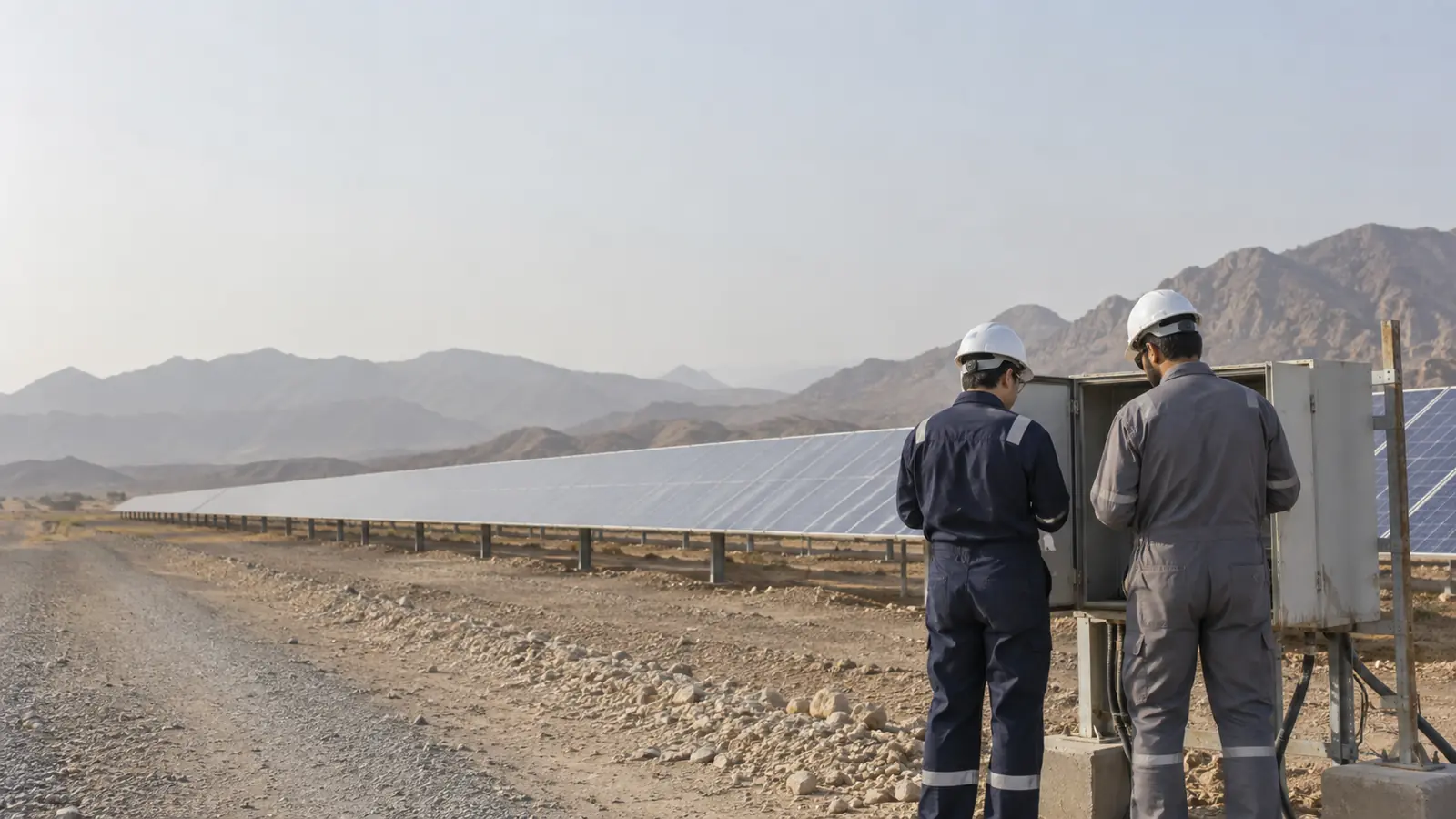
Chinese companies in Oman are active in oil and gas, electricity transmission, cement, solar and wind power, major EPC contracts, airport technology, space applications, shipping and vehicle distribution. The depth of presence varies sharply. Some groups own shares in Omani assets; some own part of a project company; others are contractors, technology vendors or brands represented by Omani distributors.
There is no reliable public registry showing the total number of Chinese companies operating in Oman. The Chinese Enterprises Association in Oman is active, but a current, public and verifiable membership count was not found. This article therefore maps named company–project relationships rather than inventing a headline company count.
Classification matters: ownership, project development, EPC delivery, technology supply, distributor-led sales and an MOU are different forms of presence. They should not all be labelled “Chinese FDI.”
A map of visible Chinese activity in Oman
| Chinese-linked actor | Oman activity | Role | Status at review date |
|---|---|---|---|
| CNPC / Daleel Petroleum | Block 5 production and Block 15 exploration | Asset partner and operator | Block 5 operating; Block 15 exploration programme follows 2024 agreement |
| State Grid International | Oman Electricity Transmission Company | 49% shareholder | Operating investment |
| Huaxin Building Materials | Oman Cement | Approximately 65% controlling shareholder | Operating investment |
| Jinko Power | Manah II, 500 MW solar IPP | Project-company shareholder with Sembcorp | Commercial operation from May 2025 |
| POWERCHINA | Ibri II, 607 MWp solar plant | EPC contractor | Operating plant |
| Shanxi Installation | Al-Kamil 1, 500 MW solar project | EPC plus about 2.5 years of O&M | Contract awarded in 2026 |
| POWERCHINA subsidiary | Riyah, 200 MW wind project for PDO | EPC contractor | Under construction |
| SEPCOIII | Misfah, approximately 1,700 MW CCGT | EPC contractor | Contract announced in August 2026 |
| Huawei | Wi-Fi 7 and smart airport network across four airports | Enterprise technology supplier | Delivered and operating |
| ADA Space | Oman Lens-1 satellite, ground capability and training | Space-technology partner | Satellite launched in 2024; operational programme |
| COSCO Shipping | Shipping services and Sohar route | Carrier and logistics network | Route and Oman presence confirmed |
| Chinese vehicle brands | Passenger and commercial vehicle sales | Mostly Omani distributor-led | Active and growing, but generally not local manufacturing |
1. Chinese ownership in Omani assets
CNPC and Daleel Petroleum
Daleel Petroleum’s published history describes a 50:50 ownership structure between Mazoon Petrogas and a subsidiary of China National Petroleum Corporation. Daleel operates Block 5 and reports production above 50,000 barrels per day. In September 2024, Oman’s Ministry of Energy and Minerals signed an exploration and production sharing agreement covering Block 15 with Daleel Petroleum, extending the relationship into another upstream area.
This is a long-duration operating presence with asset, subsurface, workforce and supply-chain exposure. It is different from a Chinese contractor arriving only for a construction package.
State Grid International and OETC
State Grid International acquired 49% of Oman Electricity Transmission Company in a transaction announced in 2019 at approximately US$1 billion. OETC materials continue to identify the ownership structure. This is a clear example of Chinese infrastructure investment through equity ownership in an operating national network company.
Huaxin Building Materials and Oman Cement
Huaxin Building Materials became the controlling shareholder of Oman Cement, with company reporting indicating ownership of about 65%. The transaction represents acquisition-led entry into an existing Omani industrial business rather than a greenfield announcement. It also places a Chinese industrial group inside Oman’s building-materials value chain.
Jinko Power and Manah II
Nama Power and Water Procurement lists Jinko Power and Sembcorp as shareholders in Manah II, a 500 MW solar independent power project. The project’s commercial operation date is recorded as 1 May 2025. It is an example of Chinese participation in project ownership—not only module supply or EPC delivery. Public material reviewed for this article does not justify inventing an exact shareholder percentage.
2. Chinese EPC and O&M activity
Chinese engineering groups have built or won major power packages in Oman. These contracts demonstrate delivery capability and create demand for subcontracting, commissioning, maintenance, parts and training. They are not automatically equivalent to equity investment.
- Ibri II: POWERCHINA describes its EPC role in the 607 MWp solar project, which entered operation in 2021.
- Al-Kamil 1: Shanxi Installation won the EPC contract for the 500 MW project in 2026, with reported contract value around US$222 million and approximately two and a half years of operation and maintenance.
- Riyah wind: a POWERCHINA subsidiary began construction activity on the 200 MW PDO wind project, extending Chinese delivery into utility-scale wind.
- Misfah CCGT: SEPCOIII announced an EPC contract in August 2026 for an approximately 1,700 MW combined-cycle gas turbine project. Chinese involvement in Oman’s power system is therefore not limited to renewables.
For a new Chinese supplier, the secondary opportunity may be more attractive than bidding for the entire plant: local test equipment, replacement inventory, field service, HSE support, workforce training, bilingual project controls and long-term reliability work.
3. Technology, space and logistics
Huawei at Oman Airports
Huawei’s enterprise case study describes deployment of Wi-Fi 7 and related smart-network capability at Muscat, Salalah, Sohar and Duqm airports. This is evidence of Chinese enterprise technology in an operating Omani environment. The recurring value is likely to sit in integration, cybersecurity coordination, monitoring, upgrades and local technical support rather than equipment delivery alone.
ADA Space and Oman Lens-1
Oman Lens-1 was launched in 2024 through cooperation involving China’s ADA Space. Published Chinese sources describe the satellite, ground capability and training. The commercial opportunity is not simply “space”: it is applying imagery and analytics to ports, coastal monitoring, agriculture, infrastructure, mining and environmental decisions, with Omani users able to operate and interpret the system.
COSCO and the Sohar route
COSCO materials confirm an Oman network presence, and a Sohar-related shipping route has operated since 2023. This supports the idea of a China–Oman logistics corridor, but sailing service alone does not prove that a new warehouse is viable. Cargo volume, customer concentration, dwell time, inventory turns and onward transport must still be tested.
4. Chinese automotive brands
Multiple Chinese vehicle brands are sold in Oman through local distributors, and market summaries show brands such as MG and Jetour gaining visibility. This is commercial presence, but generally not evidence of a Chinese-owned factory or direct distribution subsidiary.
The more durable local opportunity may be the ecosystem around the vehicles: parts availability, diagnostics, technician training, body and battery repair, fleet maintenance, residual-value data and charging support. The selected activity must be checked because some repair, agency or related activities may be restricted or separately licensed.
5. Duqm and the gap between announcement and execution
The China–Oman Industrial Park at Duqm was announced in 2016 over approximately 1,172 hectares, with an ambition exceeding US$10 billion. Some activity followed: Duqm’s archive records the Hongtong pipe factory as the park’s first operating factory in 2021, and a 32,000-square-metre building-materials market with reported investment of OMR 7.5 million opened in 2024.
However, delivery has been far below the original headline ambition. A 2026 independent satellite-based assessment found only limited development and treated the flagship refinery concept as paused or highly uncertain. This is an external assessment, not an official cancellation notice. The accurate label is therefore “paused/uncertain,” not “definitively cancelled.”
An AIIB learning review of the wider Duqm port commercial-terminal project reached a complementary lesson: infrastructure outputs were delivered, but cargo demand grew more slowly than forecast. For investors, the implication is direct—land and port capacity do not replace anchor cargo, tenants, feedstock, financing and customer contracts.
6. The solar and battery manufacturing pipeline
Oman’s emerging solar-materials and battery cluster contains projects at very different stages. Treating every announced capacity figure as operating production would materially overstate the sector.
| Project | Cautious status | What can be stated |
|---|---|---|
| United Solar polysilicon, Sohar, 100,000 tonnes/year | Operations started in January 2026; ramp-up continuing | A China-linked supply chain, with OIA, IFC and international capital; not accurately described as pure Chinese FDI |
| JA Solar, 6 GW cells and 3 GW modules | Announced/planned | Still described as planned in July 2026; verified commercial operation was not established |
| Drinda/JTPV, 5 GW cells | Uncertain / under reassessment | Company reporting cites tariff, trade and regional factors affecting evaluation |
| Q-SUN, proposed 10 GW programme | MOU / announcement | No current evidence reviewed here proves construction or production |
| Zhongke Electric anode materials, Sohar | Development-stage | Large two-phase plan reported; stage and committed capital require confirmation |
| Silicon-carbon anode project, Duqm | Contracted / pre-construction | Official Oman announcement states US$500m and a 2,000-tonne first phase targeting trials in Q2 2027; investor name was not disclosed |
This pipeline can create work for water treatment, process gases, testing, clean-room services, safety systems, industrial maintenance, logistics and workforce development. It also faces tariff, origin, technology-cycle, energy, water and offtake risks. A factory should not be recommended merely because a capacity announcement exists.
How we label project status
| Label | Minimum meaning |
|---|---|
| Operating | Commercial activity or production is evidenced |
| Under construction | Physical work is evidenced, not only a ceremony |
| Contracted | A binding award or agreement is reported, but construction/operation may not have begun |
| Development-stage | Approvals, design, finance or site work remain in progress |
| MOU / announced | An intention exists; financing and execution are not proven |
| Paused / uncertain | Timing or viability is materially unresolved |
| Unverified | Evidence is insufficient or relies on one weak claim |
What does the current footprint reveal?
- Energy remains foundational, from crude supply and upstream production to power networks and generation.
- Chinese capability is accepted in large projects, but EPC awards do not necessarily create a permanent local service base.
- Acquisition can be a viable entry route, as the OETC and Oman Cement examples show.
- After-sales depth may lag product penetration, particularly around equipment and vehicles.
- Industrial announcements need stage verification, especially in Duqm and the solar-materials pipeline.
- Local execution is the recurring gap: technicians, parts, bilingual project coordination, compliance, procurement and customer support.
For the commercial numbers behind this footprint, use the China–Oman trade and FDI data review. For the strategic case, see the China–Oman business relationship overview. The ranked gaps are examined in Oman business opportunities for Chinese companies.
A company ready to establish a local vehicle should then use the separate Oman company registration guide for Chinese investors. That page covers China-side outbound-investment planning, documents, funding, banking and residence without duplicating this market map.
Sources
- Daleel Petroleum: company history and ownership
- Oman Ministry of Energy and Minerals: Block 15 agreement
- Reuters: State Grid acquisition of 49% of OETC
- OETC investor presentation
- Huaxin Building Materials annual report and Oman Cement company history
- Nama PWP: Manah II shareholders and commercial operation date
- POWERCHINA: Ibri II solar project
- Renewables Now: Al-Kamil 1 EPC and O&M award
- Utility Business MENA: Riyah wind construction
- SEPCOIII: Misfah CCGT EPC
- Huawei: Oman Airports network case study
- China National Radio: Oman Lens-1
- China SASAC: COSCO Sohar route
- Reuters: initial China–Oman Industrial Park plan
- SEZAD archive: Chinese projects in Duqm
- Tearline: independent 2026 Duqm assessment
- AIIB: Duqm Port project learning review
- United Solar: Sohar polysilicon operations and financing
- pv magazine: JA Solar project’s planned status
- Drinda annual report: overseas-project reassessment
- Foreign Ministry of Oman: Duqm agreements including silicon-carbon anode project
- Chinese Embassy in Oman: Chinese Enterprises Association activity
Status note: project status can change quickly. “Announced,” “contracted,” “under construction” and “operating” are not interchangeable. Verify the current position with the company, project owner, zone and competent authority before relying on it.