
Last reviewed: 9 September 2026
The most credible Oman opportunities for Chinese companies are not limited to another large factory. Near-term opportunities are strongest where existing trade and projects already create an operating problem: market-entry execution, industrial maintenance and parts, solar and battery services, specialised logistics, vehicle after-sales, water technology, industrial digital systems and fisheries value-chain support.
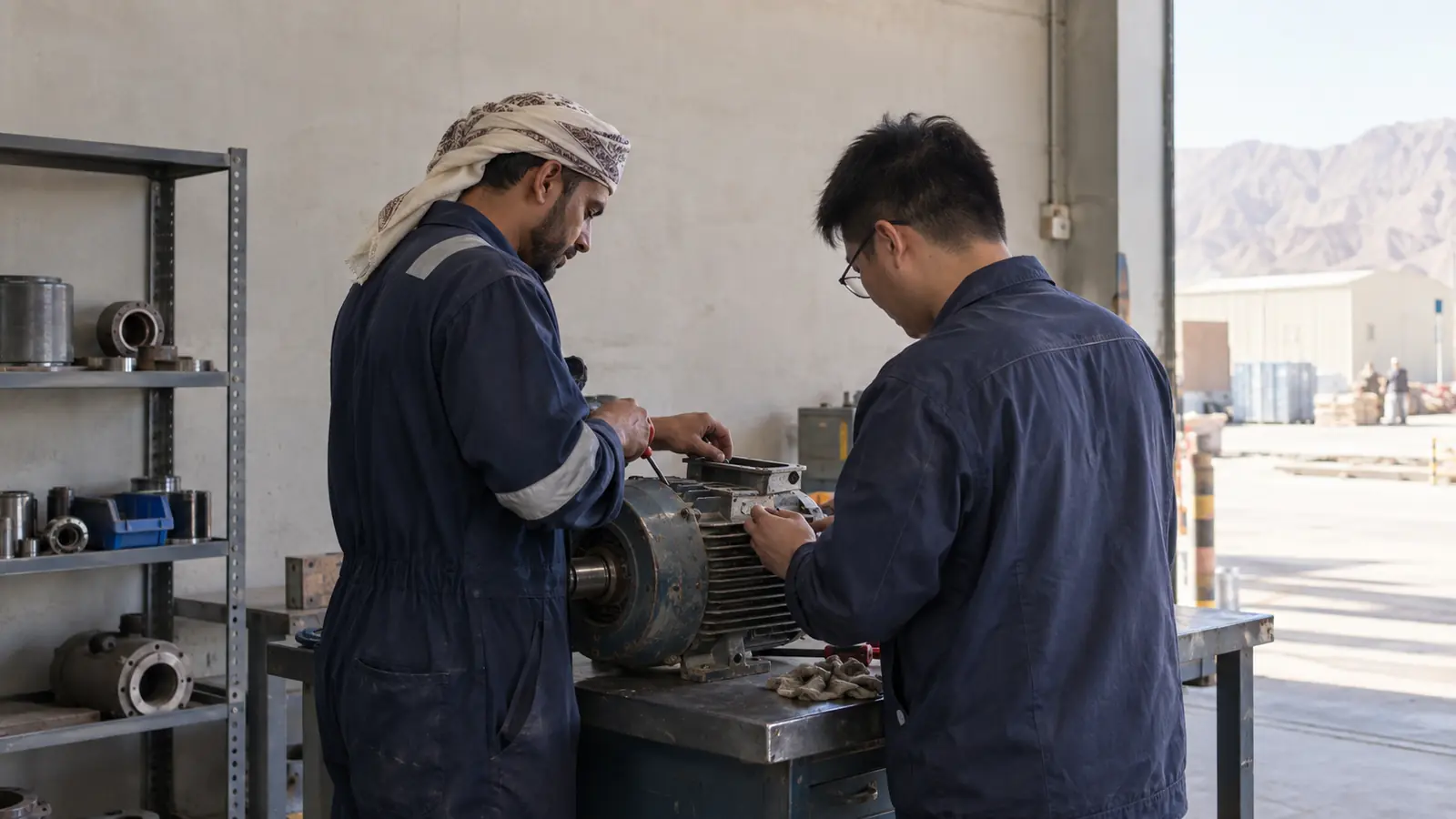
Capital-intensive manufacturing may also work, but only after customers, offtake, utilities, origin rules, financing, workforce and logistics have been proven. The rankings below are decision priorities based on available evidence—not forecasts of profit or guaranteed market size.
Best entry principle: begin with a paid problem and a reversible pilot. Registering a company, leasing a warehouse or announcing capacity should follow commercial validation, not substitute for it.
Ranked China–Oman opportunity map
| Rank | Opportunity | Indicative score /100 | Entry thesis |
|---|---|---|---|
| 1 | China–Oman market-entry and execution desk | 87 | Reduce friction in licensing, partners, tenders, language, ICV and operations |
| 2 | Industrial MRO, spare parts and technical training | 86 | Turn the installed base of Chinese equipment into recurring local service |
| 3 | Solar, BESS and grid-support services | 79 | Testing, EMS, safety, O&M, warranty, water and auxiliary systems |
| 4 | Demand-led B2B logistics and parts warehousing | 77 | Shorten lead times for machinery, power, vehicles and construction |
| 5 | Chinese-vehicle after-sales ecosystem | 74 | Parts, diagnostics, training, fleets, batteries and charging |
| 6 | Water and desalination technology and O&M | 73 | Membranes, pumps, energy recovery, monitoring and efficiency |
| 7 | Industrial digital and geospatial solutions | 70 | Ports, airports, grids, mines, remote sensing and predictive maintenance |
| 8 | Fisheries value chain for the China market | 68 | Cold chain, processing, compliance, branding and distribution |
| 9 | Prefab and industrial-tenant services | 65 | Site buildings, packaging, repair, waste and workforce services |
| 10 | Large PV/battery factory without committed buyers | 57 | Proceed only with offtake, utilities, finance and defensible origin |
1. China–Oman market-entry and execution support
Potential customers: Chinese OEMs, EPC contractors, manufacturers, investors, exporters and distributors that need to evaluate or operate in Oman.
What they may pay for: sector screening, activity-code and ownership checks, counterparty due diligence, location comparison, tender and ICV navigation, bilingual commercial coordination, workforce planning, operating setup and a transparent project-status dashboard.
The gap exists because the market is fragmented. There is no single reliable public register of every Chinese company and project, and companies must coordinate zones, ministries, banks, customers, suppliers and service providers. The model works only if it produces verified decisions and execution—not generic introductions or promises of influence.
2. Industrial MRO, spare parts and training
China exported about US$1.31 billion of machinery and US$896.9 million of electrical/electronic equipment to Oman in 2024. Chinese contractors and suppliers are visible in energy, utilities, construction and transport. The opportunity is to reduce downtime around that installed base.
- Critical-spares mapping and local stock
- Field inspection, repair and commissioning
- Warranty and failure-data management
- Remote diagnostics with on-site response
- Operator and technician training
- Lifecycle upgrades and obsolescence planning
Validation test: identify 20–50 installed units, calculate their annual downtime cost and obtain a service commitment from at least one asset owner. Do not lease a large workshop before the equipment population and willingness to pay are known.
3. Solar, battery storage and grid services
Chinese firms already participate in Omani solar and wind projects as developers, shareholders and contractors. In June 2026, Nama PWP began qualification for the 1,000 MW Adam Solar IPP with battery energy storage and a separate 500 MW Sinaw Solar project. This creates more than a module-sales opportunity.
- Battery commissioning, safety cases and thermal management
- Energy-management systems and grid integration
- Performance testing and independent quality inspection
- Cleaning-water optimisation and robotic maintenance
- Warranty administration and replacement logistics
- Long-term O&M, technician training and emergency response
- Auxiliary industrial inputs for cell, module, polysilicon or anode plants
Main risk: confusing announced manufacturing capacity with operating demand. Several solar and battery-material projects are planned, under reassessment or at memorandum stage. Build the service case around contracted plants, actual equipment and verifiable construction milestones.
4. Demand-led B2B logistics and parts warehousing
A specialised warehouse can shorten lead times for industrial equipment, grid components, vehicle parts and project consumables. It becomes attractive when the operator knows which SKUs customers need, their failure or replacement pattern, target service level and inventory turn.
| Location | Potential fit | Question that must be answered |
|---|---|---|
| Sohar | Northern Oman, UAE corridor, port-linked industry and manufacturing | Does the cargo/customer base justify local stock versus UAE fulfilment? |
| Muscat / mainland | Service teams, government and corporate customers, domestic distribution | Is port proximity less important than customer response time? |
| Duqm | Large industrial sites and Arabian Sea access outside Hormuz | Are anchor projects, cargo and tenants sufficient now? |
| Salalah | Transshipment, southern Oman, Indian Ocean and East Africa routes | Does the actual sailing and inland network fit the product? |
Red flag: a generic import warehouse filled before customer contracts. The pilot should begin with a small catalogue, named customers and measurable fill-rate and delivery-time targets.
5. Chinese-vehicle after-sales capability
Chinese passenger and commercial vehicle brands are increasingly visible in Oman, primarily through Omani distributors. As the fleet ages, the competitive issue shifts from initial price and features to parts, diagnostics, repairs, technician skill, software, batteries and resale confidence.
- Multi-brand diagnostic and technician training systems
- Fast-moving and collision-parts planning
- Fleet maintenance and uptime contracts
- EV battery health, safe repair and replacement
- Charging hardware maintenance and payment integration
- Used-vehicle inspection and residual-value data
Regulatory caution: vehicle agency, repair and related activity codes may be reserved, restricted or separately licensed. The operating model may require an Omani partner or an already licensed local provider. Check the exact activity before incorporation.
6. Water and desalination technology
Oman’s power and water procurement plan shows continuing demand growth and future water projects. A Chinese company does not need to own an entire independent water project to participate. Lower-capital routes include membranes, pumps, energy-recovery devices, leak detection, water-quality sensors, digital optimisation, spare parts and O&M.
Proof required: reference performance in comparable salinity and climate, local service response, lifecycle energy use, consumables cost and acceptance by the relevant project owner or operator.
7. Industrial digital and geospatial solutions
Huawei’s airport network deployment and the Oman Lens-1 programme show that Chinese technology can enter mission-critical and geospatial environments. Commercial propositions may include port visibility, asset monitoring, predictive maintenance, grid analytics, mine mapping, environmental surveillance and inspection.
The product must be adapted to Omani data, cybersecurity, hosting, procurement and operational requirements. Hardware without local integration, user training and ongoing support is unlikely to create durable value.
8. Fisheries value chain for Chinese buyers
Direct Omani fish exports to China have begun, and an official Oman source reported 23 Omani companies accredited for the market. The opportunity is broader than buying fish at the dock: quality systems, cold storage, traceability, processing, packaging, China-market compliance, branding and distribution can determine whether the trade is repeatable.
A larger aquaculture or recirculating system should be a later-stage option, after species economics, feed, water, environmental conditions, mortality, buyer commitment and local approvals have been established.
9. Processing minerals and serving industrial tenants
Oman has regulated exports of gypsum and chromite in ways that can encourage domestic processing. Potential projects include beneficiation, calcination and ferrochrome, while industrial zones also create needs for prefabricated structures, packaging, repair, waste handling and workforce services.
Policy pressure against raw exports is not itself a profitable business case. Feedstock volume and grade, electricity or gas price, environmental approval, logistics and a creditworthy buyer must support the economics.
10. Large manufacturing: when should it proceed?
Oman may suit solar-materials, battery-materials, chemicals, metals and other industrial manufacturing, especially where port access, energy, land or export routes create a genuine cost advantage. It is also the area where weak assumptions can destroy the most capital.
A large project should normally pass all of these gates:
- Bankable offtake or multiple validated buyers
- Confirmed feedstock, utility capacity and delivered cost
- Product-specific origin and trade-remedy analysis
- Environmental and technical feasibility
- Committed equity, debt and working capital
- Realistic construction, commissioning and ramp-up plan
- Omanisation, skills-transfer and local-procurement plan
- Downside case for prices, tariffs, shipping and technology change
Opportunity fit by Chinese company type
| Company type | Best first opportunities to test | Likely first entry mode |
|---|---|---|
| Industrial OEM | MRO, parts, training and project support | Qualified service partner or lean local service entity |
| Renewables / storage company | Commissioning, EMS, safety, O&M and warranty | Project partnership, service contract or subsidiary |
| Logistics provider | Contract-backed specialised inventory and fulfilment | Existing operator partnership before own facility |
| Automotive technology company | Diagnostics, battery, fleet and workshop systems | Licensed distributor/workshop partnership |
| Digital or geospatial company | Asset analytics, monitoring and system integration | Pilot with an Omani anchor customer |
| Food / fisheries group | Cold chain, compliance, processing and China distribution | Offtake and operating partnership |
| Manufacturer | Processing only where inputs and export economics are proven | Zone or mainland project after feasibility and offtake |
Go / no-go gates before entering Oman
Gate 1: Is there a named paying customer?
Proceed only when the need, buyer, procurement route, budget and decision timing are understood. General market growth is not enough.
Gate 2: Is the activity legally and operationally available?
Confirm the precise activity code, ownership position, sector regulator, premises, product approvals and staffing obligations before selecting an entity.
Gate 3: Do landed cost and working capital still work?
Include freight, duty, VAT cash timing, storage, warranty, local payroll, credit period, inventory obsolescence and collection risk.
Gate 4: Is the partner verifiable and governable?
Check ownership, licences, financial standing, references, conflicts, signing authority and termination rights. Avoid nominee or influence-based structures.
Gate 5: Can money move and banking be supported?
Align Chinese outbound-investment requirements, source of funds, Oman bank KYC, payment purpose, guarantees and expected transactions.
Gate 6: Is the pilot reversible?
Use a limited customer, product range, contract or service footprint with defined KPIs before committing major inventory, land or plant capital.
A 90-day entry-validation plan
| Period | Work | Decision evidence |
|---|---|---|
| Days 0–30 | Select up to three value chains; interview 15–20 buyers, operators, authorities and banks; map installed base and activity rules | Verified problem, customer profile and disqualifying constraints |
| Days 31–60 | Secure LOI or pilot pathway; model landed cost; compare locations; verify partner; test origin, tax, labour and licences | Transaction economics and execution route |
| Days 61–90 | Make go/no-go decision; structure the vehicle; prepare banking and staffing; execute a small pilot | Paid validation and measurable KPIs |
Where this fits in the China–Oman decision
Start with the China–Oman business relationship and strategic rationale, then use the trade and investment data to test the category. Review which Chinese companies and projects are already present before positioning the offer.
Only after the commercial case is credible should the company choose mainland, free zone, branch, subsidiary or partner-led entry. Our Oman economic-zone comparison for foreign investors explains location differences, while the China-to-Oman company setup guide covers outbound investment, documents, lawful funding, banking and residence.
For an independent first-pass decision, request an Oman opportunity and entry review. If the project needs specific counterparties, our counterparty and specialist introduction service can support a defined, evidence-based brief.
Sources
- Trading Economics / UN Comtrade: Chinese export categories to Oman
- Nama PWP: Adam Solar with BESS and Sinaw Solar qualification
- Nama PWP: 7-Year Statement 2026–2032
- Huawei: Oman Airports technology case
- Foreign Ministry of Oman: direct fish exports and accredited companies for China
- YallaMotor Oman: Chinese vehicle brands available in Oman and BestSellingCarsBlog: H1 2025 Oman market summary
- Ministerial Decision 18/2025: gypsum and chromite export controls
- Foreign Ministry of Oman: 2026 Duqm industrial agreements
- AIIB: Duqm Port project learning review
- Royal Decree 50/2019: Foreign Capital Investment Law
- Ministerial Decision 209/2020 and Ministerial Decision 435/2024: foreign-investment restricted activities
- OPAZ: special economic zones and free zones
- USTR: US–Oman Free Trade Agreement
Implementation note: the scores and priorities are a screening framework based on evidence available at the review date. A live project still requires customer validation and the relevant legal, tax, engineering, environmental, banking and investment-committee work, which Oman Verified can coordinate on the Oman side with the appropriate specialists and institutions.