
Last reviewed: 10 September 2026
The strongest opportunities in Oman for Indian companies are not simply the sectors named in the India–Oman CEPA. They are the intersections where India has proven supply or delivery capability, Oman has a specific demand or development gap, and the company can earn repeatable revenue after licensing, origin, logistics and workforce requirements are included.
The ranking below favours commercial evidence, speed to validation and a clear reason to operate locally. It separates export opportunities from reasons to establish an Oman company and from capital-intensive projects that may take years to become operational.
Decision rule: do not start with “Which free zone should we choose?” Start with the customer, transaction, compliance pathway and recurring reason for an Oman presence.
Opportunity ranking at a glance
| Rank | Opportunity | Best first model | Typical commitment | Main proof required |
|---|---|---|---|---|
| 1 | Engineering equipment, parts and industrial after-sales | Exporter plus qualified service/distribution partner | Low to medium | Installed base and paid service gap |
| 2 | Pharmaceuticals, medical products and health partnerships | Registered products plus local distributor or licensed partner | Medium | Approval pathway and procurement demand |
| 3 | Food, processed food, marine products and cold-chain | Importer/distributor, then demand-led local capability | Low to medium | Repeat buyers, compliance and spoilage economics |
| 4 | IT, engineering design and digital operations | Anchor-client delivery team | Low to medium | Contract, permitted activity and talent plan |
| 5 | Electronics, electrical systems and industrial controls | Product channel with integration and support | Low to medium | Exact category demand and differentiation |
| 6 | Chemicals, plastics and downstream industrial products | Export first; local storage or production only after volume | Medium to high | End users, safety, feedstock and environmental route |
| 7 | Specialised logistics, inventory and fulfilment | Contract-backed warehouse or 3PL partnership | Medium | Committed cargo and route economics |
| 8 | Green hydrogen, ammonia and project supply chain | Project supplier, consortium or developer | Medium to very high | Project milestone, finance and offtake |
| 9 | Mineral processing and low-carbon materials | Offtake-backed industrial project | High | Resource, permits, utilities, origin and buyer |
| 10 | Education, tourism and professional services | Licensed specialist partnership | Low to medium | Differentiated demand and recognition rules |
1. Engineering equipment, components and industrial after-sales
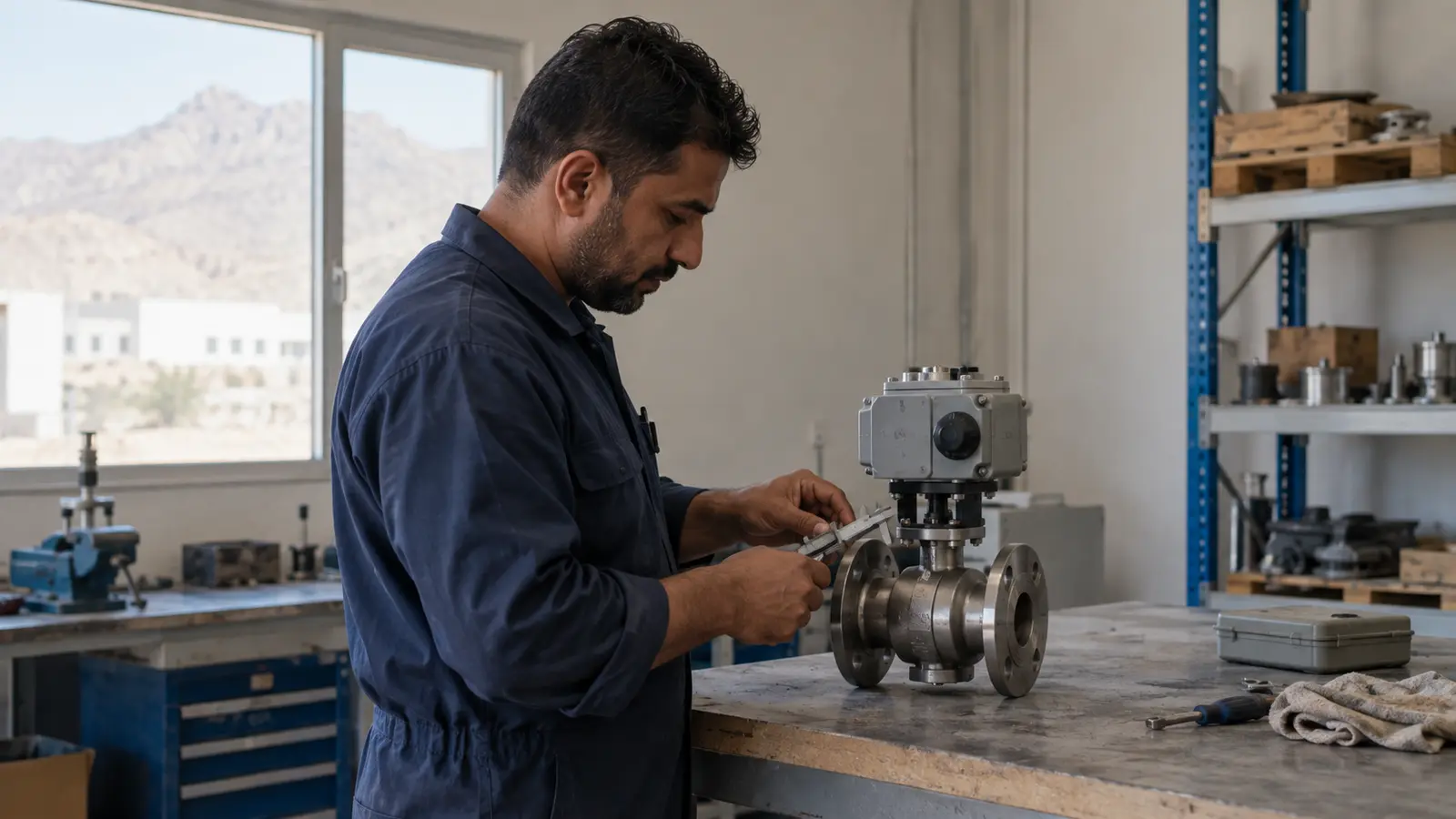
India exported US$875.83 million of engineering goods to Oman in FY 2024–25, according to the official CEPA backgrounder. The basket includes machinery, electrical equipment, automobiles, iron and steel and non-ferrous metals. CEPA gives qualifying engineering products zero-duty access, but the more defensible opportunity is often the service layer around products already in Oman.
- spare-parts availability and critical inventory;
- inspection, commissioning and maintenance;
- warranty coordination and failure analysis;
- operator and technician training;
- retrofit, automation and energy-efficiency upgrades;
- local fabrication or assembly where volume supports it.
Why it ranks first: demand can be tested through an installed-base map and customer interviews before major capital is committed. A manufacturer should identify equipment by model, age, owner, downtime cost and replacement cycle. If customers will not pay for local support, an Oman entity may not be justified.
2. Pharmaceuticals, medical products and health partnerships
India’s official analysis valued Oman’s pharmaceutical market at US$302.84 million in 2024 and described it as import-dependent. CEPA provides zero-duty access for specified finished medicines, vaccines and active pharmaceutical ingredients and introduces a faster marketing-authorisation route for eligible products approved by recognised stringent regulators.
The stated target is 90 days where a complete dossier qualifies without prior inspection and 270 working days where inspection is required. These are agreement pathways, not automatic approvals. Product registration, pricing, pharmacovigilance, storage, importer licensing, tender qualification and local health rules still determine execution.
Nearer-term models include a registered-product portfolio through a capable Oman distributor, hospital supply, diagnostics, medical technology, telehealth support, training and carefully structured healthcare partnerships. A full manufacturing plant requires a separate scale, utilities, quality and export-market case.
3. Food, processed food, marine products and cold-chain
Oman imported US$5.97 billion of agricultural products in 2024; India supplied US$556.34 million, or 10.24%, according to India’s CEPA backgrounder. India is already a major supplier of rice, bananas, potatoes, onions, biscuits, cashews, seasonings, butter, feed, meat and eggs. This is both a strength and a warning: many mainstream food channels are already competitive.
More attractive gaps may lie in branded or private-label processed food, institutional procurement, quality-controlled fresh supply, ingredients, packaging, temperature monitoring and reduced waste. Marine products are a more specific underpenetration signal: Oman imported US$118.91 million during 2022–24, while only US$7.75 million came from India.
Go/no-go gate: calculate the entire cold-chain and shelf-life path from Indian plant or port to the Oman buyer. Approved origin, halal or veterinary certificates, temperature integrity, rejected-load risk and retailer payment terms can be more important than a 5% tariff change.
4. IT, engineering design and digital operations
Indian services exports to Oman were US$665 million in 2024, and CEPA includes commitments across computer, professional, engineering, R&D and business services. TCS and Wipro show established IT-delivery models; Kaynes Semicon’s Muscat design centre shows a more specialised knowledge-intensive model.
- enterprise systems and managed operations;
- cybersecurity, cloud and data governance;
- industrial software, predictive maintenance and digital twins;
- engineering design and remote technical support;
- fintech and payment integration where regulated approval is obtained;
- semiconductor, embedded-systems and electronics design.
The best first step is an anchor contract, not an empty office. Confirm whether data must remain in Oman, whether the activity is regulated, which professionals need recognition and how the Omanisation plan changes the delivery model.
5. Electronics, electrical systems and industrial controls
Oman imported US$3 billion of electronics in 2024, while India supplied US$123 million. The official analysis identifies smartphones, photovoltaic cells, telecom instruments, control or distribution boards and static converters among important segments. Most electronics already entered at zero duty; CEPA therefore improves certainty for remaining lines but does not create a universal new price advantage.
The more defensible model combines product with local integration, testing, configuration, warranty and spare parts. Competing only on imported hardware is difficult where global and Chinese suppliers have scale. Product certification, telecom approval, cybersecurity, customer references and service response time should be tested category by category.
6. Chemicals, plastics and downstream industrial products
India’s CEPA analysis placed Oman’s 2024 chemical imports at US$3.13 billion and Indian supply at US$169.41 million. Oman’s plastics imports were US$1.06 billion, with US$89.39 million from India. These are large apparent gaps, but “chemicals” and “plastics” contain hundreds of different markets.
An Indian company should identify the exact molecule, resin, additive, finished component or industrial application; then map current suppliers, storage class, safety approvals, customer specifications and freight. Local production becomes credible only where Omani feedstock, energy, land or logistics creates a durable cost advantage and buyers will contract volume.
7. Specialised logistics, inventory and fulfilment
Oman’s ports can support India–Oman and selected regional flows. The opportunity is not “rent a warehouse because Oman is a gateway.” It is a defined service such as critical engineering spares, temperature-controlled food or pharma, project cargo, vendor-managed inventory, repair-and-return or fulfilment tied to actual customers.
A logistics model should be tested with shipment frequency, minimum volume, dwell time, customs status, inland distance, inventory financing, service-level penalties and the economics of competing routes through the UAE or direct shipment from India. A letter of intent from cargo owners is more valuable than a general port presentation.
8. Green hydrogen, ammonia and the project supply chain
ACME’s Duqm development gives Indian companies a visible position in Oman’s green-hydrogen ambitions. Reuters reported 2026 agreements for phases 2 and 3 with an estimated value of US$4.2 billion. India and Oman have also identified green hydrogen and green ammonia as strategic cooperation areas.
For most Indian companies, the realistic opportunity is not to become the project developer. It may be to supply engineering, electrolyser balance-of-plant, power electronics, water systems, storage, materials, safety, construction, digital monitoring, port services or maintenance. Suppliers must follow the project’s actual procurement stage and bankability.
Risk: announced capacity and project value can precede financial close, offtake, final investment decision and construction by years. Do not build fixed cost around a memorandum alone.
9. Mineral processing and low-carbon materials
Oman’s mineral resources and port-connected industrial sites can support selected processing or materials projects, while India offers engineering capacity and a large materials market. Green-steel and mining-related company announcements add strategic interest, but each resource has different quality, extraction, water, power, environmental and logistics economics.
A credible project requires independently tested resource data, secure mining or supply rights, a permitted process, utilities at the required specification, product qualification and long-term offtake. Repacking an imported Indian input in Oman does not create Omani origin; substantial transformation and the destination agreement’s origin rules must be checked.
10. Education, tourism and professional services
CEPA includes education, health, tourism and defined professional categories, while the large Indian community and regular business links create a natural customer base. Possible models include specialist training, executive education, medical or wellness travel coordination, hospitality partnerships, accounting or engineering support and India-focused travel products.
These sectors are often regulated and locally competitive. The business needs a differentiated curriculum, recognised qualification, licensed professional, contracted institutional client or clearly defined visitor segment. A generic consultancy, travel agency or training centre is not an opportunity merely because bilateral relations are strong.
Where should an Indian company base the activity?
| Operating requirement | Location type to examine | Do not decide before checking |
|---|---|---|
| Professional services and proximity to ministries or corporate clients | Muscat/mainland; Knowledge Oasis Muscat for relevant technology activities | Activity approval, client location, office need and staffing |
| Port-linked industry, metals, fabrication or northern-market logistics | Sohar area and industrial/free-zone options | Port tariff, utilities, land, mainland access and customer distance |
| Large land, energy, green-industry or export project | Duqm and other project-specific sites | Resource award, project milestone, utilities, offtake and construction schedule |
| Transshipment, cold-chain or southern trade routes | Salalah and nearby industrial/free-zone options | Sailing schedule, seasonality, cargo volume and inland cost |
| Food logistics, warehousing or domestic distribution | Mainland logistics locations such as Khazaen, depending on customers | Buyer routes, temperature needs, customs status and last-mile economics |
Review the wider Oman free-zone guide for foreign investors only after defining the operating requirement. Incentives vary by zone and activity, and the lowest headline tax or land cost may not produce the lowest delivered cost.
Which ideas should be treated cautiously?
- Generic trading: no advantage without exclusive supply, customer access, service or working-capital strength.
- Undifferentiated consumer retail or restaurants: visible India-linked demand also attracts heavy competition.
- Speculative warehousing: a port location is not enough without committed cargo.
- Assembly only to claim origin: simple repacking or minimal work may fail origin rules.
- Large factories for the Oman market alone: domestic demand may not support efficient scale.
- Projects based on an MOU: wait for procurement, finance and construction evidence.
- Services based only on CEPA mobility language: professional recognition, licensing and labour approvals still apply.
- Commodity gaps measured only in dollars: price movement can be mistaken for volume growth.
Best fit by Indian company type
| Indian company | Highest-fit opportunities | First commercial test |
|---|---|---|
| Engineering MSME | Components, MRO, industrial support and project supply | Ten customer interviews plus one paid pilot |
| Pharma or medical manufacturer | Selected registered products, diagnostics and institutional supply | Product-by-product regulatory and distributor assessment |
| Food producer or exporter | Processed food, institutional supply and selected marine products | Landed-cost and shelf-life pilot with a named importer |
| IT or design company | Managed services, industrial digital and specialist design | Anchor contract and workforce/compliance plan |
| Chemical or plastics producer | Exact industrial inputs or downstream products | Three end-user specifications and annual volume commitments |
| Logistics company | Specialised India–Oman inventory or cold-chain | Lane economics using committed monthly shipments |
| Large industrial group | Energy derivatives, materials, processing or infrastructure | Pre-feasibility with resource, offtake, utilities and finance |
A 90-day opportunity-validation plan
Days 0–30: narrow the thesis
- Choose one product, service or value-chain problem—not a broad sector.
- Identify the exact customer and current supplier.
- Check the HS code, CEPA category, origin rule or licensed activity.
- Interview buyers, regulators, distributors and project owners.
- Define why an Oman presence improves the transaction.
Days 31–60: prove the economics
- Obtain a pilot order, letter of intent or procurement qualification route.
- Model landed cost, tariff, inventory, payroll, rent, tax and receivables.
- Compare direct export, distributor, mainland and free-zone models.
- Check product approval, staffing, Omanisation, data and banking evidence.
- Set a minimum volume or gross-margin threshold for entry.
Days 61–90: structure a reversible pilot
- Select the smallest route that can lawfully deliver the transaction.
- Agree customer, partner and distributor responsibilities in writing.
- Prepare bank-source-of-funds and compliance documentation.
- Launch with limited stock, staff or capital.
- Measure repeat orders, service response, margin, receivables and customer retention.
The India–Oman trade data article provides the numerical base, and the Indian company and project map shows which models already exist. The broader rationale is in the India–Oman business relationship overview. Once a commercial case is proven, use the separate company registration guide for Indian investors.
Sources
- Embassy of India in Oman: current trade, investment, company and cooperation profile
- Press Information Bureau of India: CEPA sector data and services commitments
- Oman Customs: CEPA tariff schedules, exclusions, origin and documentation
- OPAZ: special economic zones, free zones and official zone information
- Larsen & Toubro: Sohar industrial-fabrication case
- Economic Times: Kaynes Semicon design-centre case
- Reuters: ACME Duqm agreement status and announced value
Ranking note: the order is an editorial assessment of commercial fit and verifiability, not an investment recommendation. A sector can move up or down materially once a specific customer, product and project are defined.