
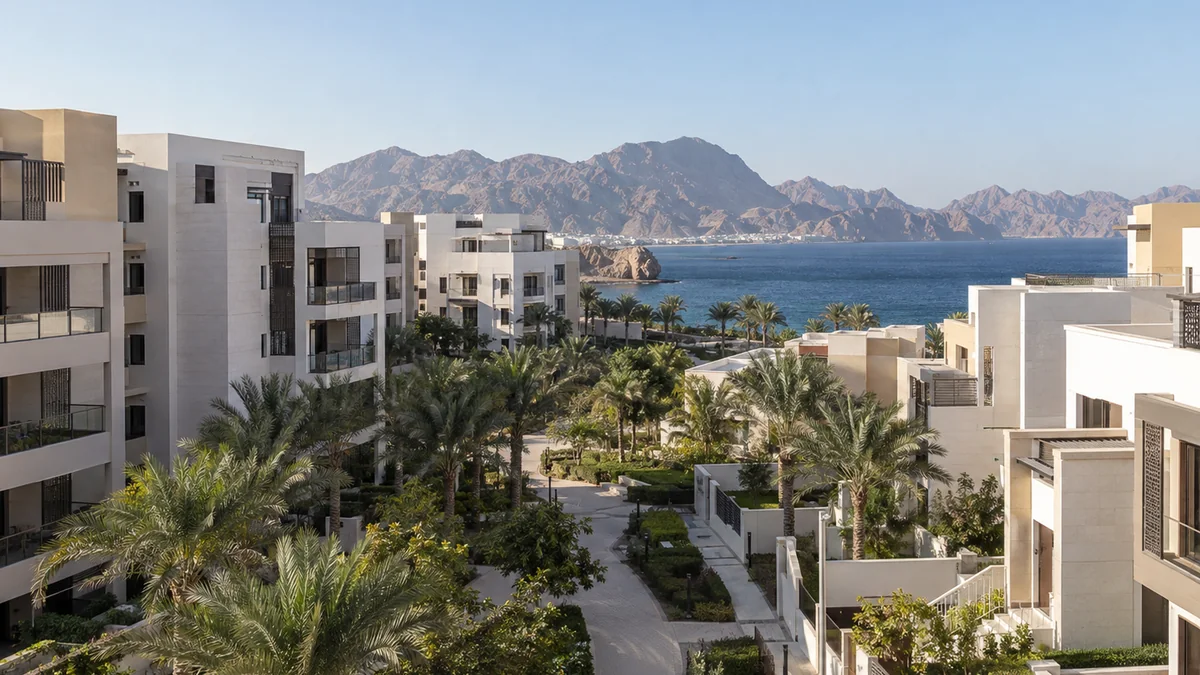
Foreigners can buy property in Oman, but there is no single nationwide rule that makes every property available to every foreign buyer. The correct question is not simply “Can foreigners buy in Oman?” It is: under which legal framework can this buyer acquire this exact unit or property right?
As of September 2026, the main foreign-buyer routes include Integrated Tourism Complexes (ITCs), designated investment zones in Future Cities and integrated residential projects, qualifying usufruct schemes, and approved real-estate development projects in Special Economic Zones or Free Zones. Separate restrictions still apply in strategic, agricultural and protected locations.
The practical rule
- ITC: the longest-established route for foreign freehold ownership.
- Future Cities / approved urban projects: foreign freehold can exist in designated investment zones or approved project phases; do not assume the whole city has one identical rule.
- Usufruct: a registered right to use and benefit from a property for a defined term; it is not the same as freehold ownership.
- Special Economic Zones / Free Zones: Royal Decree 38/2025 creates a separate framework under which approved real-estate development units may be sold freehold to non-Omanis, subject to the regulation and project approval.
- Restricted locations: Royal Decree 29/2018 still prohibits non-Omani ownership in specified strategic, agricultural and protected locations, subject to legal exceptions and special frameworks.
Foreign ownership is a framework question, not a marketing label
A development can be in Muscat, Salalah or another attractive location and still have a different legal position from the project next door. A brochure that says “freehold,” “international ownership,” “Golden Visa eligible” or “foreign investors welcome” is not enough on its own.
Before paying, identify four things separately:
- Buyer eligibility: can this nationality and buyer structure acquire the stated property right?
- Project eligibility: what approved legal framework applies to this project, phase and unit?
- Right being acquired: freehold, usufruct or another registered right?
- Registration evidence: what will be recorded in the official real-estate register and what document will evidence the right?
1. Integrated Tourism Complexes: the established foreign freehold route
Oman’s Integrated Tourism Complex ownership framework expressly allows Omani and non-Omani natural and legal persons to own land or constructed units inside licensed ITCs, subject to the applicable regulations and approved project rules.
Gov.om maintains a specific Ministry of Housing and Urban Planning service titled “Own Real Estate in Tourist Complexes.” The service covers title issuance and transaction registration.
Well-known ITC communities include developments such as Al Mouj Muscat, Muscat Bay, Jebel Sifah, Hawana Salalah and other licensed tourism complexes. However, even inside an ITC, the buyer should verify the exact unit, phase, title status, restrictions and project rules rather than relying only on the community name.
Important: an ITC is a legal development category, not simply a luxury-community label. Ask for the project’s approved status and confirm that the exact unit can be registered to the intended non-Omani buyer.
2. Future Cities and designated investment zones
Foreign ownership in Oman is no longer explained accurately by the sentence “foreigners can only buy in ITCs.” Ministry-led Future Cities and integrated residential developments have introduced additional approved routes.
The Ministry of Housing and Urban Planning’s Live Oman platform describes 100% freehold ownership with Mulkiya title in designated investment zones. The platform highlights major new-city developments including Sultan Haitham City, A’Thuraya City and Al Jabal Al Aali.
MoHUP also publishes a separate mechanism for non-Omanis in Future Cities and Sorouh integrated residential neighbourhoods. The safe interpretation is project-specific: do not assume that every parcel or every project inside a Future City is automatically foreign freehold.
For a detailed example, see the Sultan Haitham City property guide for foreign buyers.
3. Usufruct: long-term property rights outside normal freehold ownership
Usufruct is a real property right that allows the holder to use and benefit from a property for a defined period without owning the underlying freehold title in the same way as a freehold owner.
Ministerial Decision 357/2020 created a specific route for non-Omanis to acquire residential units under usufruct in designated multi-storey residential-commercial buildings. This is a regulated scheme with conditions; it is not a blanket right to buy any apartment outside an ITC.
| Decision 357/2020 point | Rule |
|---|---|
| Minimum age | Buyer must be at least 23. |
| Residence history | Buyer must have had residence in Oman for at least two years when applying under this scheme. |
| Number of units | One residential unit, individually or jointly with first-degree relatives. |
| Initial term | Usufruct may not exceed 50 years. |
| Maximum total term | Renewals may take the total term up to 99 years. |
| Foreign-unit quota | Up to 40% of residential units in the qualifying building, with nationality limits inside that allocation. |
| Registration | The usufruct right is acquired only through registration. |
| Financing | The registered usufruct may be mortgaged to finance the same property. |
| Inheritance | The registered right passes to heirs for the remaining term, subject to the applicable rules. |
A usufruct purchase therefore requires different due diligence from a freehold purchase. Check the exact remaining term, renewal rules, permitted transfer, project approval, resale restrictions and the right that will actually appear in the register.
4. Special Economic Zones and Free Zones
Royal Decree 38/2025 created a separate statutory framework for real-estate development projects in Oman’s Special Economic Zones and Free Zones.
Article 42 states that a real-estate developer may sell units in approved real-estate development projects to non-Omanis—natural or legal persons—as freehold, in the manner specified by the regulation. Article 40 also provides for residency for non-Omani investors and real-estate unit owners, their spouses and first-degree relatives, subject to the regulation and coordination with the Royal Oman Police.
The same law requires an escrow account for off-plan real-estate projects and a Preliminary Real Estate Register for off-plan units inside the zone framework. This does not mean that all Free Zone property is automatically foreign freehold; verify that the exact project is approved under that framework.
5. Where is foreign ownership restricted?
Royal Decree 29/2018 prohibits non-Omani ownership of land and real estate in specified locations, while preserving separate approved ownership systems.
- Dhofar Governorate except the Wilayat of Salalah;
- Musandam, Al Buraimi, Al Dhahirah and Al Wusta Governorates;
- the Wilayats of Liwa, Shinas and Masirah;
- Jabal Akhdar, Jabal Shams and other strategically identified mountains;
- islands;
- areas near palaces, security bodies and military sites identified by the competent authorities;
- specified archaeological and old quarters;
- agricultural-use land, subject to the law’s provisions.
A restricted governorate or strategic location does not mean that every lawful special project inside the wider geographic area should be analysed by geography alone. Always verify the project-specific legal basis.
Why does a Gov.om page say foreigners may only buy land in ITCs?
The general Gov.om service for issuing a title deed from a sale contract contains wording that foreign nationals are only allowed to purchase land within ITCs. That wording is useful for the scope of that general service, but it should not be read as a complete map of every newer project-specific foreign ownership route now operating in Oman.
For example, the Ministry’s own Future Cities material describes freehold ownership in designated investment zones, and Royal Decree 38/2025 expressly creates a freehold route for approved real-estate development units in Special Economic Zones and Free Zones.
Freehold, usufruct and leasehold are not interchangeable
| Right | What it generally means | What to verify |
|---|---|---|
| Freehold | Registered ownership under the applicable foreign-ownership framework. | Title, project eligibility, common-property share, restrictions and resale rules. |
| Usufruct | Registered right to use and benefit from property for a defined period. | Remaining term, renewal, transfer, mortgage, inheritance and expiry consequences. |
| Lease | Contractual right to occupy or use for the lease term. | Lease period, renewal, assignment, termination and landlord rights. |
When a salesperson uses the word “ownership,” ask which of these rights will be registered and what document will evidence it.
A foreign-buyer verification checklist
- Identify the legal route. ITC, designated Future City investment zone, usufruct scheme, SEZ/Free Zone project or another approved framework.
- Identify the exact unit. Project, phase, building, unit, plot and cadastral information must match.
- Confirm the buyer structure. Individual, co-buyers or legal entity.
- Confirm the property right. Freehold, usufruct or another registered right.
- Check the register. Understand what is registered now and what will be registered after completion.
- Check restrictions. Mortgage, seizure, project rules, nationality quotas, transfer restrictions or restricted location.
- Separate residency. Property ownership, Property Owner Residence and Golden Residency are separate questions.
Frequently asked questions
Can foreigners buy freehold property in Oman?
Yes, in approved legal frameworks. ITCs are the established route, while designated investment zones in new cities and approved projects in Special Economic Zones or Free Zones can also provide freehold routes. Verify the exact project and unit.
Can foreigners only buy in ITCs?
No. That statement is too broad. ITCs remain a major route, but newer project-specific frameworks include designated Future City investment zones, qualifying usufruct schemes and approved SEZ/Free Zone real-estate projects.
Is a 99-year usufruct the same as freehold?
No. A long usufruct can provide substantial rights, but it remains a time-limited registered right and should be analysed differently from permanent freehold ownership.
Does foreign ownership automatically give residence?
No. Ownership and immigration status are separate. See Oman Property Owner Visa and Residence after Decision 87/2026.
Official and primary reference points
- Gov.om — Own Real Estate in Tourist Complexes
- MoHUP — Real Estate Ownership Act in Integrated Tourism Complexes
- MoHUP Live Oman — designated investment zones and Future Cities
- MoHUP — Non-Omani ownership mechanism for Future Cities and Sorouh
- Ministerial Decision 357/2020 — residential usufruct scheme for non-Omanis
- Royal Decree 38/2025 — Law of Special Economic Zones and Free Zones
- Royal Decree 29/2018 — restricted locations for non-Omani ownership
Last reviewed: 12 September 2026. Foreign-buyer eligibility can be project-, phase-, unit- and buyer-specific. Confirm the current authority position and transaction documents before paying a reservation or signing an SPA.
Continue your Oman property research
Start with the full Oman property buying guide. Then compare freehold vs usufruct, how to verify a property project, and Property Owner Visa and Residence.