
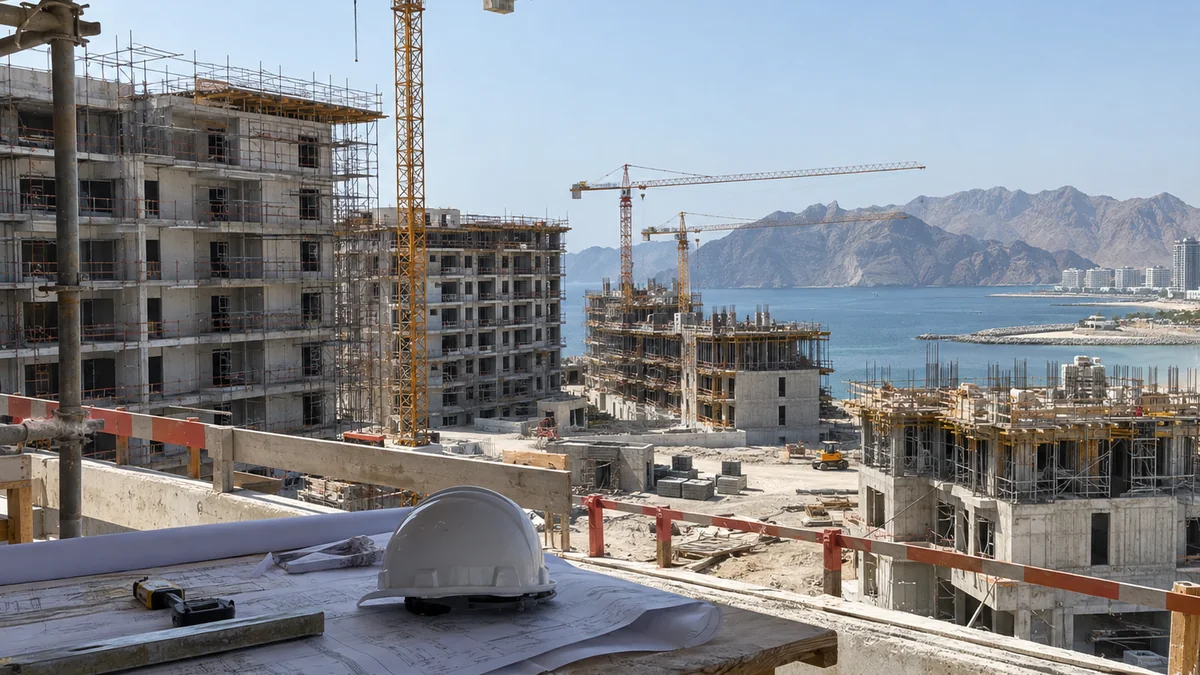
Oman’s off-plan property rules changed materially under Royal Decree 79/2025. The law now places the Preliminary Real Estate Register, an approved off-plan sale contract and a dedicated project escrow account at the centre of buyer protection.
An off-plan buyer should therefore verify more than the developer’s name and construction progress. The key legal questions are whether the project is licensed, whether the sale contract is the Ministry-approved off-plan contract, whether the unit and transaction are recorded in the Preliminary Real Estate Register, and whether payments go through the dedicated project escrow structure.
The five checks before paying
- Project licence: the project must be legally authorised for off-plan development and sale.
- Approved contract: the sale should use the Ministry-approved off-plan sale contract.
- Preliminary registration: the exact unit and transaction must be recorded in the Preliminary Real Estate Register.
- Escrow: verify the dedicated project escrow route before transferring buyer funds.
- Handover protection: read the completion, delay, termination, defect and final-registration provisions instead of relying on the brochure.
What is an off-plan property under Omani law?
Royal Decree 79/2025 defines an off-plan project as the sale of subdivided property units before they are constructed or before construction is complete. It also defines the off-plan sale contract as the Ministry-approved contract between the developer and buyer for a specific unit, with payment linked to construction progress or an agreed advance.
The Preliminary Real Estate Register is not optional
Article 21 creates the Preliminary Real Estate Register at the Real Estate Registry. Off-plan units, their descriptions and legal transactions affecting them are recorded there.
The law is unusually clear: a transaction affecting an off-plan unit is not recognised unless it is recorded in the Preliminary Real Estate Register.
This is why a reservation form, receipt or even a signed agreement should not be treated as the final legal protection if the transaction has not reached the registration stage required by law.
Only the approved off-plan sale contract should transfer the future unit
Article 25 states that, except for the off-plan sale contract approved by the Ministry, any contract or agreement whose purpose is to transfer ownership of a property unit to the buyer before the project is completed is void.
A buyer should therefore distinguish between a preliminary booking document and the legal off-plan sale contract. Ask exactly when the Ministry-approved SPA will be signed and registered.
How the project escrow account works
Royal Decree 79/2025 defines the escrow account as a bank account opened by the developer in the name of the off-plan project at a licensed bank in Oman. Buyer payments and project-finance amounts are deposited into that account and it is dedicated to building, implementing and managing the project.
- The developer must obtain Ministry approval before opening or closing the escrow account.
- The escrow agreement between the developer and licensed bank regulates account management and withdrawals.
- A copy of that escrow agreement must be deposited with the Ministry before the off-plan project licence is issued.
- Project lenders must deposit project construction financing directly into the escrow account where the land or registered usufruct is mortgaged for project finance.
- The bank provides periodic account statements and the developer must provide them to the Ministry.
Do not invent a fixed “5% escrow retention” from the law
Article 36 requires the developer to retain a percentage of unit sales value in the escrow account for one year after the unit is handed over, to support proper performance and repair of defects. The law leaves the percentage and release conditions to the Executive Regulation.
Until the applicable implementing rule is identified for the specific project, buyers should not assume that Royal Decree 79/2025 itself sets the retained percentage at 5%.
Escrow protects funds, but it does not guarantee an on-time handover
Escrow reduces the risk of buyer money being treated like ordinary developer cash, but it does not eliminate construction, approval, contractor, infrastructure or market delays.
Article 28 requires the project consultant to report a stalled off-plan project to the Ministry within 30 days, explaining the causes. The Ministry then studies the failure and can seek a solution to complete the project or refer the matter to the competent court.
What happens if the developer has other creditors?
Article 37 gives the project escrow account important protection. Money in the escrow account cannot be seized for the developer’s general creditors and the off-plan project does not fall into the developer’s general creditor pool in bankruptcy, except for obligations related to that project and buyer rights.
Ten-year liability for major construction and infrastructure defects
Article 18 states that the developer guarantees major defects in the construction or structure of the unit, and defects in project infrastructure, for ten years from handover, subject to the implementing rules and other applicable legal provisions.
This does not mean every cosmetic snag is automatically a ten-year claim. Buyers should distinguish structural or major infrastructure defects from ordinary snagging, finish defects and warranty issues.
What should be inside the SPA review?
- Exact unit, area, parking, storage and plan.
- Approved project and developer details.
- Payment milestones and escrow/payment instructions.
- Completion target and any grace period.
- Buyer and developer remedies for default.
- Specification, finishes and permitted substitutions.
- Assignment or resale before completion.
- Handover inspection and defect process.
- Final registration and transition from the Preliminary Register to the Real Estate Register.
- Service charges and owners-association obligations after handover.
How final registration happens
Article 22 requires the developer to transfer units registered in buyers’ names from the Preliminary Real Estate Register to the final Real Estate Register in accordance with the implementing rules. The developer may not charge buyers a fee merely for moving those registrations, apart from Ministry fees for registering the sale contract.
Off-plan and property-linked residence are separate questions
ROP Decision 87/2026 recognises property situations where registration is not yet complete, but a buyer should not treat every off-plan reservation as an automatic residence right. The immigration application still depends on the competent-authority certificate and legally recognised property status.
See the separate guide to Oman Property Owner Visa and Residence after Decision 87/2026.
Buyer checklist before transferring a deposit
- Confirm the developer’s current licence and project approval.
- Confirm the project is authorised for off-plan sale.
- Ask for the approved project payment/escrow route.
- Confirm when your exact unit and SPA will be entered in the Preliminary Real Estate Register.
- Do not rely on a marketing reservation document as a substitute for the approved off-plan contract.
- Read the delay, refund, default and termination provisions before accepting a non-refundable payment.
- Keep every payment receipt linked to the exact project and unit.
Official and primary sources
- Royal Decree 79/2025 — Law Regulating Real Estate
- Royal Decree 56/2026 — Real Estate Registry Law
- Gov.om — Real Estate Development Project Licence
Last reviewed: 12 September 2026. Off-plan protection depends on the project’s legal status, approved contract, preliminary registration and escrow structure—not only on developer reputation.