
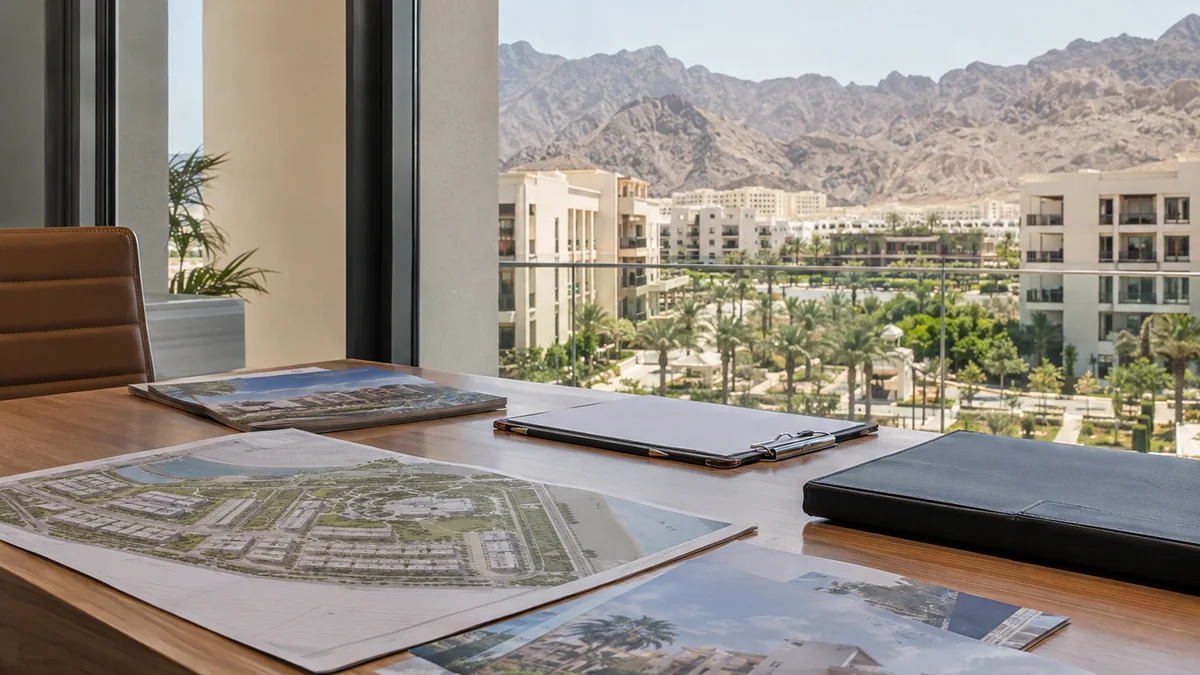
A legitimate-looking project brochure is not enough to justify a deposit. Before a foreign buyer pays for property in Oman, the project, developer, sales authority, payment route and exact unit should all be verified against the applicable Ministry framework.
For off-plan projects, Oman’s current real-estate framework makes this easier to structure: the developer should be licensed, the project should be registered, the off-plan project should have an approved legal basis, marketing should be authorised, and the project should use the required escrow structure.
Before paying, verify six things
- Who legally owns or controls the project land?
- Is the developer licensed for real-estate development?
- Is the project registered and approved for its current sales stage?
- If off-plan, is there a dedicated project escrow structure?
- Is the developer legally authorised to advertise and sell the project?
- Can the exact unit be sold and registered to this foreign buyer?
1. Verify the developer and the project separately
A developer may be a real company while a particular project, phase or sales campaign still requires separate approval. Do not stop at checking the company name.
Gov.om’s real-estate development project licence service requires core project documents including the title deed or usufruct contract, initial approval, maps, the off-plan sale contract, consultant agreement, implementation plan and land valuation.
2. Check whether the project is registered on Tatwir
Gov.om’s current advertising-permit service states that a local project must be registered on the Tatwir platform before the developer can obtain permission to advertise it.
A buyer may not always have direct access to every internal project record, but the developer should be able to provide clear evidence of the project’s current registration and approval status. If sales staff cannot explain the project’s Ministry registration or approved phase, treat that as a due-diligence issue.
3. Advertising permission matters
Under Royal Decree 79/2025, real-estate projects cannot simply be advertised or promoted without project-specific Ministry licensing. Gov.om’s current service says a developer may advertise or promote units only after receiving the relevant approval.
The service also requires evidence of project registration on Tatwir and the opening of a guarantee/escrow account with a licensed bank for the relevant off-plan framework.
4. Verify the escrow route before transferring money
For an off-plan purchase, ask for the official project payment instructions and verify that the beneficiary account matches the approved project structure. Royal Decree 79/2025 requires the escrow account to be opened in the name of the off-plan project at a licensed bank in Oman.
Do not redirect a deposit to a salesperson, unrelated company, personal account or different beneficiary merely because an informal message says it is faster.
5. Ask whether the exact unit is in the approved inventory
A project approval does not automatically prove the legal status of every advertised unit. Match the building, unit number, floor, area, parking, storage and plot information against the approved sale documents.
Gov.om’s advertising-permit requirements include a statement of the number of subdivided units and details such as location and area. That is a useful reminder that project-level approval and unit-level data should align.
6. Verify foreign-buyer eligibility separately
A project can be fully licensed and still have buyer-specific restrictions. Confirm whether the exact unit can be registered to the intended non-Omani buyer and under what right—freehold, usufruct or another approved framework.
Use the dedicated guide to where foreigners can buy property in Oman before treating the project’s marketing language as proof of ownership eligibility.
What documents should you request?
- Developer legal name and licence details.
- Project licence or registration evidence.
- Land title or registered usufruct basis.
- Approved project plans and unit schedule.
- Off-plan sale contract or SPA form.
- Project escrow/payment instructions.
- Current marketing or sales approval where relevant.
- Foreign-buyer eligibility evidence for the exact project/unit.
- Construction progress and consultant certification for an off-plan project.
Red flags before reservation
- “The approval is coming next week.”
- Pressure to pay before seeing the SPA.
- Payment to an account that does not match the project/developer documentation.
- Sales staff cannot identify the project licence or approved legal framework.
- The foreign-ownership argument depends only on a brochure or WhatsApp message.
- The exact unit is missing from the written project schedule.
- Residency is promised as automatic after a small reservation payment.
Completed property needs verification too
Project verification is not only for off-plan buyers. For a completed or resale unit, check the title deed, current registered owner, mortgage or seizure, outstanding service charges, permitted use, physical condition and any restrictions on transfer.
A finished building can reduce construction risk but it does not remove title, seller-authority or building-management risk.
A simple verification sequence
- Confirm buyer eligibility.
- Confirm developer and land/project basis.
- Confirm project licence and current sales stage.
- Confirm exact unit and approved documents.
- Confirm payment/escrow route.
- Review the SPA before accepting non-refundable terms.
- For off-plan, confirm preliminary registration after signing.
For the legal mechanics behind off-plan protection, read Buying Off-Plan Property in Oman: Escrow, Preliminary Registration and Buyer Protection.
Official reference points
- Gov.om — Get Real Estate Development Project License
- Gov.om — Permit to Advertise Local Properties
- Royal Decree 79/2025 — Law Regulating Real Estate
Last reviewed: 12 September 2026. Project status, sales authority and escrow arrangements can change by phase, so verify the current file rather than relying on an older brochure.