
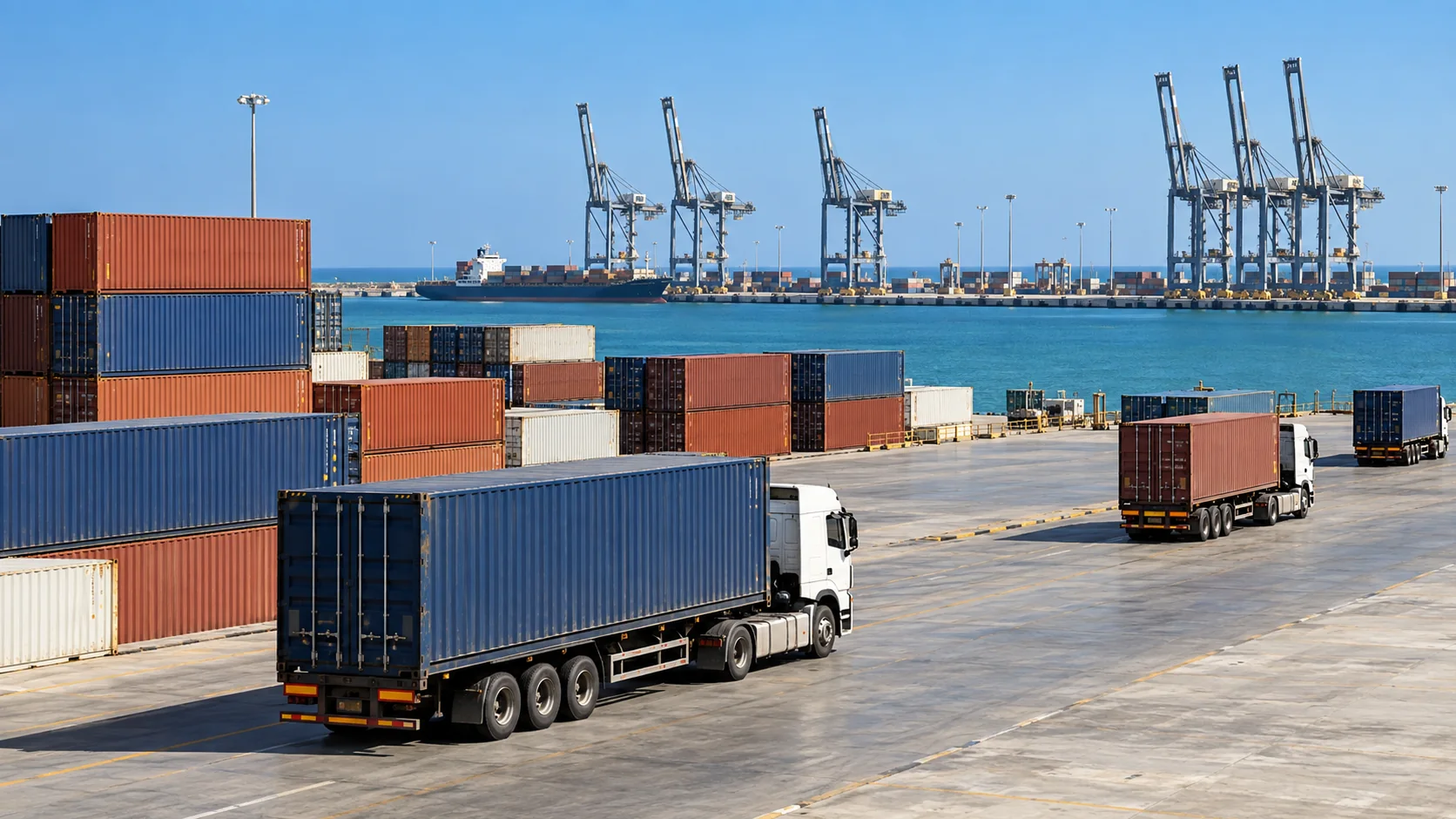
Salalah Free Zone combines a port-connected location with on-site customs support, warehousing, road access and a One-Stop Shop for import, export and re-export operations.
The most useful way to plan a logistics project is to map the complete cargo flow: arrival, customs declaration, transfer into the free zone, storage or value-added work, and the final route to export markets or mainland Oman.
For the wider Salalah investment framework, use the Salalah Free Zone Investor Guide.
Cargo-flow principle: define the ownership of the goods, customs status, storage location and final destination before the first shipment.
1. Port-linked logistics in Salalah
SFZ positions its logistics offer around immediate connectivity to the Port of Salalah, Salalah International Airport and the national road network. Its current facilities include warehouses, land, loading infrastructure and tailored logistics solutions.
This creates a practical base for import, storage, consolidation, regional distribution, re-export and selected value-added logistics activities.
2. The customs route starts in Bayan
Oman Customs uses the Bayan system for customs declarations and free-zone transfers. The declaration type follows the actual movement of the goods.
| Cargo movement | Customs route to plan |
|---|---|
| Port / free market → Salalah Free Zone | Transfer from free market to free zone. |
| Salalah Free Zone → another Oman free zone | Transfer from one free zone to another. |
| Salalah Free Zone → mainland Oman | Transfer from free zone to free market. |
| Warehouse → re-export abroad | Re-export / warehouse release route through Bayan. |
| Port-to-port or controlled movement | Relevant transfer declaration and transport guarantee where applicable. |
3. Transfer into Salalah Free Zone
Oman Customs’ current service for transfer from the free market to a free zone uses a Bayan transfer declaration, supporting goods details and the entry declaration. The cargo remains connected to its customs record as it moves into the zone.
The commercial file is strongest when the invoice, packing list, transport documents, customs declaration and warehouse receipt all describe the same shipment.
4. Storage and value-added operations
SFZ offers ready-built warehouses and industrial units that can support storage, distribution and approved value-added operations. The licensed activity defines the scope of handling, processing, assembly, packaging or manufacturing carried out in the zone.
The facility decision is covered in Salalah Free Zone Offices, Warehouses, Industrial Units and Land.
| Operation | Planning point |
|---|---|
| Storage | Product conditions, racking, security and inventory control. |
| Consolidation | Shipment identity, customs records and outbound documentation. |
| Packing / repacking | Licensed activity, product rules and origin implications. |
| Assembly / processing | Activity licence, technical approvals and production records. |
| Cold chain | Temperature control, monitoring and product-specific approvals. |
| Regional distribution | Destination customs, transport, inventory and customer flow. |
5. Re-export from Salalah
Re-export projects benefit from a clear document chain linking the original import or transfer declaration to the outbound shipment. Oman Customs provides re-export procedures and Bayan declaration routes for goods moving back out of Oman or into another approved customs destination.
SFZ’s One-Stop Shop also provides certificate-of-origin services, including Oman, re-export, GCC, Arab, EFTA and global certificate categories. The appropriate certificate follows the actual origin and shipment status.
For preferential-origin planning, use Oman Trade Agreements and Rules of Origin.
6. Mainland Oman sales
Goods moving from Salalah Free Zone into mainland Oman use the applicable free-zone-to-free-market customs route. Oman Customs currently requires a Bayan transfer declaration and supporting commercial and entry documents for this movement.
The mainland transaction also brings the product, importer, customs-duty and VAT workstreams together. This makes importer planning part of the sales model from the beginning.
The full structure is explained in Can an Oman Free Zone Company Sell in Mainland Oman?.
7. Importer, exporter and customs broker roles
| Role | Main responsibility |
|---|---|
| Free-zone company | Commercial ownership, licence, warehouse/project records and shipment instructions. |
| Importer / consignee | Mainland import responsibility where applicable. |
| Customs broker | Bayan declaration and customs-clearance execution under authorisation. |
| Warehouse operator | Inventory receipt, custody and release records. |
| Shipping / logistics provider | Transport, port handling and cargo movement. |
| Product regulator | Approval for controlled goods and sector-specific requirements. |
8. Product controls and permits
The customs route becomes more efficient when product approvals are prepared before shipping. Food, pharmaceutical, medical, chemical, telecom and other controlled products can connect to specialist approval systems.
The national process is covered in the Oman Customs Clearance and Bayan Guide.
9. Cargo-flow file
- Commercial invoice and packing list
- Bill of lading or airway bill
- HS classification
- Entry / transfer declaration
- Warehouse or facility record
- Product approvals where applicable
- Origin documents for preferential claims
- Outbound sales invoice
- Re-export or mainland-transfer declaration
- Transport and delivery evidence
10. Logistics models in Salalah
| Model | Flow |
|---|---|
| Re-export hub | Port → SFZ warehouse → regional/international export. |
| Regional distribution | Port → SFZ inventory → multiple destination markets. |
| Light value addition | Port → SFZ unit → approved processing/packing → export. |
| Industrial export | Raw materials → SFZ factory → finished goods → port/export. |
| Oman + export mix | SFZ inventory → export routes plus planned mainland transfers. |
11. Best-practice planning points
- Map the shipment before booking freight.
- Confirm the HS code and product approvals.
- Keep the original customs-declaration chain.
- Align the warehouse with the product and activity.
- Define the importer for mainland movements.
- Prepare origin records before claiming trade preferences.
- Reconcile inventory with customs declarations.
- Use the SFZ One-Stop Shop and Oman Customs route for each movement.
12. Frequently asked questions
Can goods move from Port of Salalah into Salalah Free Zone?
Yes. The cargo moves through the applicable customs transfer route and Bayan declaration, with the supporting commercial and entry documents.
Can goods move from Salalah Free Zone to another Oman free zone?
Yes. Oman Customs publishes a free-zone-to-free-zone transfer service through Bayan.
Can Salalah Free Zone goods enter mainland Oman?
Yes. Oman Customs provides a free-zone-to-free-market transfer route, with the importer, product, customs and VAT workstreams prepared for the transaction.
Can a Salalah company re-export goods?
Yes. Re-export is a core logistics use case, supported by customs declarations, shipment records and the appropriate certificate-of-origin route.
Does SFZ support customs procedures?
Yes. SFZ’s One-Stop Shop includes customs coordination and on-site customs support.
13. Implementation note
Current customs declarations, supporting documents and product approvals are confirmed in the live Bayan and SFZ systems for each shipment type.
14. Official sources
- Salalah Free Zone: One-Stop Shop and customs services
- Salalah Free Zone: logistics and facilities
- Oman Customs: transfer from free zone to free market
- Oman Customs: transfer between free zones
- Oman Customs: transfer from free market to free zone
Official public information reviewed on October 4, 2026.