
Last reviewed: 13 September 2026
The best opportunities in Oman for UK companies are not necessarily the sectors with the largest announced investment targets. The strongest near-term cases combine a visible Omani buyer problem, proven British capability, a practical procurement route and a delivery model that can localise skills without carrying unnecessary fixed cost. That puts industrial services, asset integrity, digital systems, cybersecurity, water technology, technical education and selected professional services ahead of many speculative greenfield ideas. The underlying goods, services and investment figures are documented in the UK–Oman commercial data analysis.
Capital-intensive opportunities in renewables, hydrogen, mining, manufacturing and logistics can be larger, but they need stronger evidence: an award, concession, resource, customer, offtake agreement, land, utility allocation and finance. This article ranks opportunities within the broader United Kingdom–Oman business framework and identifies the first model to test.
Opportunity ranking for UK companies
| Opportunity | Evidence of demand | Typical time to first revenue | First model to test | Main constraint |
|---|---|---|---|---|
| Asset integrity and industrial efficiency | Strong | 6–18 months | Specialist service or approved partner | Vendor qualification, HSE and ICV |
| Industrial digitalisation and cybersecurity | Strong/selective | 6–18 months | Paid pilot with local integration | Data, cyber and buyer-specific approval |
| Water and environmental systems | Strong/selective | 9–24 months | Outcome-based pilot or EPC partner | Procurement cycle and performance proof |
| Technical education and workforce development | Strong/selective | 6–18 months | Local institutional partnership | Accreditation and enrolment economics |
| Professional and project services | Established | 3–12 months | Cross-border mandate, then local office | Regulated scope and repeat pipeline |
| Renewables, grid, storage and carbon | Strong pipeline | 12–36+ months | Bid consortium or equipment/service package | Award, bankability and price pressure |
| Mining services and mineral processing | Emerging | 12–36+ months | Technical services or staged joint venture | Geology, metallurgy, permits and offtake |
| Logistics, cold chain and port technology | Selective | 9–30 months | Anchor-client service | Cargo volume and route economics |
| Healthcare and diagnostics | Selective | 9–24 months | Registered product or hospital pilot | Registration, procurement and payment |
| Manufacturing for export | Conditional | 24–60+ months | Offtake-led project company | Scale, utilities, origin and finance |
1. Asset integrity, energy services and industrial efficiency
This is the clearest immediate fit. Oman’s producing gas, LNG, refining, petrochemical, power, water and metals assets require inspection, corrosion management, rotating-equipment support, shutdown planning, process safety, emissions monitoring, energy efficiency, advanced controls and workforce training. UK goods data reinforces the installed-base thesis: mechanical power generators and general industrial machinery were the two largest British export categories in the latest rolling year.
The buyer does not purchase “British expertise” in the abstract. It purchases fewer unplanned outages, longer asset life, lower energy use, safer operations or compliance. Proposals should establish a baseline and attach payment or renewal to measurable performance. A qualified Omani service company can often provide field labour, permits and response capacity while the UK partner supplies specialist diagnostics, software or engineering.
- Likely buyers: operators, utilities, LNG and industrial companies, EPC contractors and major maintenance providers.
- Best first step: a defined assessment, paid pilot or subcontract linked to one asset class.
- Proof required: comparable references, HSE record, local technical response, savings model and buyer-specific vendor approval.
- Failure mode: opening a general engineering office before securing a specialist mandate.
2. Industrial digitalisation, data and cybersecurity
Omani operators and institutions are digitising processes while managing operational technology, cloud, identity, data-governance and cyber risk. UK providers can compete in asset analytics, digital twins, condition monitoring, secure industrial connectivity, managed detection, compliance tooling, fraud control and sector-specific workflow platforms.
Generic software pitches are weak. The strongest entry links a product to a regulated or expensive problem: compressor failure, maintenance backlog, energy loss, port dwell time, hospital workflow, cyber incident response or audit evidence. Local hosting, data transfer, security clearance, integration and 24-hour support must be resolved before a pilot is described as deployable.
- Likely buyers: energy and industrial operators, banks, telecom companies, logistics operators and public institutions.
- Best first step: paid proof of value with one data set and an Omani integration/support partner.
- Proof required: cyber architecture, data map, integration scope, local support and measurable operating outcome.
- Failure mode: treating a reseller agreement as customer validation.
3. Water, wastewater and environmental technology
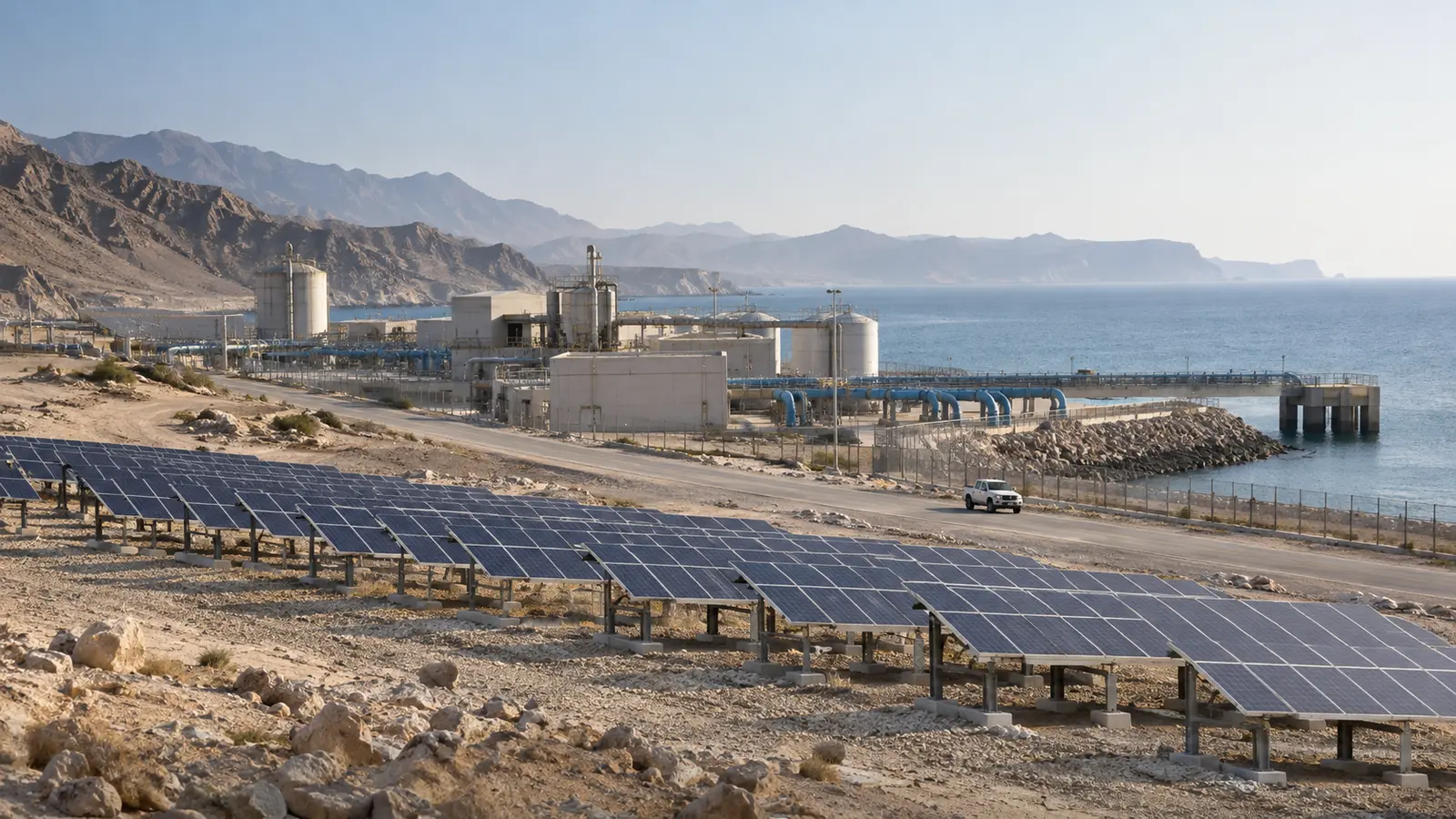
Water scarcity, desalination intensity, network losses, industrial wastewater and new project demand create a persistent need for efficiency. UK opportunities include leak detection, non-revenue-water analytics, membranes and pretreatment, reuse systems, industrial effluent treatment, sludge management, smart metering and environmental monitoring.
A technology must work in Oman’s salinity, temperature, dust and operating conditions. Buyers will also test lifetime consumables, energy use, local maintenance and warranty response. A pilot should therefore measure total cost per cubic metre, water recovered, energy saved or compliance improved—not only laboratory performance.
- Likely buyers: water utilities, independent water projects, industrial plants, municipalities and developers.
- Best first step: site assessment and performance-backed pilot through a licensed local or EPC partner.
- Proof required: climate-relevant references, operating cost, consumables plan and local service capability.
- Failure mode: quoting equipment cost without power, maintenance and lifecycle economics.
4. Technical education and workforce development
Omanisation turns skills into an operating requirement as well as a policy objective. The University of Westminster–Muscat College partnership shows one viable model: UK programmes delivered through an Omani institution in cyber, data, sustainability and digital business. Opportunities also exist in engineering certification, maintenance academies, health training, project controls, leadership and English for technical purposes.
The market does not need imported course catalogues detached from employment. A strong programme begins with job roles and employer demand, then defines curriculum, practical assessment, placement, faculty development and completion outcomes. Training attached to an equipment sale or operating contract can be easier to monetise than standalone consumer education.
- Likely buyers: colleges, employers, sector academies, operators and workforce programmes.
- Best first step: co-designed cohort or employer-backed certification with an approved Omani partner.
- Proof required: academic approvals, quality assurance, employer commitments and graduate outcomes.
- Failure mode: assuming a UK qualification alone guarantees enrolment or employability.
5. Professional, property and project services
UK services exports already exceed goods exports to Oman in the latest rolling data. Existing British-linked legal, engineering and property practices show demand for transaction advice, valuation, feasibility, project management, controls, restructuring, sustainability, dispute work and asset optimisation. These can be comparatively low-capital entry routes.
Local establishment should still follow repeat mandates. Legal, audit, engineering and other professional activities can be regulated, and a foreign consulting label does not bypass licensing. A cross-border assignment or consortium role can test demand, after which a local office becomes useful for staffing, client access and continuity.
- Likely buyers: investors, developers, lenders, public bodies, family businesses and major projects.
- Best first step: one scoped mandate or subcontract with a clearly permitted delivery model.
- Proof required: decision-maker access, local licence route, fee collection and a twelve-month opportunity pipeline.
- Failure mode: building a full office around non-exclusive conversations.
6. Renewables, grid, storage and carbon management
Oman is procuring renewable power and developing a large green-hydrogen programme. British capability can fit in project development, grid studies, power electronics, storage integration, offshore and marine engineering, electrolyser balance of plant, measurement, certification, carbon accounting, insurance, finance and operations. Existing energy relationships can reduce search friction.
The distinction between pipeline and revenue is critical. Hydrom’s land awards and targets show strategic direction, but each project still needs studies, offtake, finance, infrastructure and final investment decisions. A UK supplier should enter around an awarded developer or bankable tender package, not build a team around national capacity targets alone.
- Likely buyers: renewable developers, Hydrom-awarded consortia, utilities, industrial offtakers and EPC contractors.
- Best first step: consortium role, owner-engineer’s package or equipment/service scope tied to a named project.
- Proof required: award status, interface responsibility, offtake, finance, grid connection and payment security.
- Failure mode: treating a target or memorandum as a funded order.
7. Mining services and mineral processing
Oman is seeking more value from copper, chromite, gypsum, limestone and other mineral resources. Knights Bay’s Block 21 concession gives the corridor a visible UK-linked example. Opportunities can arise in geoscience, drilling, resource modelling, laboratory services, mine planning, environmental work, processing pilots, equipment and operational systems.
Mining risk is sequential. A concession is not a reserve; a sample is not a resource; a pilot is not a commercial plant; a resource is not bankable without recovery, infrastructure, permits and offtake. British service firms can earn earlier revenue by helping prove these stages. Equity investors should release capital against technical milestones.
- Likely buyers: concession holders, Minerals Development Oman, processors and industrial-zone developers.
- Best first step: paid technical work or milestone-based development partnership.
- Proof required: title, data quality, independent resource work, metallurgy, water/power route, permits and buyer.
- Failure mode: valuing a project on concession area or commodity narrative alone.
8. Logistics, cold chain and port productivity
Sohar, Duqm and Salalah support different trade lanes and industrial clusters. UK firms may find opportunities in warehouse systems, cold chain, port-community platforms, cargo visibility, maintenance, screening, maritime services and supply-chain optimisation. The most investable facilities begin with an anchor client, known commodity and route analysis.
“Oman as a regional hub” is not an adequate business case. The model must compare sailing frequency, transshipment, inland cost, inventory days, customs, destination licences and competing hubs. A warehouse without contracted throughput can become an expensive real-estate position.
- Likely buyers: ports, industrial companies, food and pharmaceutical distributors, 3PLs and exporters.
- Best first step: managed service or small dedicated facility backed by an anchor contract.
- Proof required: cargo history, route economics, customer term, utilisation and mainland customs pathway.
- Failure mode: selecting a zone for incentives before mapping the cargo.
9. Healthcare, diagnostics and hospital productivity
Selective opportunities exist in diagnostics, laboratory systems, digital pathways, remote monitoring, specialist clinical services, hospital efficiency and workforce development. UK providers may benefit from clinical credibility and education links, but products and professional activity can require registration, local representation and sector approval.
Demand should be tested against procurement budgets, reimbursement, patient volumes, interoperability, clinician adoption and payment terms. A distributor can handle product registration and logistics, while a hospital-backed pilot may be better for software or care pathways.
- Likely buyers: public and private hospitals, laboratories, distributors, insurers and education providers.
- Best first step: registered product route or clinical/operational pilot with a named institution.
- Proof required: regulatory classification, outcomes, data handling, reimbursement and support.
- Failure mode: importing a UK delivery model without testing Omani workflow and payment.
10. Offtake-led manufacturing and export
Oman offers industrial land, ports, energy and selected feedstocks, creating possibilities in specialty materials, metal products, industrial components, chemicals, food processing and low-carbon products. The future UK–GCC FTA may eventually improve some trade conditions, but it is not in force and its UK–GCC modelling is not an Oman-specific demand forecast.
Manufacturing should start with a customer and an origin analysis. Simple assembly or repackaging may not create preferential Omani or GCC origin. A project needs committed offtake, competitive input and utility costs, environmental approval, skilled labour, logistics, working capital and a downside case. Zone incentives should improve an already sound model rather than create the model.
- Likely buyers: industrial customers, global supply chains, GCC distributors and project developers.
- Best first step: customer-backed feasibility study and pilot production before a full plant.
- Proof required: offtake, bill of materials, origin, utilities, yield, environmental route and finance.
- Failure mode: choosing capacity from a headline market-size estimate rather than signed demand.
Selective and highly regulated: defence and security
The UK and Oman have deep defence ties, and opportunities can exist in training, maintenance, communications, cyber, maritime systems and supply-chain support. This is not a general-market opportunity. Products, software, technical assistance, end users and destinations may be subject to UK export controls, Omani approvals, security restrictions, sanctions screening and anti-bribery obligations.
Only companies with the relevant compliance infrastructure, licences and verified counterparties should pursue this sector. An intermediary relationship does not replace end-use diligence. Revenue forecasts should exclude any controlled opportunity until the licensing and procurement route is credible.
Where in Oman should a UK company look?
| Location | Best fit | Question to answer first |
|---|---|---|
| Muscat | Corporate buyers, government, telecom, professional services, healthcare and education | Does client access justify a permanent office? |
| Sohar | Port logistics, metals, chemicals, food, manufacturing and industrial services | Which operating plant or cargo owner is the anchor customer? |
| Duqm | Large industrial sites, energy transition, minerals, logistics and project services | Is the relevant project awarded and funded, and when does procurement start? |
| Salalah | Transshipment, food, cold chain, regional distribution and selected manufacturing | Does the route beat competing hubs after inventory and inland cost? |
| Interior producing areas | Oil, gas, mining, utilities and field services | Can the company meet HSE, mobilisation, local-value and response requirements? |
Location follows the customer, asset, concession or cargo. The current UK company footprint in Oman is useful precisely because it shows where live counterparties already exist.
Entry-model ladder
- Research and buyer interviews: verify the problem, budget, decision-maker and incumbent.
- Direct export or cross-border service: test one transaction where licensing and tax permit.
- Distributor or delivery partner: add local sales, registration, installation or support.
- Paid pilot: measure technical performance, adoption, payment and local support.
- Representative or small operating base: use only when response time and pipeline justify fixed cost.
- Omani subsidiary or joint venture: establish for recurring contracts, regulated local activity, personnel or liability needs.
- Project company and capital asset: commit after award, land, permits, offtake, utilities and finance are bankable.
For companies that reach the sixth step, the operational requirements are set out in the Oman company-registration guide for British investors. The legal form should match the contract rather than precede it.
Commercial constraints to price from day one
- Market size: Oman represented only 0.1% of total UK trade in the latest ranking.
- Relationships and sales cycle: UK guidance emphasises long-term engagement; tender and enterprise sales can be slow.
- Payment: milestone acceptance, retention and delayed receivables can matter more than headline margin.
- Agency risk: scope, exclusivity, registration, performance and termination must be drafted carefully.
- Omanisation: staffing obligations vary by activity and sector and must be modelled with recruitment and training.
- ICV: major Omani buyers may score local employment, procurement, training and investment; a generic localisation promise is insufficient.
- Vendor systems: JSRS is material for many energy opportunities, while other sectors use separate portals and qualification routes.
- Currency: the Omani rial is pegged to the US dollar, creating GBP/USD exposure for a UK cost base.
- Tax: corporate, withholding, VAT, permanent-establishment and future personal-income-tax questions must be separated.
- Compliance: UK Bribery Act, sanctions and export controls can apply outside the United Kingdom.
- FTA timing: the UK–GCC agreement is concluded but not yet usable.
A 90-day market test
Days 0–30: narrow the hypothesis
Select one sector and no more than three use cases. Interview at least ten relevant buyers, operators, contractors or channel candidates. Record the problem, current solution, quantified cost, budget owner, procurement route, regulator, vendor category and target decision date.
Days 31–60: test economics and compliance
Price a real transaction. Include freight, duty, approvals, local partner margin, tax, currency, insurance, travel, staff, Omanisation, ICV, warranty, collection time and working capital. Screen partners and confirm whether direct, distributor, cross-border, consortium or local-entity delivery is legally possible.
Days 61–90: seek commitment
Ask for a paid pilot, request for quotation, letter of intent with conditions, distributor sales plan or tender prequalification. Define a stop rule: no establishment if there is no qualified pipeline, no viable margin after local costs, or no credible route to payment and approval.
Frequently asked questions
What is the best opportunity for a small UK company?
A specialist service or technology tied to a measurable industrial, digital, water, education or professional problem usually offers a lower-risk test than a capital project. Start through a customer-backed pilot or qualified local partner.
Should a British company set up in a free zone?
Only when the selected zone matches the asset, cargo, customer and regulatory route. A free-zone incentive does not repair weak demand or automatically provide unrestricted mainland access.
Does the future FTA make manufacturing for the UK attractive?
Potentially for selected products, but the agreement is not yet in force. Even after entry into force, product-specific tariff schedules and origin rules will apply. Manufacturing needs customer demand and competitive production economics independently of the treaty.
Is hydrogen an immediate sales market?
It is a strategic project pipeline, not a uniform immediate market. Nearer-term opportunities are tied to awarded developers, studies, engineering packages, measurement, permitting and enabling infrastructure. Large equipment or investment commitments should wait for project-specific bankability.
Sources
- UK government: exporting to Oman, market and sector guidance
- UK Department for Business and Trade: Oman trade and investment factsheet
- Oman Foreign Ministry: end-2025 investment by sector and country
- Hydrom: Oman green-hydrogen programme and project information
- Wood: PDO engineering and project-management contract
- University of Westminster: local programme partnership with Muscat College
- Royal Decree 36/2023: Block 21 mining concession
- UK government: concluded UK–GCC FTA summary and implementation status
- UK government: controls on military goods, software and technology
Editorial note: opportunities are screened from public evidence and do not imply an award, licence, customer commitment or expected return. Verify each buyer, approval, tender and project milestone before spending.