
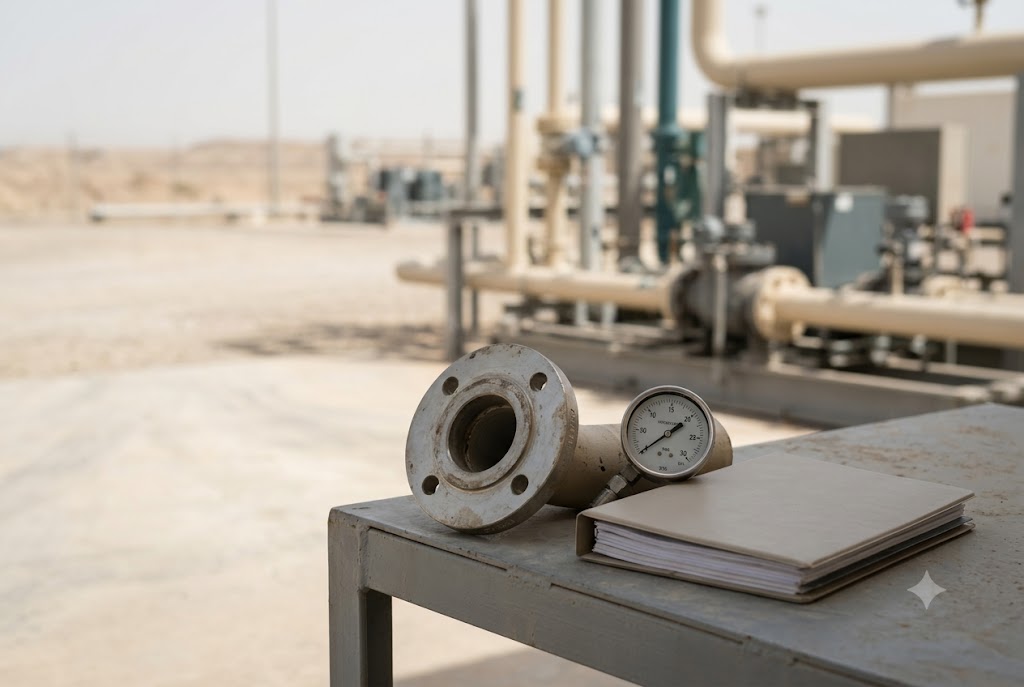
An oilfield services and industrial maintenance company supports operators, factories, refineries, contractors and industrial sites. It does not own an oil or gas concession. It sells technical services, equipment, repairs, rental support or project work under approved commercial activities and contracts.
The first decision is not the company name. It is the exact service scope. A business that repairs pumps is different from a business that rents cranes, supplies workers, imports safety equipment or issues inspection certificates. Each model can need different activities, staff, premises, insurance and buyer approval.
This guide explains the practical structure for an oilfield services and industrial maintenance company in Oman. It does not cover exploration rights, drilling concessions or oil production.
Start with four clear answers
- What exact service will the company sell?
- Will the company work from an office, workshop, yard or client site?
- Will it use its own technicians and machines, or subcontract them?
- Does the target buyer require JSRS, OPAL standards, special insurance or operator approval?
A clear answer to these questions controls the activity list, licence sequence and first-year budget.
What type of business is this?
This is normally a service contractor, technical supplier or industrial support company. It may work for an oil and gas operator, an EPC contractor, a factory, a refinery, a utility company or another maintenance contractor.
The company may be paid through a maintenance contract, call-off order, purchase order, rental agreement, project subcontract or supply contract. Commercial registration gives the legal company structure. It does not guarantee site access, tender access, vendor approval or a contract.
| Business model | What it may sell | Main planning point |
|---|---|---|
| Industrial maintenance | Preventive and corrective maintenance for mechanical, electrical or instrument systems | Technical staff, tools, site rules and contract scope |
| Oilfield support | Equipment, spare parts, field support and specialist subcontract work | Product approvals, logistics and buyer prequalification |
| Workshop repair | Repair of pumps, valves, rotating equipment or industrial machinery | Suitable industrial premises, utilities and environmental review |
| Inspection service | Testing, examination and reporting within an approved scope | Accreditation, operator recognition and inspector competence |
| Equipment rental | Machinery, lifting equipment, generators, tools or vehicles | Separate activity, asset ownership, operators, insurance and inspection |
| Project manpower | Technical teams deployed under a contract | Labour permissions, employer responsibility and client-site requirements |
Industrial maintenance services
Industrial maintenance can include planned maintenance, breakdown support, shutdown work and equipment overhaul. The service can cover factories, processing plants, warehouses, utilities and energy facilities.
Mechanical maintenance
- Pump, gearbox and rotating-equipment maintenance
- Valve removal, repair, testing support and reinstallation
- Machine alignment and planned service support
- Replacement of approved mechanical parts
Electrical and instrumentation maintenance
A company may support electrical panels, motors, sensors, control devices and industrial instruments. The activity, employee qualifications and client approvals must match the actual work. Calibration or certification claims should only be made when the company has the required competence and accepted traceability.
Important: A maintenance contract should state the asset, work scope, exclusions, response time, spare-parts responsibility, acceptance method, warranty, HSE duties and payment terms.
Oilfield equipment and support
An oilfield support company can supply tools, approved spare parts, valves, hoses, fittings, safety products, pumps, consumables and other equipment. It may also provide field technicians or specialist repair support.
Product supply and technical service are not always the same commercial activity. A company that imports or trades equipment should confirm its trading and import activities. A company that installs or repairs the same equipment should also confirm the service activity.
Major buyers may ask for manufacturer authorisation, product data sheets, certificates of conformity, test records, warranty terms, country of origin and past supply history. The exact list depends on the product and tender.
Inspection and specialist services
Inspection work has an important boundary. A maintenance company can inspect equipment for its own service work and prepare internal findings. It should not present itself as an independent statutory or third-party inspection body unless its approved scope, competence and accreditation support that claim.
For example, OPAL states that lifting-equipment inspections under its sector standard are performed by OPAL-approved lifting equipment inspection bodies. A client may also require an accredited inspection body, approved method, qualified inspector and accepted reporting format.
- Define whether the work is maintenance inspection, condition assessment or independent certification.
- Check whether the operator accepts the company and inspector.
- Use only methods, instruments and reports within the approved scope.
- Keep calibration, competence and traceability records.
Welding and pipeline maintenance
Welding, fabrication and pipeline repair can be part of industrial maintenance, but the activity must match the real work. The contract may also require approved welding procedures, qualified personnel, material records, inspection evidence and client acceptance.
A company should separate workshop fabrication, site welding, pipeline maintenance and engineering design. Design calculations or professional engineering advice may fall under a different professional scope. Review engineering consultancy licence support when the business will sell independent engineering consultancy rather than maintenance execution.
This guide does not provide hazardous-work instructions. Work on live systems, pressure equipment, confined spaces, hydrocarbons or hazardous materials must follow the client, operator and competent-authority controls.
Machinery rental and project manpower
Equipment rental
Do not assume that a maintenance activity automatically permits equipment rental. Rental of cranes, lifting equipment, earth-moving machines, generators, vehicles or specialised tools can need a separate commercial activity and additional operating controls.
- Confirm the rental activity and permitted equipment class.
- Confirm ownership, registration and insurance records.
- Keep maintenance and inspection records for every asset.
- Check operator and driver competence before deployment.
- Define whether the rental is dry hire or includes an operator.
Project manpower
Supplying a technical team is different from selling a maintenance result. The company must confirm that its activity, labour file, employee permits and contract structure allow the proposed model. Workers must remain under lawful employment and cannot be moved between employers or sites outside the approved rules.
Before hiring or promising a mobilisation date, review workforce compliance support in Oman. Job titles, Omanisation duties, reserved occupations, work permits and technical certification can change.
Vendor registration and tender access
A commercial registration allows the company to exist and conduct approved business. It does not automatically place the company on operator tender lists.
JSRS certification
The Joint Supplier Registration System is the common supplier certification system used for Oman’s oil and gas procurement network. The current JSRS guidance states that an active JSRS certificate is required for suppliers that bid for opportunities issued by oil and gas operators and concession companies.
An Oman-registered supplier normally prepares its company profile, service and product categories, commercial documents, bank evidence, employee information, financial information and experience evidence. National suppliers are also subject to site-visit validation. The published process has no fixed completion time, although JSRS states that a ready application often takes about two to three weeks.
Operator-specific onboarding
- PDO: JSRS is a precondition for PDO vendor registration. PDO may apply further product or service qualification.
- OQEP: OQEP states that it engages suppliers with active JSRS certification and uses the Tawreed portal for supplier sourcing and transactions.
- Other buyers: Each operator, EPC contractor or industrial buyer can have its own prequalification, audit, HSE and commercial requirements.
No contract promise: JSRS, vendor registration and site approval improve readiness. They do not guarantee an invitation, tender award, purchase order or payment.
HSE, insurance and certification
Oilfield and heavy-industry buyers review safety and technical readiness before work starts. The required documents depend on the work, site and operator.
| Area | Typical evidence | Important limit |
|---|---|---|
| HSE system | Policy, responsibilities, risk-control process, incident reporting and training records | Buyer format may be different |
| Workforce competence | Qualifications, experience, skill assessments and job-specific certificates | A certificate must match the actual role |
| Insurance | Employer, vehicle, equipment, public liability or project-specific cover | Coverage and limits must match the contract |
| Tools and equipment | Asset register, maintenance history, calibration and inspection records | Expired records can block mobilisation |
| Quality | Procedures, traceability, inspection and document control | ISO certification may be requested but is not a substitute for technical approval |
OPAL and EMSSU
OPAL operates sector programmes for HSE, road safety, lifting, camps, training and workforce competence. The Energy and Minerals Sector Skills Unit lists certification areas such as HSE, lifting operations, hard facilities maintenance, welding and fabrication, engineering maintenance and mechanical manufacturing engineering.
Do not use an old list of job titles. Check the live certification scheme for each role before recruitment or mobilisation. OPAL also states that its Unified HSE Passport is required for access to oil and gas concession areas.
OPAL’s current products page describes Compliance Verification Certification as voluntary. A buyer may still request OPAL membership, CVC or other evidence as a contract condition. Confirm the live tender requirement rather than treating every industry credential as a general company licence.
In-Country Value
Local employment, training, local purchasing, local subcontracting and investment in Oman can affect tender evaluation. OIA also maintains a Mandatory List of products and services that must be sourced from the local market within its framework. The list is updated, so the company should check the current version for each tender.
A practical ICV plan should be real. It can include Omani recruitment, technical training, local workshop investment, local suppliers and a clear subcontracting plan. Do not copy a percentage from another company or tender.
Workshop, yard and industrial location
A consulting office is not enough for a business that repairs heavy equipment, stores chemicals, keeps large machinery or performs fabrication. The premises must match the activity and actual operation.
| Premises | Suitable use | Checks before signing |
|---|---|---|
| Office | Management, sales and light coordination | Activity acceptance, address use and buyer expectations |
| Light workshop | Small tools, instruments and controlled repair | Power, ventilation, access, waste and civil protection |
| Industrial workshop | Machinery repair, fabrication and heavier maintenance | Industrial licence, building use, insurance and environmental classification |
| Open yard | Equipment parking, pipes, containers and project assets | Zoning, surface, drainage, security and storage restrictions |
| Client-site model | Mobile maintenance with limited own premises | Storage, mobilisation, client approval and legal address needs |
Madayn industrial cities can provide industrial workshops, warehouses and developed infrastructure. Duqm can suit large industrial, refinery, marine and fabrication work. The best location depends on target customers, transport routes, workshop size, utilities, labour access and the licences accepted at that site.
Current Gov.om guidance for a Madayn activity licence lists documents such as a Civil Defence certificate, building completion certificate and insurance certificate. Environmental approval may also apply. Use industrial location advisory in Oman before committing to a long lease or buying a workshop.
Environmental review
The Environment Authority classifies activities by environmental impact. A high-impact Category A activity requires an environmental impact assessment prepared by an approved environmental consultancy. The live application can also request land or lease evidence, a site plan and approvals from relevant authorities.
A small non-hazardous workshop should not assume that it is Category A. A heavy maintenance base should not assume that a simple municipality licence is enough. Submit the real activity, equipment, materials, waste streams and site details for classification.
Short company, residence and banking pathway
The legal company route should stay short in this sector guide:
- Define the service, trading, rental and manpower activities.
- Check foreign ownership, the restricted list and external approvals.
- Select a mainland, industrial-city or zone structure that supports the real operation.
- Register the company and complete the required post-registration licences.
- Secure the correct premises, labour permissions and technical certifications.
- Prepare banking, vendor registration and tender documents.
For the full legal setup route, use Oman company setup advisory. Many activities can allow full foreign ownership, but the final position depends on the live activity, the restricted activities for foreign investors in Oman and sector approval.
Investor residence and employee residence are separate applications. Technical staff may also need job-specific evidence before a labour or site process is complete. Review employee visa coordination in Oman only after the workforce plan is clear.
A corporate bank account is not automatic. Oilfield service companies should prepare shareholder records, source of funds, expected customers, contracts or leads, payment currencies, equipment purchases and expected transaction flows. Business banking preparation support can be used for the separate bank process.
Costs and planning tools
The company registration fee is usually a small part of the full project cost. The main budget can come from workshop rent, vehicles, machinery, tools, insurance, deposits, certifications, recruitment, mobilisation and working capital.
| Cost group | Examples | Why it varies |
|---|---|---|
| Company and licences | Commercial registration, investment, municipality, industrial and sector licences | Activities, ownership and location |
| Premises | Office, workshop, yard, fit-out, utilities and security | Size, industrial classification and lease terms |
| Assets | Vehicles, machines, tools, test equipment and spare parts | New or used assets and technical scope |
| People | Recruitment, permits, training, assessments, PPE and accommodation | Job roles, nationality, site and contract |
| Commercial readiness | Insurance, JSRS, audits, quality records and tender preparation | Buyer and project requirements |
| Working capital | Payroll, fuel, materials and supplier payments before client collection | Payment terms and mobilisation period |
Use the search Oman commercial activity codes tool to identify possible CR activities. The tool does not prove foreign-ownership eligibility or regulator approval.
You can also estimate company and investor residence costs. The estimator covers general mainland company and investor-residence costs only. It does not calculate workshop rent, industrial land, utilities, vehicles, machinery, inventory, environmental studies, technical licences, certifications or project mobilisation.
Common mistakes
- Using one general maintenance activity for every service: trading, rental, inspection and manpower may need separate activities.
- Renting the wrong premises: an office may not support workshop, storage or fabrication work.
- Buying equipment before checking the contract: the buyer may require another specification, certification or inspection standard.
- Calling maintenance work “certification”: independent certificates need the correct approved scope.
- Hiring before checking job requirements: permits, Omanisation and skill certifications can delay mobilisation.
- Expecting JSRS to create contracts: it is a procurement gateway, not a sales guarantee.
- Ignoring payment terms: industrial clients may pay after delivery, acceptance and invoicing stages.
- Mixing consultancy and execution: professional engineering advice can require a different licence from repair work.
For adjacent non-oilfield work, see construction and building maintenance activities in Oman.
Practical launch checklist
- Write a one-page list of services, products, rentals and excluded work.
- Map every revenue line to a possible commercial activity.
- Check foreign ownership and external approvals.
- Choose the correct office, workshop or yard model.
- Prepare an equipment and tool register.
- Prepare a role-by-role workforce and certification plan.
- Identify the required insurance before buying a policy.
- Prepare HSE, quality and document-control systems.
- Complete JSRS and operator onboarding only when the company is document-ready.
- Keep enough working capital for mobilisation and delayed client payment.
- Do not promise contract award, visa approval, vendor approval or site access.
Frequently asked questions
Can a foreign investor own an oilfield services company in Oman?
Many service and industrial activities can allow full foreign ownership. The final result depends on the exact activity, restricted list, location and external approvals. Confirm the live activity before registration.
Does the company need an oil concession?
No. A normal oilfield services company is a contractor or supplier. It does not own or operate an exploration or production concession.
Is JSRS required?
The current JSRS mandate requires an active certificate for suppliers bidding for opportunities issued by oil and gas operators and concession companies. Other industrial buyers may use different supplier systems.
Does JSRS guarantee PDO or OQ work?
No. JSRS supports supplier certification and procurement access. PDO, OQEP and other buyers can apply their own qualification, tender and contract decisions.
Can the company operate from a small office?
It may use an office for management and coordination. A workshop, yard or approved industrial site may be needed for repair, fabrication, equipment storage or heavy work.
Can one company provide maintenance, rental and manpower?
Possibly, but each business line must be checked separately. The commercial activities, labour permissions, premises, insurance and buyer requirements must support the combined model.
Is OPAL CVC mandatory for every company?
OPAL’s current products page describes CVC as voluntary. A contract or buyer may still request it or other OPAL evidence. Confirm the tender requirement.
How much does an oilfield services company cost?
There is no single total. Registration is only one cost. The main budget depends on premises, machinery, vehicles, tools, insurance, people, certifications, mobilisation and working capital.
Related Oman Verified guides and services
Omanisation
Understand how national workforce requirements can affect staffing and tender planning.
Employment visas
Review the main steps for bringing approved technical employees into Oman.
Free-zone assessment
Compare a free-zone base with a mainland workshop before committing to a location.
Investment context
See how industrial growth, localisation and energy priorities fit Oman’s long-term plan.
Conclusion
An oilfield services and industrial maintenance company in Oman should be built around a narrow, proven service scope. The company must connect five parts: correct activities, suitable premises, competent people, buyer-ready systems and enough working capital.
Registration alone is not contract readiness. A realistic launch plan should show what the company can do, what it will not do, which approvals apply and which buyer it is preparing to serve.
International setup support
Oman Verified supports international founders and investors with Oman-side oilfield-services setup, licensing, JSRS/vendor registration, workforce and tender coordination. Government authorities, oil and gas operators, JSRS, accreditation bodies and other competent institutions complete their respective official, technical and commercial functions, including approvals, certifications and contract awards.
Official sources
- Gov.om — Environmental Permit for Category A Activities
- Environment Authority — Environmental Permit for Class A Activities
- JSRS — Official Frequently Asked Questions
- JSRS — Certification Process
- Petroleum Development Oman — Vendor Registration
- OQ Exploration & Production — Supplier Relationship Management
- Oman Energy Association — Products and Services
- Energy and Minerals Sector Skills Unit — Skill Certification
- Energy and Minerals Sector Skills Unit — National Occupational Standards
- Oman Investment Authority — In-Country Value
- Gov.om — Madayn Licence to Practice an Activity
- Gov.om — Final Civil Protection Licence for an Establishment
Official public information reviewed on 1 August 2026. Confirm the current requirements in the live government systems before submission.