
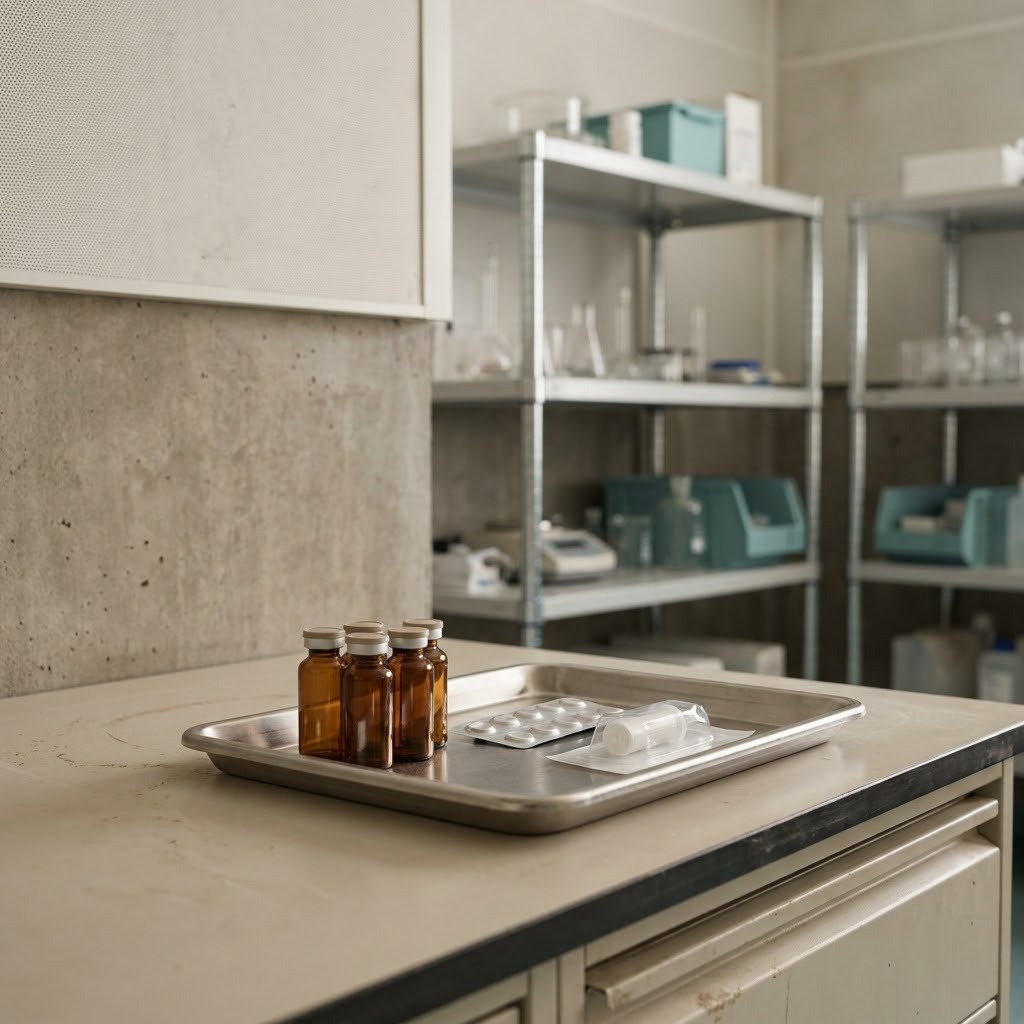
A pharmaceutical, medical-supplies or medical-device business in Oman is a regulated business. A Commercial Registration is only the legal company layer. It is not the final permission to manufacture, import, store, promote or sell a regulated healthcare product.
The correct route depends on the real product and business model. Medicines, biological products, veterinary products, medical devices, diagnostic products, consumables and general hospital supplies do not all follow one licence.
Plan the route before signing a warehouse or factory lease. The product classification, ownership structure, local establishment approval, technical staff, manufacturer registration, product registration and import release can all affect the sequence.
Regulated-business warning
Do not buy a generic “medical supplies licence” and assume it covers everything. Company registration, establishment approval, warehouse approval, manufacturer registration, product registration, customs release and professional licensing are separate controls.
The current Ministry of Health service page for pharmaceutical establishments also states that the owner or partner must be Omani. Medical-device establishment conditions are listed separately. This makes ownership planning especially important. Confirm the live rule for the exact activity and facility before forming the company or transferring shares.
Business models at a glance
| Business model | Main regulatory layers | Key planning point |
|---|---|---|
| Pharmaceutical manufacturing | Company and industrial activity, approved site, Ministry of Health pharmaceutical-factory approval, manufacturer or site review, product registration, inspection and technical staff | A factory project needs a site and process plan before final approval. Each medicine still needs its own market-authorisation route. |
| Medical-device manufacturing | Manufacturing activity, site approvals, local medical-device establishment approval, manufacturer registration, quality-system evidence and device registration | Manufacturer registration and device registration are separate. Risk class changes the dossier and fee. |
| Medicine import and distribution | Commercial activity, pharmaceutical warehouse, local representation or agency documents, company or site registration, product registration and import release | A registered company alone cannot import unapproved medicine for normal sale. |
| Medical-device import and distribution | Wholesale activity, local device-establishment approval, manufacturer registration, device registration, suitable store and shipment release | Class A–D and the intended use must be confirmed before the filing plan is fixed. |
| Medical consumables and hospital supplies | Product classification first, then the relevant device, health-product or non-specialised route | Words such as “consumable” or “hospital supply” do not decide the legal category. |
| Veterinary products | Separate listing and import-permit route through the Ministry of Agriculture, Fisheries Wealth and Water Resources | Do not place veterinary products under a human-medicine or general medical-supplies assumption. |
1. Pharmaceutical manufacturing
A pharmaceutical factory is not only a company with a manufacturing activity. The project must connect the legal company, the industrial location, the building and utility design, the production process, quality controls, qualified staff and Ministry of Health approval.
Start with a written product and process map. Identify the dosage forms, active ingredients, raw materials, production steps, clean or controlled areas, laboratory work, storage conditions, waste streams, utilities and planned capacity. This information affects the site and approval route.
Site and facility planning
The site may need approvals from the industrial-city or zone operator, municipality, Civil Defence and Ambulance Authority, Environment Authority, utilities and other bodies. The exact list depends on the location, process, materials and environmental impact. A factory location assessment in Oman can help compare a Madayn location with another industrial or zone-based option before a long lease is signed.
- Confirm that pharmaceutical manufacturing is permitted at the proposed site.
- Prepare a layout that separates material, personnel and waste flows.
- Plan receiving, quarantine, released stock, rejected stock and finished-goods areas.
- Plan temperature, humidity, ventilation, water, power backup and monitoring systems.
- Identify laboratory, cleaning, sanitation and contamination-control needs.
- Confirm how damaged, rejected and expired materials will be handled.
Manufacturer and product approval
Factory or manufacturing-site approval does not automatically approve every medicine. Pharmaceutical product registration is a separate application. The Ministry of Health’s published service requires an eCTD-format file and valid approved certificates. Technical review can include quality, safety, efficacy, manufacturing and stability information.
Do not build the business plan around a short unofficial registration estimate. The Ministry’s published pharmaceutical-product service shows a long completion period. Actual timing can also depend on file quality, questions, inspections, samples, laboratory work and current regulatory measures.
Manufacturing decision rule: First confirm product category, ownership eligibility, site acceptance and the regulator’s initial facility route. Then invest in detailed design, equipment and fit-out.
2. Veterinary and biological products
Veterinary products
Veterinary medicines and related preparations are a specialist category. Gov.om lists a separate service for companies and institutions that want to register veterinary products before obtaining import permits. The service is provided by the Ministry of Agriculture, Fisheries Wealth and Water Resources.
This means a human pharmaceutical warehouse, medical-device approval or general trading activity should not be treated as automatic permission for veterinary products. Confirm the product listing, import permit, storage, technical-person and distribution requirements with the responsible ministry.
Biological products
Vaccines, plasma-derived products and other biological products can need specialist dossiers, batch evidence, cold-chain controls and additional release documents. The Ministry of Health publishes a separate biological-products registration guideline.
The Drug Safety Center also published Circular 51/2026 concerning a suspension of receiving medicine and biological-product registration files. Confirm the current scope and status of that circular before promising a submission date or paying for a complete dossier.
3. Medical devices and consumables
Medical devices can include equipment, implants, instruments, diagnostic products, software, kits and many consumables. The legal category depends on the intended medical purpose, claims, design and risk. It does not depend only on the seller’s description.
Classify the product before planning the licence
The Drug Safety Center has a product-classification service. It can classify a product as pharmaceutical, herbal, health, medical device or outside the specialised route based on ingredients, form, claims, labels, leaflet and regulatory status.
Classification is useful when the product is unclear. Examples include disinfectants, wound-care items, cosmetics with medical claims, supplements, software, home-use diagnostic kits and products that combine medicine and device functions.
Risk classes and registration
The Ministry of Health device service uses risk classes A–D. Its published fees are grouped as A–B and C–D. Higher-risk devices normally need a fuller technical file. The official Class C and D guideline requires prerequisites such as local establishment approval and manufacturer registration before the device application.
| Layer | What it controls |
|---|---|
| Local establishment approval | The Oman entity, approved activity, store and operating controls |
| Manufacturer registration | The legal manufacturer, manufacturing licence, agency link and quality-system evidence |
| Device registration | The individual device, family, system or approved grouping and its technical dossier |
| Shipment release | The specific imported shipment and supporting commercial and storage evidence |
| Post-market vigilance | Complaints, incidents, corrective actions, safety notices and recalls after sale |
Quality-system evidence
The official manufacturer-registration guideline asks for quality-management information and certificates, such as ISO 13485, for the manufacturer. Do not turn this into a blanket statement that every local trader needs the same certificate in every case. The exact evidence depends on the applicant, manufacturer, product and service route.
4. Import and distribution
Importing a regulated health product normally has more than one checkpoint. The company needs the correct commercial activity. The local facility and store must be accepted. The manufacturer and product may need registration. The shipment may then need a Ministry of Health release before customs completion.
A practical import sequence
- Describe the exact products, claims, intended users and countries of origin.
- Confirm the product classification and risk class.
- Confirm the permitted ownership and correct Commercial Registration activities.
- Obtain initial establishment or facility approval before committing to premises.
- Prepare and approve the store, procedures and technical staffing.
- Complete manufacturer, agency and product registrations where required.
- Prepare Bayan and customs records.
- Apply for the shipment release with the correct invoices, certificates and batch or lot data.
- Keep full receiving, storage, customer and recall records after clearance.
Oman Customs and the health regulator perform different functions. Bayan registration and customs declarations do not replace Ministry of Health product or shipment approval. Customs documentation support in Oman can help organise the customs side after the regulatory route is clear.
Commercial channels
Possible channels include private hospitals, clinics, laboratories, pharmacies, distributors and public procurement. Each buyer may have its own vendor, technical, insurance, warranty, service, training and tender conditions.
A Commercial Registration, warehouse approval or product certificate does not guarantee access to a hospital list, public tender or contract award. Build a separate market-entry plan for buyers, pricing, service, maintenance, stock levels and credit terms.
5. Regulated warehousing
The warehouse is part of the regulatory system. It is not only a room for boxes. The store must protect product quality, prevent mix-ups, support traceability and allow damaged, expired, rejected or recalled stock to be isolated.
Medical-device and supply store controls
The current Ministry of Health establishment page includes detailed store conditions for medical devices and supplies. These include suitable shelving, no boxes directly on the floor, temperature and humidity monitoring, ventilation, protection from sunlight, safety systems, pest control, waste controls and a separate monitored area for damaged, expired or rejected products.
- Keep a valid Commercial Registration and trade licence for the approved store.
- Use clear receiving, dispatch, storage and quarantine areas.
- Follow the manufacturer’s storage and transport instructions.
- Record temperature and humidity continuously where required.
- Use a backup plan for power failure, especially for refrigerated products.
- Keep products off the floor and below the ceiling.
- Maintain digital inventory data with manufacturer and batch, lot or serial details.
- Keep disposal records from an approved specialist contractor.
- Report relevant product accidents or safety issues.
Pharmaceutical warehouse controls
Pharmaceutical storage needs controlled receiving, quarantine, release, returns, expiry and recall procedures. The published Ministry guideline for medical stores describes pharmacist supervision, daily temperature records, separate expired stock and batch-level records. The current Drug Safety Center requirements must be checked because guides and service pages can be updated.
Cold storage is product-specific. A refrigerator or cold room does not solve the full problem. The company needs mapped storage, calibrated monitoring, alarm response, backup power, qualified transport, excursion assessment and documented decisions about affected stock.
Lease warning: Ask for initial regulator feedback on the proposed location and layout before paying for a long lease or complete fit-out. A cheap warehouse can become expensive if its use, construction, access, ceiling, safety system or storage layout cannot be approved.
6. Product and establishment registration
“Registration” can refer to different approvals. Keep each certificate and expiry date in a regulatory register.
| Registration or approval | Typical subject | Why it matters |
|---|---|---|
| Commercial Registration | The legal company and activities | Creates the company layer but not final sector permission |
| Initial facility approval | Proposed establishment, activity, location and concept | Should come before major fit-out commitments |
| Final facility or warehouse licence | Inspected premises, systems and staff | Allows the approved regulated operation, subject to scope |
| Manufacturer or manufacturing-site registration | The legal producer and site | Connects the product to an accepted manufacturer |
| Product registration | A medicine, health product or medical device | Controls lawful market placement for the approved product |
| Import or shipment release | A specific consignment | Allows regulatory clearance of the shipment |
| Professional licence | Pharmacist, assistant pharmacist, medical representative or other regulated professional | Confirms that a person may perform the approved role |
Prepare a dependency map before filing. For example, the current medical-device service lists local establishment approval, manufacturer registration, manufacturer licence and local agency evidence as conditions. A product application submitted before its prerequisites are ready can stop or fail.
7. Qualified people and technical responsibility
Regulated healthcare businesses need people whose qualifications match the approved operation. The staffing rule is not the same for every model.
Pharmaceutical roles
The Ministry of Health has professional licensing routes for pharmacists, assistant pharmacists and medical representatives. The published medical-store guideline states that an assistant pharmacist works under a registered pharmacist and should not run the medical store alone.
Check degree recognition, professional verification, examinations, experience, professional insurance and licence validity for the proposed person. Start this work early because the facility may depend on approved technical staff.
Device and technical roles
A device distributor may also need trained people for storage, complaints, vigilance, installation, calibration, maintenance or user training. The exact roles depend on the device and the approved business scope.
Employment permissions, reserved occupations and Omanisation duties are separate from Ministry of Health approval. Review workforce compliance support in Oman before building the headcount plan. Where non-Omani specialists are needed, employee visa coordination in Oman is a separate process and approval is not automatic.
8. Traceability, vigilance and recalls
Compliance continues after the product is sold. The company must be able to find affected stock, customers and shipments quickly when a safety issue appears.
- Record manufacturer, supplier, product name, model and registration number.
- Record batch, lot, serial number and expiry date where applicable.
- Link each receipt to storage records and each sale to the customer.
- Keep complaint, incident and adverse-event procedures.
- Define who reports safety events to the Drug Safety Center.
- Maintain recall and field-safety-corrective-action procedures.
- Run a mock recall and record the result.
- Quarantine returned, damaged, rejected, expired and recalled stock.
- Keep disposal certificates and reconciliation records.
- Control promotional claims and approved product information.
For devices, the local establishment and manufacturer may need to coordinate incident investigation and corrective action. For medicines, pharmacovigilance, batch controls and recall duties can apply. Contracts with foreign manufacturers should clearly define reporting deadlines, document access and recall costs.
9. Legal company, residence and banking pathway
The company layer normally begins through the Oman Business Platform with the legal form, shareholders, activities and company documents. The exact regulated activity and ownership eligibility must be checked before submission. For structure review and application coordination, see Oman company setup advisory.
After Commercial Registration, the business may still need an investment licence, municipality records, sector approvals, tax registration, labour records and an approved operating location. Do not describe the company as operational until the required health-sector permissions are active.
A corporate account is also a separate bank decision. A regulated product list, expected suppliers and customers, source-of-funds evidence, licences, premises and projected transactions can affect the bank review. Business banking preparation support can help organise the file, but no adviser can guarantee bank approval.
10. Cost planning and useful tools
Do not use one “company setup price” for the complete project. Build the budget in layers.
| Cost layer | Examples |
|---|---|
| Company and site | Commercial Registration, investment or industrial approvals, lease, municipality and safety permissions |
| Facility | Design, fit-out, shelving, clean or controlled areas, monitoring, backup power, security and inspection work |
| People | Recruitment, qualification verification, exams, licences, insurance, labour and residence costs |
| Regulatory files | Classification, manufacturer registration, product dossiers, translation, legalisation, testing and samples |
| Import | Agency documents, freight, customs, regulatory release, temperature-controlled transport and insurance |
| Ongoing compliance | Renewals, calibration, audits, QMS records, vigilance, recall readiness, waste and expiry disposal |
Published official fee examples
The Ministry of Health pages reviewed for this guide publish examples such as OMR 20 for product classification, OMR 500 for a pharmaceutical product, OMR 500 for a non-local device manufacturer for five years, OMR 1,500 for a local device manufacturer for three years, OMR 100 for Class A–B devices and OMR 200 for Class C–D devices.
The initial establishment page also publishes separate facility fees, including OMR 1,500 for a pharmaceutical factory and OMR 450 for a drug warehouse. Other pages may show separate confirmation, final, renewal or shipment-release fees. Always check the live service page and invoice because stages, categories and fees can change.
Activity Finder
Use the search Oman commercial activity codes tool to identify possible CR codes. It does not prove that an activity is open to foreign ownership or that the health regulator will approve it.
Mainland Cost Estimator
The mainland company registration cost estimator covers general mainland company and investor-residence costs only. It does not calculate land, factory construction, utilities, equipment, inventory, professional licences, environmental studies or health-sector approvals.
11. Common mistakes
- Using one generic licence: Medicines, devices, health products and veterinary products can have different regulators and approvals.
- Signing the lease too early: The premises may not meet the regulator’s location, layout, construction or storage rules.
- Choosing the activity before classifying the products: The product route can change the company and warehouse plan.
- Ignoring ownership conditions: A commercial activity may appear available while a sector-facility rule creates a different ownership condition.
- Submitting product files before prerequisites: Establishment, manufacturer and agency approvals may need to come first.
- Hiring technical staff too late: A facility can remain inactive while professional verification and licensing are incomplete.
- Weak temperature and inventory records: A working air conditioner is not a documented storage-control system.
- No recall procedure: The company must be able to identify stock and customers quickly.
- Assuming registration guarantees tenders: Buyer qualification and contract award are separate commercial decisions.
- Under-budgeting: Fit-out, monitoring, regulatory dossiers, renewals and stock can cost more than the first company registration.
12. Practical checklist
- List every planned product, manufacturer and country of origin.
- Write the intended use and claims for each product.
- Classify unclear products before selecting the final activity.
- Separate human medicine, biological, device, health-product and veterinary routes.
- Confirm the exact CR activity and ownership rule.
- Confirm the regulator’s initial facility route before leasing.
- Prepare the warehouse or factory layout and equipment list.
- Identify required pharmacists, representatives and technical staff.
- Map manufacturer, agency, product and shipment approvals.
- Prepare temperature, transport, inventory, complaint and recall procedures.
- Confirm customs and Bayan needs after the health route is clear.
- Build a staged budget and working-capital plan.
- Check official fees and service status in the live portals.
- Do not promise a tender, registration or import date before regulator confirmation.
Frequently asked questions
Can one licence cover medicines, devices and medical supplies?
No. The product category and business model decide the route. A company may need separate activities, establishment approvals, manufacturer registrations, product registrations and import releases.
Can a foreign investor own this business in Oman?
Do not answer this from the general foreign-ownership rule alone. The exact CR activity and the sector-facility rule must both be checked. The current Ministry of Health pharmaceutical-establishment service states that the owner or partner must be Omani, while medical-device establishment conditions are presented separately. Obtain live confirmation for the exact model before forming the ownership structure.
Do I need a warehouse before product registration?
Often the local establishment or warehouse is part of the prerequisite chain. The exact sequence depends on the category. For medical devices, the current service lists local establishment approval and manufacturer registration before device registration. Confirm the sequence before submitting.
Is ISO 13485 required?
The official medical-device manufacturer guideline asks for manufacturer quality-system information and certificates such as ISO 13485. Do not assume that the same certificate is a blanket requirement for every local distributor. Check the exact applicant and product route.
Does a pharmaceutical warehouse need a pharmacist?
The published Ministry medical-store guideline describes operation under a registered pharmacist and says an assistant pharmacist should not run the store alone. Confirm the current staffing condition with the Drug Safety Center for the proposed warehouse.
Can the company sell directly to hospitals or join tenders?
The company can pursue suitable buyer and tender channels after completing the relevant legal, facility, product and vendor requirements. Approval or registration does not guarantee buyer acceptance, tender eligibility or contract award.
Are veterinary and biological products handled like normal medical supplies?
No. Veterinary products have a separate ministry listing and import-permit route. Biological products can have specialist registration, batch and cold-chain requirements. Check the current circulars before planning a filing.
Related Oman Verified guides
Customs and Bayan
Read about Oman customs registration and Bayan account after the product-regulatory route is confirmed.
Foreign ownership checks
Compare the exact activity with the guide to restricted activities for foreign investors in Oman, then confirm the separate health-sector rule.
Company tax
Review Oman tax rules for companies for the separate corporate-tax, VAT and record-keeping layer.
Conclusion
The safest way to start a pharmaceutical, medical-supplies or medical-device business in Oman is to separate the layers. First define and classify the products. Then confirm ownership and company activities. Next confirm the facility, staff, manufacturer and product prerequisites. Only after that should the business invest heavily in premises, dossiers, imports and stock.
A clear sequence reduces the risk of an unusable licence, rejected premises, delayed product files or stock that cannot be released. Final approval always belongs to the relevant authorities.
International setup support
Oman Verified supports international founders and investors with Oman-side company setup, licensing coordination and follow-up through the relevant authorities, operators and specialist providers. It is not the Ministry of Health, the Drug Safety Center, the Ministry of Agriculture, Fisheries Wealth and Water Resources, Oman Customs or another government authority. The relevant official services and decisions—including licences, registrations, import releases or tender awards—are completed by the competent authorities and authorised providers; Oman Verified coordinates the client-side preparation and follow-up in Oman.
Official sources
- Ministry of Health — Drug Safety Center
- Ministry of Health — Pharmaceutical Establishments Licence and Medical Device Facility Initial Approval
- Ministry of Health — Product Classification
- Ministry of Health — Pharmaceutical Product Registration
- Ministry of Health — Medical Device Manufacturer Registration
- Ministry of Health — Medical Device Registration
- Ministry of Health — Class C and D Medical Device Registration Guideline
- Ministry of Health — Medical Device Manufacturer Registration Guideline
- Ministry of Health — Medical Devices and Supplies Shipment Release
- Ministry of Health — Pharmacist, Assistant Pharmacist and Medical Representative Licensing
- Ministry of Health — Biological Products Registration Guideline
- Ministry of Health — Circular 51/2026 on Medicine and Biological Registration Files
- Gov.om — Listing of Veterinary Products
- Oman Customs — Company and Bayan Registration
- Ministry of Commerce, Industry and Investment Promotion — Investor Information
Official public information reviewed on July 30, 2026. Confirm the current requirements in the live government systems before submission.