
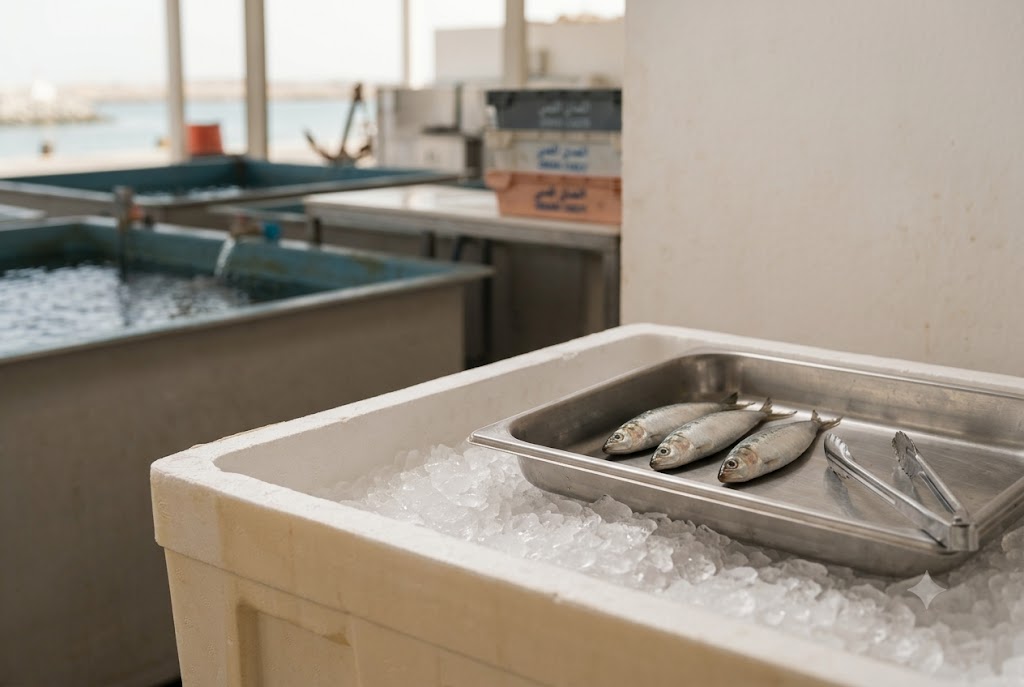
A fisheries business in Oman can mean several different things. It may buy fish from licensed suppliers. It may clean, grade, pack, freeze or process seafood. It may operate a fish or shrimp farm. It may also operate fishing vessels. Each model has a different licence path.
The first decision is therefore not the company name or the building. It is the exact business model. A company that buys landed fish does not receive the right to catch fish. A seafood packing room is not licensed in the same way as an aquaculture farm or a commercial fishing vessel.
This guide explains the main models, sites, approvals, hygiene controls, cold-chain duties and export steps. It covers small processing units and larger factories. Large aquaculture and industrial projects need technical, environmental and financial planning before construction starts.
Start with this licence logic
- Will you catch fish? You need the fishing-vessel and fisheries route. Company registration alone is not enough.
- Will you farm fish or shrimp? You need an approved farm model, site, water plan, biosecurity plan and environmental review.
- Will you buy seafood from others? Use licensed suppliers and keep legal source and lot records. Buying does not give fishing rights.
- Will you clean, pack, freeze or process seafood? The premises, design, HACCP system and Fish Quality Control requirements become important.
- Will you export? Add Bayan, shipment documents, laboratory evidence and the certificate required by the destination market.
Business models at a glance
| Business model | What the business does | Main approval areas | Important limit |
|---|---|---|---|
| Capture-fisheries operator | Uses licensed vessels to catch living aquatic resources | Company activity, preliminary and final vessel approval, vessel licence, maritime papers, fisheries controls and Omanisation | This is not the same as seafood trading |
| Seafood buyer or supplier | Buys legally landed or farmed seafood and sells it onward | Correct commercial activity, fisheries registration where required, fish transport and marketing controls, municipality and health requirements | Must prove the legal source of the seafood |
| Cleaning, grading and packing unit | Washes, sorts, trims, ices and packs seafood | Approved premises and design, hygiene flow, HACCP, Fish Quality Control and waste controls | Even simple handling can be a regulated food activity |
| Freezing or cold-chain operator | Chills, freezes, stores or moves seafood under controlled temperature | Suitable cold rooms, temperature records, licensed vehicles, backup systems and product separation | Cold storage does not replace processing approval |
| Seafood processing factory | Produces fillets, frozen products, cooked products, cans or other value-added food | Industrial site, factory design, utilities, environmental permit, HACCP, quality certificate and destination-market controls | A factory is not a simple small trading licence |
| Aquaculture farm | Farms fish, shrimp or other approved aquatic species | Sector approval, site, water source, feasibility, environmental review, farm controls and biosecurity | The approval depends on the species, system and site |
1. Define the exact fisheries business
Do not place every seafood activity under one broad description. Write down each operation from source to sale. This helps identify the correct commercial activities and external approvals.
A simple value-chain map
- Source: licensed fishing vessel, aquaculture farm, fish market, landing centre or approved supplier
- First handling: unloading, weighing, icing, washing and grading
- Preparation: gutting, trimming, filleting, peeling or portioning
- Preservation: chilling, freezing, cooking, canning or another approved process
- Storage: chilled, frozen or dry ingredients and packaging
- Delivery: local wholesale, retail, food service or export
The licence plan should cover every step that your company will perform. If another licensed company performs a step, the contract and responsibility should be clear.
2. Capture-fisheries supply and vessel operations
There is an important line between catching fish and buying fish. A processor can buy seafood from a licensed vessel, market or farm without becoming the fishing operator. The buyer must still keep source records and meet transport, handling and food-safety rules.
A company that wants to operate a commercial fishing vessel follows a separate approval path with the Ministry of Agriculture, Fisheries and Water Resources. The official preliminary-approval service lists documents such as a valid commercial register, an Omanisation programme, vessel purchase or lease papers, approved vessel plans, maritime registration and navigation papers, a feasibility study and evidence of financial ability.
The final approval and vessel permit remain subject to fisheries law, the vessel record, approved fishing methods, operational conditions and current authority decisions. Ownership and foreign-participation conditions must be checked for the exact activity. Do not assume that a general foreign-owned company can automatically operate a capture-fishing vessel.
Do not buy unknown catch. Record the supplier, vessel or farm, landing or harvest date, species, quantity, purchase document and lot number. Export markets may also ask for catch information or other proof of legal origin.
3. Fish and shrimp aquaculture
Aquaculture is a production project. It is not only a commercial activity on the company record. The authority needs to understand the species, production system, site, water source, stocking material, feed, disease controls, discharge and route to market.
Common farm systems
| System | Typical use | Main early questions |
|---|---|---|
| Marine cages | Finfish in approved sea areas | Marine location, depth, currents, navigation, mooring, feed, waste, storms and access |
| Coastal ponds | Shrimp or approved marine species | Land, seawater intake, discharge, salinity, disease barriers, power and pond design |
| Land-based tanks or RAS | Fish, shellfish or hatchery operations | Water treatment, oxygen, energy, backup power, sludge, stocking density and technical staff |
| Integrated farm aquaculture | Freshwater fish linked to an agricultural farm | Agricultural land, stable water source, farm size, pond-area limit and agricultural no-objection |
| Hatchery | Eggs, larvae, fry or post-larvae | Broodstock source, health status, quarantine, water quality, genetics and movement permits |
Integrated aquaculture
Gov.om lists a specific integrated aquaculture licence under Ministerial Decision 177/2012. The current service page asks for agricultural land documents, a cadastral plan and a no-objection letter. It also lists a feasibility study, a stable water source, land larger than three acres and a fish-basin limit of 10% of the total land. The listed licence fee is OMR 100.
This route is for an integrated agricultural model. It should not be used as proof that a large coastal shrimp farm, marine cage farm or standalone hatchery has the same conditions.
Species and stocking material
The species should be accepted for the planned system and site. Imported live fish, broodstock, fry or other stocking material may need a veterinary import permit through Bayan. The current Gov.om veterinary service asks companies for a commercial register with the relevant import activity, a farm or facility licence and health documents based on the shipment. Inspection, health and quarantine conditions may also apply.
- Confirm the scientific and commercial species names.
- Identify whether seed comes from Oman or abroad.
- Check disease status and health-certificate format before shipment.
- Plan quarantine or isolation where required.
- Do not use medicines, hormones or feed additives without the required approval.
- Keep batch records from stocking to harvest.
4. Site, water and environmental approvals
The site can decide whether an aquaculture or processing project is possible. Check the site before signing a long lease or ordering equipment.
Aquaculture site review
- Legal access to the land or marine area
- Water quantity, quality, temperature and salinity
- Intake and discharge design
- Flood, cyclone, wave, current and erosion risk
- Distance from pollution sources and sensitive habitats
- Road, port, power, ice, feed and maintenance access
- Separation from other farms and disease pathways
- Worker access, housing and emergency response
Environmental permit
The Environment Authority classifies activities by environmental impact. The live Gov.om pages show Category A, B and C permit routes. Category A requires an environmental impact assessment by an approved environmental consulting office. Other categories can also require an environmental study or impact assessment, depending on the site and activity.
An aquaculture or processing proposal may need to cover wastewater, seawater discharge, sludge, fish waste, odour, chemicals, refrigerants, noise, generators, fuel, packaging waste and effects on the marine environment. The required study and authority can also depend on whether the site is inside an industrial city, free zone, port or special economic zone.
Stop before construction
Do not treat a land offer, warehouse lease or zone discussion as final sector approval. Confirm land use, utilities, environmental classification, food-facility suitability and the fisheries approval path before civil work starts.
5. Cleaning, grading and packing seafood
A small unit may only wash, sort, gut, grade, ice and pack fish. This is simpler than a cannery, but it still handles high-risk food. The layout must stop dirty operations from contaminating clean product.
| Area | Practical control |
|---|---|
| Receiving | Check supplier, product condition, temperature, quantity and lot identity |
| Dirty preparation | Keep scales, blood, guts and dirty containers away from clean packing |
| Clean preparation | Use washable food-contact surfaces, safe water and controlled tools |
| Ice | Use ice made from suitable water and protect it from contamination |
| People | Provide handwashing, protective clothing, health controls and hygiene training |
| Chemicals | Store cleaning chemicals away from seafood and packaging |
| Waste | Remove fish waste quickly and control pests, odour and leakage |
| Packing | Use food-grade material and apply a clear lot code |
The product flow should move in one clear direction where possible: receiving, dirty work, clean work, packing, cold storage and dispatch. Staff movement, tools, drains and waste routes must support this separation.
6. Freezing, cold storage and refrigerated transport
Seafood loses quality quickly when time and temperature are not controlled. The company should set a temperature rule for each product and record the result at receiving, processing, storage and dispatch.
Cold-chain plan
- Define the approved temperature range for chilled and frozen products.
- Use calibrated thermometers and data loggers.
- Record product temperature, not only room temperature.
- Separate raw seafood, finished products, rejected goods and chemicals.
- Control loading time and door opening.
- Plan alarm, generator and equipment-failure response.
- Keep cleaning, maintenance and calibration records.
The current Gov.om service for transporting and marketing living aquatic resources asks companies for a commercial register, affiliation certificate, refrigerated-vehicle ownership and health documentation. It also requires the vehicle container to meet technical and health conditions. Companies planning their own fleet should review the wider road-freight rules. A transport activity, vehicle permit and fish-sector approval can be separate matters.
Cold rooms and refrigerated vehicles do not correct poor handling before chilling. The control starts when the fish is landed or harvested.
7. Seafood processing factory
A processing factory may make fillets, portions, frozen packs, cooked seafood, canned products or another value-added product. The process, capacity and risk level affect the building, equipment, utilities and approval path.
Factory design and quality certificate
Gov.om provides a Quality Control Certificate service for onshore and floating fish processing plants. The listed documents include a cadastral drawing, an electronic HACCP manual, a commercial register and the official letter approving the designs. The service includes facility inspection, HACCP approval, final examination and certificate issuance. The current listed fee is OMR 25, and the listed service time is 30 days.
This published service time is not the total factory setup time. It does not include company registration, site selection, building approval, construction, utilities, environmental work, equipment installation, product development or corrections after inspection.
Core factory design points
- One-way product flow from raw receiving to finished dispatch
- Separation of raw, cooked, clean and waste areas
- Washable floors, walls, ceilings and food-contact surfaces
- Drainage that does not move contamination into clean areas
- Safe water, ice and steam where used
- Handwashing, changing and staff hygiene facilities
- Pest prevention and controlled waste storage
- Temperature-controlled rooms sized for real production volume
- Laboratory sampling and product-hold space
- Backup power and a response plan for refrigeration failure
Choosing a processing site
A small unit may need an approved food-processing location near suppliers and customers. A larger factory may need industrial land, more power, water, wastewater capacity, truck access and space for expansion. Use factory location assessment in Oman to compare industrial locations. The final choice must still be checked with the site operator and each regulator.
Mainland, industrial city or economic zone
An export-focused factory may compare mainland industrial cities with a special economic zone or free zone. Duqm has an official fishing port and an area planned for fish-processing and canning establishments. OPAZ has also reported work on cold-chain and fish-processing facilities in Duqm. This can support a location study, but it does not prove that every plot, utility or incentive is available to every investor.
Use Oman free-zone selection advisory to compare export access, customs position, local-market sales, land, utilities and labour conditions before choosing a zone.
8. Food safety, HACCP and traceability
HACCP means Hazard Analysis and Critical Control Points. It is a written system that identifies food-safety hazards and controls the steps that matter most. It must match the real product and factory. A copied manual is not enough.
Typical seafood hazards
| Hazard group | Examples to assess | Possible controls |
|---|---|---|
| Biological | Pathogens, poor hygiene, time and temperature abuse | Approved source, chilling, sanitation, cooking where used and testing |
| Chemical | Cleaning chemicals, residues, fuel, heavy metals or species-related risks | Supplier controls, chemical storage, monitoring and laboratory plans |
| Physical | Hooks, metal, glass, plastic or bone where relevant | Inspection, equipment control and detection where needed |
| Allergen | Fish, crustaceans, molluscs and cross-contact | Separation, cleaning, recipe control and correct labels |
| Authenticity | Wrong species, origin, weight or production claim | Species records, supplier approval, lot coding and label review |
Traceability records
- Approved supplier name and licence information
- Vessel, market or farm source where applicable
- Species and product description
- Catch, landing, harvest or receiving date
- Quantity, temperature and condition at receipt
- Internal lot number and processing date
- Packaging and finished-product lot
- Customer, invoice and dispatch record
- Link between raw lots and finished lots
The business should be able to trace one step back to the source and one step forward to the buyer. It should also be able to isolate an affected lot during a complaint, test failure or recall.
9. Export certification and customs
An export-ready factory still needs shipment documents. The required certificate depends on the product, source and destination country.
Food-safety certificate for non-GCC exports
The current Gov.om service for a food-safety certificate for export outside the Gulf lists a sales invoice and an approved laboratory report. For fish products, the report is linked to the Fish Quality Control Center. The service also lists Bayan registration and a valid commercial register with the licensed activity as special conditions. The current listed certificate fee is OMR 5.
European Union catch certificate
For relevant wild-caught fish exports to the European Union, the official catch-certificate service asks for information such as vessel licences, catch quantity and species, fishing locations and dates, quality data, commercial registration and Chamber documents. The company must hold a quality-control certificate. Farmed products and other destinations may follow different evidence rules.
Export documents and customs
- Commercial invoice
- Packing list
- Customs declaration through the required channel
- Certificate of origin where required
- Health or food-safety certificate
- Laboratory report where required
- Catch certificate for applicable wild-caught shipments and markets
- Temperature and transport records
- Buyer-country import permit or approved certificate format where applicable
Use customs documentation support in Oman to prepare the customs side of imports and exports. The customs broker, fisheries regulator, laboratory, certificate issuer and destination authority can have separate roles.
Export market planning
Check the buyer-country rule before producing the first commercial batch. Product approval, establishment listing, label language, health statements, residue plans or certificate wording may take time. Also check whether a trade agreement applies, but confirm the product’s tariff classification and origin rule. An agreement does not make every shipment duty-free.
10. Workforce and Omanisation
A fisheries project may need farm managers, aquaculture technicians, vessel crew, food-safety staff, refrigeration technicians, machine operators, cleaners, drivers and sales staff. The company should check the current Omanisation and profession rules for its activity, size and location.
Commercial fishing-vessel approval can require an Omanisation programme. Processing and aquaculture projects should also plan recruitment, training, staff housing where needed, medical checks, health cards and safe work procedures. Use labour and Omanisation support in Oman before promising a workforce structure or applying for non-Omani labour.
11. Short company, residence and banking pathway
The company route is only one part of the project. Select the legal form and commercial activities, register the company, complete any foreign-investment requirement, secure the correct site and then complete the sector, environmental, municipality, food-safety, labour, customs and operational approvals that apply.
Many activities in Oman can allow full foreign ownership, but this should not be used as a general answer for capture fishing or another restricted or specially controlled activity. Use Oman company setup advisory to check the ownership, activities and legal sequence for the exact model.
Residence for an owner or technical employee is a separate application and is not automatic. The next stage can include employee visa coordination in Oman after the company and labour route are clear.
A bank will review the owners, source of funds, business plan, site, contracts, expected countries, currencies and transaction values. Equipment purchases and export receipts make a clear financial model important. Use business banking preparation support to help organise the application, but the bank makes the final decision.
12. Costs and planning tools
There is no useful single price for a fisheries, aquaculture or seafood-processing project. A company that buys and packs fresh fish has a very different budget from a shrimp farm or cannery.
| Cost group | Examples |
|---|---|
| Company and legal setup | Commercial registration, investment requirements, documents and professional support |
| Land and site | Lease or usufruct, surveys, access, site preparation and deposits |
| Technical studies | Feasibility, farm design, hydrodynamic work, geotechnical work and factory design |
| Environmental work | Consultant, study, sampling, permit and monitoring |
| Civil works | Buildings, ponds, tanks, intake, outfall, drainage, roads and fencing |
| Equipment | Cages, pumps, aeration, processing lines, ice machines, freezers and laboratories |
| Utilities | Power connection, water, treatment, fuel, oxygen, backup generator and wastewater |
| Biological inputs | Seed, fry, post-larvae, broodstock, feed, health checks and mortality allowance |
| Cold chain | Cold rooms, insulated boxes, refrigerated vehicles, data loggers and backup systems |
| People | Recruitment, salaries, training, visas, housing, health cards and safety equipment |
| Certification and export | HACCP work, inspection, testing, certificates, customs and destination-market approval |
| Working capital | Stock, packaging, utilities, wages, maintenance and the time before customer payment |
You can search Oman commercial activity codes as an early planning step. The tool does not prove foreign-ownership eligibility or regulator approval. The live Oman Business Platform and sector authority must confirm the final activities.
The mainland company registration cost estimator covers only general mainland company and investor-residence costs. It does not calculate land, farm construction, water systems, vessels, cold rooms, factory equipment, environmental studies, biological stock, utilities or sector approvals.
Fee warning: The OMR 100 integrated-aquaculture fee, OMR 25 fish-processing quality-certificate fee and OMR 5 non-GCC food-export certificate fee shown on current Gov.om pages are individual service fees. They are not the total project cost and do not include other approvals, studies, inspections, buildings or operating expenses.
13. Common mistakes
Using one activity for the whole value chain
Catching, farming, buying, processing, storing, transporting, importing and exporting can involve different activities and permissions.
Assuming a buyer can also catch fish
A purchase contract with fishermen or farms does not give the buyer vessel rights or a fishing quota.
Signing the site too early
The site may fail because of land use, water, discharge, power, environmental, food-safety or vehicle-access limits.
Building before design approval
Wrong product flow, drainage, wall materials or staff routes can create expensive changes after inspection.
Copying a HACCP manual
The manual must match the real species, process, equipment, temperatures, cleaning system and records.
Ignoring backup power
A power or refrigeration failure can damage stock quickly. The alarm, generator, repair contact and product decision rules should be written and tested.
Choosing an export market too late
The buyer country may require a specific certificate, plant listing, laboratory plan, label or catch evidence. Design the compliance route before production.
Treating published fees as the project budget
Small application fees do not show the cost of studies, buildings, equipment, utilities, stock or working capital.
14. Practical checklist
- Define every product and operation in one clear list.
- State whether the company will catch, farm or buy seafood.
- Identify the exact source of fish, shrimp or other seafood.
- Check commercial activities and foreign-participation conditions.
- Confirm the Ministry of Agriculture, Fisheries and Water Resources approval route.
- Prepare a realistic feasibility study.
- Compare sites only after listing water, power, discharge and logistics needs.
- Confirm the environmental category and required study.
- Obtain design review before building a processing plant.
- Design dirty-to-clean product flow and waste flow.
- Create a product-specific HACCP system.
- Plan water, ice, sanitation, pest and staff-hygiene controls.
- Build lot traceability from source to customer.
- Confirm cold-room, vehicle and backup-power capacity.
- Check the destination-country certificate and label before production.
- Plan Omanisation, technical staff and worker training.
- Include construction delay and working capital in the budget.
- Do not order live stock or equipment before the approval sequence is clear.
Frequently asked questions
Can a foreign investor own an aquaculture or seafood-processing company in Oman?
Full foreign ownership is available for many activities in Oman, but the exact activity must be checked. Capture fishing and vessel operations can have different conditions from aquaculture, packing or processing. Confirm the live commercial activity and sector approval before registration.
Does a seafood trading company need a fishing licence?
Not if it only buys seafood from licensed sources and does not catch fish. It still needs the correct trading, transport, market, food-safety and municipality permissions that apply. It must keep proof of legal source.
Can one licence cover fishing, farming and processing?
Do not assume this. These are different operations. The company may need several commercial activities and separate sector approvals for vessels, farms, transport, premises, processing and export.
What is needed for an integrated aquaculture licence?
The current Gov.om service lists agricultural land documents, a cadastral plan, a no-objection letter, a feasibility study and a stable water source. It also states that the land must be larger than three acres and that fish basins must not exceed 10% of the total land. This route does not automatically apply to standalone or coastal commercial farms.
Does an aquaculture farm need an environmental study?
The answer depends on the system, scale, site and environmental category. A coastal pond, marine cage or land-based system can affect water, discharge, waste or habitat. Confirm the environmental classification and required study with the competent authority before construction.
Does a small fish packing unit need HACCP?
The official quality-certificate service for fish processing plants requires an approved and implemented HACCP system. Confirm how the authority classifies the exact small unit and its activities. Do not assume that low production volume removes food-safety duties.
Can I use a normal delivery van for seafood?
The vehicle must protect the seafood and meet the required technical, health and temperature conditions. The current fish transport service asks for refrigerated-vehicle ownership and vehicle inspection for the relevant licence. Check the exact product and route before buying a vehicle.
What certificate is needed to export seafood?
It depends on the product and destination. A food-safety or veterinary health certificate, laboratory report, catch certificate or other destination document may apply. Confirm the buyer-country format before shipment.
Is the European Union catch certificate needed for farmed fish?
The official catch-certificate service is linked to catch information from boats or vessels. Aquaculture products follow their own source and health evidence. Confirm the current EU and Omani requirements for the exact product and customs code.
How long does a seafood factory take to open?
There is no safe standard time. The published quality-certificate service lists 30 days, but that is only one service. Site selection, design, environmental approval, construction, utilities, equipment, HACCP work and corrections can take much longer.
How much does a fisheries or aquaculture business cost?
The cost depends on the model and scale. A buyer and packing unit is different from a vessel, shrimp farm or cannery. Build a full budget for land, studies, construction, equipment, utilities, cold chain, staff, biological stock, testing and working capital.
Related Oman Verified guides and services
Transport planning
Review fleet, operator and road-freight rules when the business will move seafood in its own vehicles.
Read about road freight and trucking requirements in Oman.
Export planning
Check whether a trade agreement helps the exact product, tariff code and origin rule.
Review Oman’s trade agreements.
Investment context
Understand why food security and fisheries value chains appear in Oman’s wider economic direction.
Conclusion
A fisheries, aquaculture or seafood-processing business in Oman should start with one clear operating model. Decide who catches or farms the seafood, what your company handles, where each step happens and which market will buy the product.
Then build the licence and facility plan around that model. Capture fishing, aquaculture, processing, cold storage, transport and export are connected, but they are not one approval. Early work on the site, water, product flow, HACCP, traceability and export market can prevent expensive changes later.
This article explains public information. It is not a fishing right, farm approval, environmental approval, health certificate, customs decision, legal opinion, financial advice or guarantee. Activities, ownership conditions, documents, fees, service times and market requirements can change. Confirm the live position with the responsible authorities before paying, building, importing stock or starting operations.
Official sources
- Gov.om — Get an Integrated Aquaculture License
- Gov.om — Get Fish Hatchery License in Freshwater
- Gov.om — Preliminary Approval for a Commercial Fishing Vessel Licence
- Gov.om — Final Approval for a Commercial Fishing Vessel Licence
- Gov.om — Get a Commercial Fishing Boat Permit
- Gov.om — Licence for Transporting and Marketing Living Aquatic Resources
- Gov.om — Quality Control Certificate for Fish Processing Plants
- Gov.om — Food Safety Certificate for Export Outside the Gulf
- Gov.om — European Union Catch Certificate
- Gov.om — Veterinary Permit to Import an Animal Shipment
- Gov.om — Environmental Permit for Category A Activities
- Gov.om — Environmental Permit for Category B Activities
- Gov.om — Environmental Permit for Category C Activities
- Oman Customs — Permit Services
- Special Economic Zone at Duqm — Fishing Port
- OPAZ — Cold-chain and fish-processing development in Duqm
Official public information reviewed on July 29, 2026. Confirm the current requirements in the live government systems before submission.