
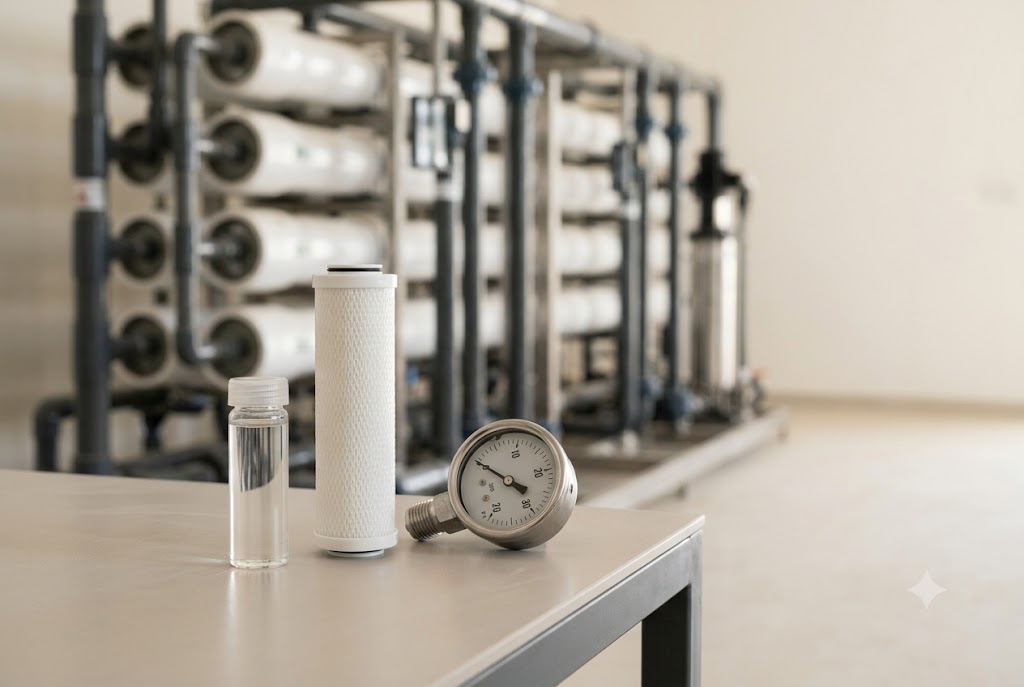
A water business in Oman can mean several different things. It may be a small company that services filters. It may sell and install reverse-osmosis systems. It may maintain industrial plants. It may produce desalinated water. It may also manufacture bottled drinking water.
These models do not follow one licence path. A service contractor is different from a water producer. A bottled-water factory is also different from a company that installs treatment equipment. The premises, technical approvals, environmental duties and product checks can change with each model.
This guide explains the main differences. It does not provide engineering instructions. It also does not replace a review of the exact activity, site, source water and final product in the current government systems.
Start with the Business Model
First question: Will the company sell a service, sell equipment, operate a water-production plant, or place packaged drinking water on the market?
- Service model: inspection, cleaning, maintenance and replacement of filters or membranes.
- Equipment model: sale, import, assembly or installation of treatment systems.
- Production model: operation of a desalination or water-treatment plant that produces water for another party.
- Food-manufacturing model: treatment, filling, packaging and sale of bottled drinking water.
Do not choose the commercial activity or sign a long lease until this difference is clear.
Business Models at a Glance
| Business model | Typical premises | Main approval focus | Main risk |
|---|---|---|---|
| Filter and treatment-system maintenance | Office, approved workshop or small store | Correct service activity, municipality rules and worker permissions | Doing electrical, plumbing or engineering work outside the licensed scope |
| RO and treatment-equipment trading | Office and suitable warehouse | Trading activity, import documents and product compliance where required | Importing equipment before checking technical or customs requirements |
| System installation and technical contracting | Office, workshop and project sites | Contracting scope, technical staff and any electrical or mechanical boundaries | Using a general activity for regulated technical work |
| Plant operation or special desalination | Industrial or approved utility site | Water-sector, environmental, source-water and discharge approvals | Assuming an ordinary commercial registration is enough |
| Bottled-water manufacturing | Approved industrial food-production facility | Source water, factory hygiene, laboratory reports, product registration and label review | Building the plant or printing packaging before approval |
| Water testing as an independent service | Approved laboratory premises | Separate laboratory activity, technical competence and recognition requirements | Presenting internal quality control as an independent accredited test service |
1. Water-Treatment Service Companies
A service company may inspect treatment systems, replace filters, clean tanks, change membranes, maintain pumps or support an existing plant. This is usually the simplest model when the company does not produce or sell water.
The exact activity still matters. Basic maintenance is not the same as electrical contracting, mechanical contracting, plumbing, civil construction or engineering design. The company should list every service it plans to invoice. It should then map each service to the correct commercial activity and any external approval.
Useful scope questions
- Will the company only maintain equipment?
- Will it install new systems?
- Will it connect pumps, panels or electrical controls?
- Will it modify water pipes or drainage?
- Will it design systems or sign technical drawings?
- Will it handle treatment chemicals?
- Will it work inside factories, hotels, farms or government sites?
A small service business may use ordinary commercial premises when the municipality and landlord permit the activity. A workshop, chemical store or equipment warehouse may need a different location and additional safety controls.
2. RO and Desalination-System Businesses
Reverse osmosis, or RO, is used in homes, commercial buildings, farms and industrial plants. A company may sell complete units, import components, assemble skids, install systems or provide after-sales maintenance.
An RO equipment supplier is not automatically a regulated water producer. However, a company that operates a desalination activity, sells produced water, or supplies water through a regulated system may enter a different approval route.
Important: Gov.om lists a Special Nature Water Desalination Licence issued by the Authority for Public Services Regulation. It also lists a separate licence for electricity generation and related water desalination. These regulated routes should not be confused with normal equipment trading or maintenance.
Check the contract before selecting the activity
The contract may require only equipment supply. It may also include design, construction, installation, commissioning, operation or water sale. Each added duty can change the licence and liability position.
Companies that import membranes, pumps, pressure vessels, dosing equipment or control panels should also prepare the product documents before shipment. For complex imports, customs documentation support in Oman can help organise the customs and shipment file. Customs clearance does not replace technical conformity or sector approval.
3. Plant Maintenance and Water Testing
Plant maintenance can include preventive checks, consumable replacement, membrane cleaning, pump servicing, instrument checks and operating records. The service agreement should clearly state which party controls the plant and which party is responsible for water quality.
A maintenance company may collect samples and send them to a recognised laboratory. It should not describe its own field readings as an independent laboratory certificate unless it holds the required laboratory activity and recognition.
Gov.om provides a product-analysis service for food and water samples. The official service requires clear sample data and suitable sample handling. Bottled-water businesses should create a written sampling plan for raw water, treated water, filled products and cleaning verification. The plan should follow the applicable standard and the competent authority’s instructions.
Records a plant should normally control
- Source-water information and supplier records
- Incoming water test results
- Filter, membrane and chemical records
- Cleaning and sanitation logs
- Equipment maintenance records
- Calibration or verification records for measuring devices
- Finished-product laboratory reports
- Batch, date and distribution traceability
- Complaint and corrective-action records
4. Bottled-Water Manufacturing
Bottled-water manufacturing is a food-production activity. The business treats water, fills containers, closes them, applies labels, stores the finished product and distributes it. It is not only a water-treatment service.
The factory normally needs an approved industrial location and a valid activity licence. It may also need environmental, municipality, food-safety, Civil Defence, building and operating approvals. The exact list depends on the governorate, industrial area, factory design, source water, storage, chemicals, fuel and discharge route.
Do not treat the factory as one approval
- The company needs the correct commercial and industrial activity.
- The site must accept food and water production.
- The source water must be legal and suitable.
- The plant layout must support hygiene and safe product flow.
- The water and final product need laboratory evidence.
- The product and label may need registration or review before sale.
- The distribution model may need separate vehicle or transport permissions.
Food product registration
The current Gov.om food-product registration service covers products made in Oman as well as imported products. It asks for a product photo, a PDF copy of the label, a laboratory report and supporting documents for any health or nutrition claim. The service also states that one product must be registered in each application.
This means that a change in bottle size, label, product claim or formulation may affect the registration file. Confirm how the authority treats each variation before printing large quantities of packaging.
5. Source Water and Health Approval
The source of the water is one of the first regulatory questions. It affects testing, treatment design, environmental duties, contracts and product claims.
| Possible source | Main checks | Do not assume |
|---|---|---|
| Municipal water | Supply capacity, commercial use, storage, incoming quality and continuity | That a normal connection can support factory demand |
| Registered well water | Well registration, legal right, partner consent, sale or transfer permission and test results | That ownership of land automatically gives commercial water rights |
| Brackish groundwater | Legal source, abstraction or transfer permission, treatment and reject-water route | That an RO unit makes the source legally usable |
| Seawater | Site rights, intake, regulated desalination route, environmental study and reject-water discharge | That a coastal lease permits intake or discharge |
| Purchased bulk water | Supplier licence, delivery records, tanker hygiene, testing and traceability | That every tanker source is approved for bottled-water production |
Using water from a well
Gov.om lists a permit to sell or transfer water from an existing well to individuals or companies. The official service refers to a surveyed and registered operating well and approval from the well partners. A bottled-water project should confirm the exact well right and intended commercial use before relying on that source.
Water-quality standards
Oman uses approved Omani and Gulf standards for drinking water and packaged food. The Omani Standards Store lists OS GSO 1025 for bottled drinking water. The Environment Authority also publishes the Omani standard for unbottled drinking water.
Do not copy chemical limits from an old online table. Buy or obtain the current applicable standard and confirm its amendments. The approved laboratory should test the required physical, chemical and microbiological parameters for the source and product.
6. Packaging, Labels and Distribution
Packaging is part of the product-safety system. Bottles, caps, large reusable containers, labels, inks and secondary packaging should be suitable for food contact and the intended storage conditions.
Before ordering bottles and labels
- Confirm the approved product name and category.
- Prepare the label in the required language and format.
- Show the responsible producer or brand owner correctly.
- Use the approved net quantity and date format.
- Support every health, mineral or nutrition claim.
- Confirm whether the water source or treatment method must be stated.
- Add batch or lot information for traceability.
- Keep laboratory evidence for the declared product information.
Gov.om also provides a service to review a food product data sheet against GSO, ISO or Codex requirements. The listed documents include a valid commercial registration, a clear PDF label and a test report from an accepted laboratory. Early label review can prevent the cost of destroying or replacing printed packaging.
Reusable large bottles
Reusable containers need a controlled return, inspection, washing, sanitation and rejection process. The plant should define when a damaged, scratched or contaminated container is removed from use. The cleaned-container area should be protected from the dirty-return area.
Transport and sale of drinking water
Gov.om lists a separate licence to transport and sell drinking water through the Ministry of Transport, Communications and Information Technology. The vehicle and delivery model should therefore be checked before the company starts direct distribution. A factory licence does not automatically answer every transport question.
A distributor that buys finished products from another factory follows a different model from the manufacturer. For that route, review food distribution and wholesale in Oman.
7. Technical Contracting Boundaries
Water projects often combine several scopes. One contract may include equipment supply, civil works, pipework, electrical panels, controls, testing and operation. The commercial activities must match the work that the company performs and invoices.
| Scope | Possible boundary to check |
|---|---|
| Equipment trading | Import, storage, warranty and product conformity |
| Mechanical installation | Pumps, pressure vessels, pipework and site safety |
| Electrical installation | Panels, motors, controls, cabling and authorised electrical work |
| Civil works | Foundations, tanks, buildings, trenches and drainage |
| Engineering design | Professional consultancy activity, qualified staff and authority acceptance |
| Plant operation | Operational responsibility, quality control, staffing and sector licence |
A contractor should not market professional design or sign technical documents under a simple trading or maintenance activity. Where the business will provide independent engineering design, review engineering consultancy licence support before selecting the structure.
Companies that also build rooms, tanks, foundations or service structures should review the separate rules for construction and building maintenance activities in Oman.
8. Site, Utilities and Environmental Planning
A service office and a bottled-water factory should not use the same site logic. A factory needs enough space for safe product flow, raw materials, treatment, filling, finished products, returned containers, chemicals, staff facilities and waste handling.
Factory site checklist
- Approved industrial or food-production use
- Confirmed water source and supply capacity
- Confirmed electricity load and connection route
- Safe reject-water, wastewater and drainage solution
- Vehicle access for raw materials and deliveries
- Separate clean and dirty movement where needed
- Suitable chemical and packaging storage
- Pest-control and waste-management arrangements
- Fire and life-safety compliance
- Space for laboratory or quality-control work
- Future expansion space, if the business plan needs it
Madayn industrial cities and other approved industrial areas can provide a clearer route for manufacturing than an ordinary commercial building. The current Gov.om industrial activity service for Madayn refers to a valid commercial registration, lease or investment agreement, building completion, Civil Defence and insurance documents. Use industrial location advisory in Oman to compare suitable factory locations before signing a lease.
Environmental permit and reject water
The environmental category depends on the project. The competent authority may ask for an Environmental Impact Assessment, an Environmental Management Plan, soil information, marine studies, safety documents or emission calculations.
The Environment Authority has a separate service for reject water from desalination plants. Its current service page states that the project must already have an environmental permit. It also lists a site assessment, technical documents and a recent water analysis where reinjection is proposed. As reviewed on August 1, 2026, the service page lists a two-year renewable licence, a ten-working-day processing period when the file is complete, and a fee of OMR 50. These details must be checked again before application.
Lease warning: A low-cost warehouse is not useful if the authority will not accept the activity, source-water system, drainage route, food-production layout or vehicle access. Obtain a written site review before making a large rent or fit-out commitment.
9. Company, Residence and Banking Pathway
The company route should stay short and practical. First, define the business model and activities. Then select the company structure, register the commercial record and complete the investment-licence route where it applies. The current Gov.om investment-licence service lists a feasibility study, experience, a bank statement covering at least three months and a lease contract among its documents.
For a review of the legal structure and activity sequence, use Oman company setup advisory. Registration does not replace the factory, water, food, environmental or technical approvals.
Owners and technical workers may need separate residence and labour procedures. Hiring permissions, reserved occupations and Omanisation duties depend on the activity, establishment size, occupation, location and the live Ministry of Labour system. Review labour and Omanisation support in Oman before planning the factory workforce.
The business may also need an operating bank account for equipment payments, rent, payroll, utilities and customer receipts. Banks review the company, owners, source of funds, contracts and expected transactions independently. Corporate bank account opening support in Oman can help prepare the application, but no bank approval can be guaranteed.
10. Costs and Useful Tools
There is no reliable single price for this sector. A maintenance company and a bottled-water factory have very different budgets.
| Cost group | Examples |
|---|---|
| Company and licences | Commercial registration, investment licence, municipality, industrial and sector approvals |
| Premises | Lease, deposit, land, fit-out, workshop, warehouse or factory building |
| Technical studies | Design, environmental study, source-water review and safety documents |
| Plant and equipment | Filtration, RO, pumps, tanks, controls, filling, capping and packaging lines |
| Utilities | Water, electricity, drainage, reject-water handling and backup systems |
| Quality and product approval | Sampling, laboratory tests, label review, product registration and inspection |
| Imports | Freight, customs, conformity documents, insurance and local delivery |
| People | Technical staff, quality staff, operators, training, payroll and labour compliance |
| Distribution | Vehicles, licences, fuel, route operations, crates and reusable-container handling |
| Working capital | Packaging, filters, membranes, chemicals, spare parts and customer credit |
You can search Oman commercial activity codes before requesting a final activity review. The tool helps find codes, but it does not prove foreign-ownership eligibility or regulatory approval.
You can also estimate company and investor residence costs. The estimator covers general mainland company and residence costs only. It does not calculate industrial land, factory construction, plant equipment, utilities, environmental studies, food approval, laboratory work or sector licences.
11. Common Mistakes
- Using one activity for every water model. Treatment services, equipment trading, regulated desalination and bottled-water manufacturing are not the same.
- Signing a factory lease too early. The location may not accept food production, water intake, storage or reject-water discharge.
- Assuming the RO system solves the legal source question. Treatment can change water quality, but it does not create a legal right to take or sell water.
- Printing labels before review. A rejected label can create large packaging losses.
- Using an old standard from the internet. Standards may have amendments, replacements or national application rules.
- Mixing maintenance with engineering design. Professional design and signed drawings may need a separate licensed scope.
- Ignoring environmental discharge. Reject water and cleaning wastewater need a legal route.
- Buying machinery before confirming utilities. The site may not have the required electrical load, water capacity or drainage.
- Planning foreign workers before checking the live labour system. Activity, occupation, size and location can change the result.
- Treating bank approval as automatic. Banking is a separate compliance review.
12. Practical Setup Checklist
- Write a one-page description of the exact business model.
- List every service, product and contract duty.
- Separate trading, installation, design, operation and manufacturing.
- Check the proposed commercial activities and foreign-investment position.
- Identify the source water and obtain evidence of the legal right to use it.
- Choose the authority route for normal service work, special desalination or bottled-water production.
- Shortlist sites only after checking activity, utilities and discharge.
- Prepare the plant flow, hygiene zones and storage plan.
- Confirm environmental study and permit requirements.
- Confirm municipality, Civil Defence and industrial-area requirements.
- Obtain the current drinking-water and food-label standards.
- Select an accepted laboratory and prepare a sampling plan.
- Prepare the product label and supporting test evidence.
- Check the distribution and drinking-water vehicle route.
- Prepare a workforce and Omanisation plan in the live Ministry of Labour system.
- Build a budget for equipment, site, approvals, packaging and working capital.
- Do not order the full production line until the site and approval path are clear.
Frequently Asked Questions
Can one company provide water treatment and manufacture bottled water?
It may be possible to hold more than one approved activity, but each activity keeps its own conditions. Bottled-water production still needs its product, site, hygiene and quality route. Do not assume that a treatment-service activity covers manufacturing.
Does every RO company need an APSR desalination licence?
No single answer applies to every RO company. Normal equipment trading or maintenance is different from operating a regulated desalination activity or producing water for supply. The contract and operating model must be reviewed.
Can a bottled-water factory use well water?
Only after the legal source, well registration, rights, partner approvals and relevant sale or transfer permission are confirmed. The water must also pass the required tests and product approval process.
Can a foreign investor own the business?
Many activities may permit foreign investment, but the result depends on the exact activity, restricted list and external approvals. Review restricted activities for foreign investors in Oman and confirm the live system before registration.
Is an office enough for a water business?
An office may be enough for some advisory, trading or coordination work. A workshop, chemical store, warehouse, plant or bottled-water factory needs premises accepted for its real operation.
Does the factory need its own laboratory?
The plant needs reliable quality control and recognised laboratory evidence. The authority may accept external testing for some needs, while the production system may still need on-site checks. Confirm the testing plan for the selected product and capacity.
Can I import the filling line before the factory is licensed?
Import may be possible, but it can create a large risk. Confirm the site, equipment specification, electrical load, customs documents, conformity needs and approval sequence before shipment.
How long does the setup take?
A small service company can be much faster than an industrial plant. Factory timing depends on the site, design, utilities, environmental review, construction, equipment delivery, inspection, testing and product registration. Do not use one general company-registration timeline for the full project.
Related Oman Verified Guides and Services
Omanisation Planning
Understand why workforce rules depend on the company, activity and occupation.
Foreign-Investment Limits
Check whether an activity is restricted, reserved or subject to an external approval.
Conclusion
The safest way to start a water business in Oman is to define the model before registering the activities or renting the site. A maintenance company, an equipment supplier, a regulated desalination operator and a bottled-water factory follow different paths.
For bottled water, the most important early questions are the legal source water, industrial location, environmental route, factory hygiene, laboratory evidence, product registration, label approval and distribution model. For treatment and RO services, the main question is the boundary between trading, maintenance, installation, contracting and engineering design.
Official Sources
- Gov.om — Get Investment License
- Gov.om — Get a Special Nature Water Desalination Licence
- Gov.om — Electricity Generation and Related Water Desalination Licence
- Gov.om — Permit to Transfer Water from a Well
- Environment Authority — Licence to Discharge Reject Water from Desalination Plants
- Gov.om — First-Category Environmental Permit
- Gov.om — Food Product Registration Certificate
- Gov.om — Product Analysis for Food and Water Samples
- Gov.om — Review of a Food Product Data Sheet
- Gov.om — Licence to Transport and Sell Drinking Water
- Gov.om — Madayn Licence to Practise an Activity
- Ministry of Labour — Activity and Occupation Status Enquiry
- Omani Standards Store — OS GSO 1025 Bottled Drinking Water
- Environment Authority — OS 8/2012 Unbottled Drinking Water
Official public information reviewed on August 1, 2026. Confirm the current requirements in the live government systems before submission.