
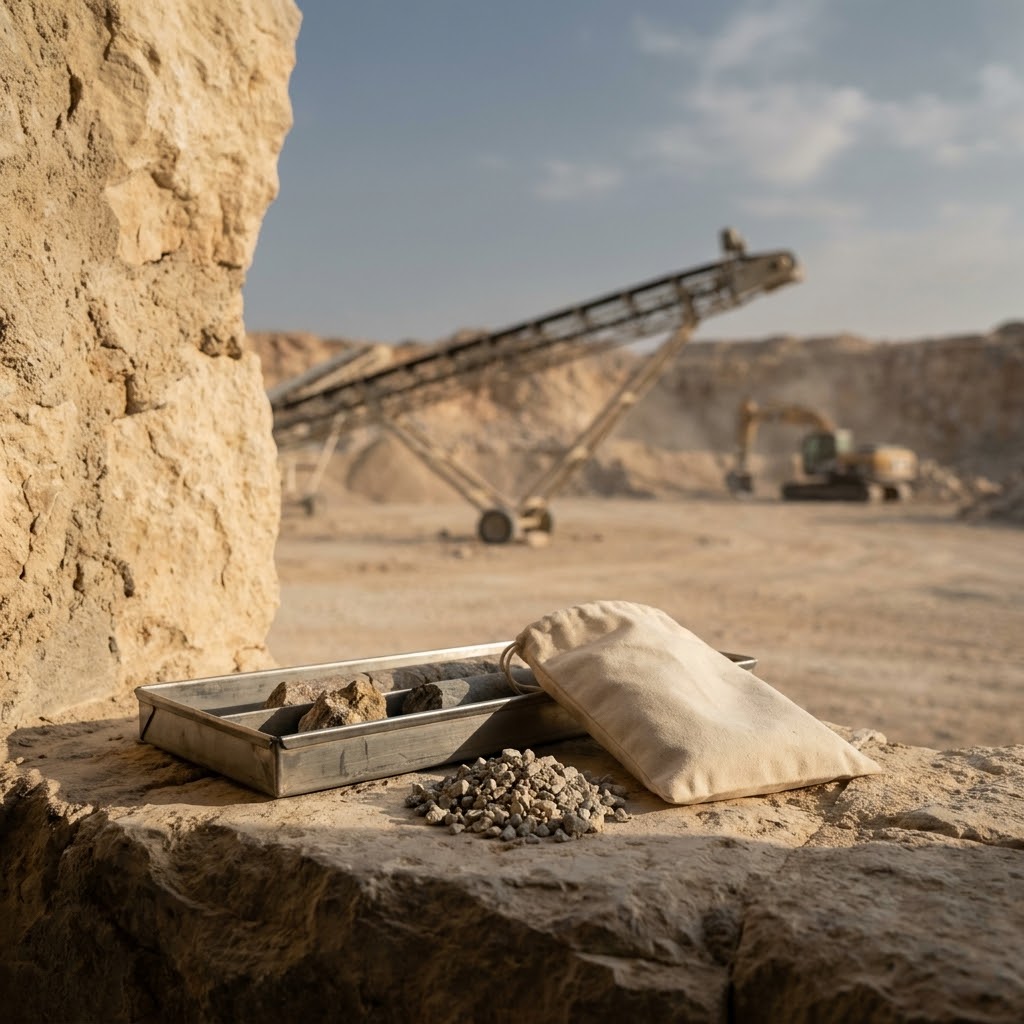
Mining, quarrying and mineral processing are not one business model in Oman. A company may hold a right to explore or extract minerals. It may operate a quarry. It may process material bought from licensed sources. It may also work only as a contractor for a mineral-right holder.
The first question is therefore not only which company to register. The first question is what legal right the business needs over the mineral, the site and the material.
A Commercial Registration can record business activities. It does not by itself grant a right to prospect, explore, extract, possess or sell raw minerals. Mineral rights are controlled by the Ministry of Energy and Minerals, while land, environment, safety, labour, transport and export approvals can involve other authorities.
Start with the correct mining-business pathway
- Will the company search for or extract minerals? It needs a mineral right from the Ministry of Energy and Minerals, usually through a licence, public-site process or concession route.
- Will the company only process purchased material? It normally needs the correct industrial activities, a suitable site, proof of lawful material supply and the required industrial and environmental approvals.
- Will the company work for a licence holder? It needs the correct service activities, contracts, site access and specialist approvals. The service contract does not transfer the mineral right automatically.
- Will the company transport or export minerals? It must also check transport, customs, mineral-export and product-specific rules.
Mining business models at a glance
| Business model | Main legal question | Mineral right normally needed? | Other main approvals |
|---|---|---|---|
| Exploration or prospecting company | Can the company study a defined mineral area? | Yes | Site access, environment, land and technical approvals |
| Mine or quarry operator | Can the company extract and dispose of the mineral? | Yes | Land, environmental permit, traffic, water, safety and rehabilitation |
| Mineral processing plant | Is the material lawfully sourced and can it be processed at the selected site? | Not always, if it buys from licensed sources | Industrial activity, land, capacity, environment, utilities and safety |
| Contract mining or drilling contractor | Can it work for the right holder under an approved contract? | Not as an independent owner of the mineral | Correct service activities, site approval, HSE and specialist permits |
| Crusher or screening operator | Is it part of a licensed quarry or a separate processing business? | Depends on the model | Environment, land, traffic, water and operating approvals |
| Haulage, laboratory or maintenance company | Is it only providing a support service? | Usually no | Sector activity, vehicles or laboratory rules, contracts and site HSE |
1. Build the project in the correct order
A mining project should not start with equipment purchases. It should start with a clear legal and operational model.
- Define the exact activity. State whether the business will explore, extract, quarry, crush, screen, wash, concentrate, refine, test, maintain, transport or trade minerals.
- Identify the mineral and source. Confirm whether the material will come from the company’s own licensed area or from another licensed supplier.
- Check the right or site route. Review public mining sites, licence opportunities and concession tenders through the Ministry of Energy and Minerals and its Taqa platform.
- Check the commercial activities and ownership. The activity title must match the real work. Foreign ownership and sector approval must be checked separately.
- Choose the entity and location. The legal entity, extraction site, processing site, storage yard and office do not have to be the same place.
- Prepare technical and financial evidence. Mineral-right applications can require proof of technical ability, financial capacity, feasibility and an implementation plan.
- Complete land and environmental work. Site coordinates, land rights, an environmental study and external no-objection reviews may be needed before final operation.
- Obtain final operating approvals. Construction, equipment installation, commissioning, labour, safety, transport and export steps follow the approved project design.
Important: A company should not describe itself as a mine owner or quarry operator only because related activities appear on its Commercial Registration. The mineral right, land access and final operating approvals must exist separately.
2. Exploration and extraction rights
Oman’s Mineral Resources Law states that raw minerals are owned by the state. A person or company cannot legally explore, extract, possess or dispose of them without the required authority.
The Ministry of Energy and Minerals manages mineral opportunities and mining licences. Its Taqa platform includes public sites, concession opportunities and services for exploration and mining licences, renewals and closure.
Standard licences and concession agreements
| Route | General legal position | Indicative statutory term |
|---|---|---|
| Prospecting or exploration licence | A defined right to study and evaluate mineral potential under licence conditions | One year at a time; the law limits the total period after renewals to three years |
| Exploitation licence | A right to extract within an approved area and under stated conditions | Five years, renewable under the law |
| Mining concession agreement | Used for a larger or strategically defined mineral project and approved by Royal Decree | Normally between 20 and 30 years under the law |
An exploitation area above five square kilometres requires a concession route. A project involving precious metals or gemstones also follows the concession route. The concession agreement does not take effect until it is approved by Royal Decree.
The law also allows quarry materials that do not need prior prospecting, and sites already identified as economically viable, to follow an exploitation route without a separate prospecting stage. This is not an automatic exemption for every quarry. The Ministry must confirm the route for the exact mineral and site.
Royalties, guarantees and community contribution
- The Mineral Resources Law sets a royalty of not less than 5% of the annual production value.
- It sets a local community contribution of not less than 1% of annual production.
- It also requires a financial guarantee of not less than 1% of the approved project cost for a mineral licence.
- The final percentage, payment method, rent and other obligations can be fixed by the licence, executive rules or concession agreement.
The applicant should model these payments before bidding or signing a site agreement. They are different from corporate tax, customs charges, land rent, environmental guarantees and normal operating costs.
3. Quarrying in Oman
A quarry usually extracts stone, aggregate or another industrial mineral from a defined site. Limestone, gypsum and other quarry materials may have different technical and export conditions. The operator must confirm the exact mineral classification with the Ministry of Energy and Minerals.
A quarry project can need several rights at the same time:
- A valid mineral exploitation right or approved site award
- A registered right to use the surface land
- An environmental permit and approved environmental study where required
- Traffic review for quarry and crusher access
- Review of possible effects on groundwater, surface water, wells, aflaj, dams or water infrastructure
- Municipal, building, civil protection and utility approvals for the supporting facilities
- A rehabilitation and closure plan
The quarry and the crusher should not be treated as the same approval. A crusher may be inside the quarry project, at another approved site or part of a separate processing plant. Its land, production capacity, environmental category, traffic effect and material source must be clear.
Practical land point: The Gov.om quarry-usufruct service asks for a letter, a cadastral plan and the mining licence contract. This shows why mineral approval and surface-land rights must be planned together, but they remain separate legal steps.
4. Mineral processing and refining
A mineral processing company may not need its own extraction right when it buys material from a lawful source. It still needs proof that the seller and material are licensed, the correct industrial activities, a suitable location and the required environment and safety approvals.
| Stage | Simple meaning | Main planning point |
|---|---|---|
| Exploration | Study whether a mineral deposit exists and can support a project | Mineral licence and technical work |
| Extraction | Remove mineral material from the ground | Exploitation licence or concession, land and environment |
| Primary processing | Crush, screen, wash, sort or concentrate material | Material source, plant activity, capacity, waste, dust and water |
| Refining or manufacturing | Change the mineral into a higher-value product or industrial input | Industrial technology, utilities, emissions, product standards and market |
Processing plants and service bases
A processing plant may fit an industrial city, an economic zone, a free zone or another approved industrial location. The choice depends on the activity, land size, electricity, water, gas, road access, port access, waste route and environmental classification. Oman Verified’s industrial location advisory in Oman can help compare Madayn locations for a processing plant or service base.
An export-focused plant may also assess Oman free-zone selection advisory. A free-zone company does not receive a mineral right merely because it operates in a zone. The raw material must still come from a lawful source, and mainland movement and customs rules must be checked.
Before reserving land, prepare a utility schedule. Crushing and screening can need large electrical loads. Washing and beneficiation can need water treatment and recycling. Some refining processes can create hazardous residues or emissions. A low land price is not useful when the site cannot support the process.
5. Contract mining and mining services
A contractor can provide services to a mine or quarry without owning the mineral right. Examples include drilling support, contract mining, crushing, equipment maintenance, laboratory work, earthmoving and site services.
This model does not allow the contractor to independently extract, keep, trade or export the mineral. The work must remain within the right holder’s approved site, licence, production plan and environmental conditions.
The Mineral Resources Law requires written approval from the Ministry before a concessionaire assigns mining operations to a subcontractor. The project contract should therefore state which party holds each approval and who is responsible for production records, royalties, safety, environmental incidents, rehabilitation, insurance and material ownership.
Select the correct service activities
Do not add one broad activity and assume it covers all mining work. Drilling, equipment rental, road transport, laboratory testing, maintenance, construction and mineral trading can be separate activities. You can search Oman commercial activity codes before the company application.
The tool only searches stored activity codes. It does not prove that an activity is open to foreign ownership, that it covers the planned work or that the Ministry of Energy and Minerals or another regulator will approve it.
6. Crushing, screening, haulage and laboratories
Crushing and screening
A crusher or screening unit should have a documented material source. The authority may review its site coordinates, land agreement, annual capacity, dust and noise controls, haul roads, water effect, waste and rehabilitation duties.
A mobile unit is not automatically free from approval. Its activity, location, movement, fuel storage, noise, dust and work inside the licence area must still match the project approvals.
Mineral haulage
Mineral transport can involve heavy vehicles, site roads, public roads, axle limits, load security, vehicle licensing and digital transport requirements. A mine contract does not replace the transport company’s own permits. Review the separate guide to road freight and trucking requirements in Oman.
Mineral laboratories
A mineral laboratory can test grade, moisture, particle size and other quality points. Its commercial activity, premises, equipment, staff and quality system should match the tests it offers. Where a test supports a government filing, shipment, sales specification or product claim, confirm whether the authority or customer requires an approved or accredited laboratory.
Good contracts also define sampling, sample custody, repeat testing, retained samples, reporting format and responsibility for disputed results.
7. Land, environment and rehabilitation
Land access
A mineral right is not the same as ownership of the land. The project may need a usufruct, lease or another approved land arrangement for the quarry, plant, stockpile, workshop, road, tailings area and utilities.
The site drawing should show the complete operating footprint. Leaving the crusher, waste area or access road outside the approved boundary can create a serious compliance problem later.
Environmental permit and EIA
Mining and quarry projects can fall under the Environment Authority’s Class A permit route. This route requires an environmental impact assessment prepared by an Environment Authority-approved consultancy. The exact environmental category must be confirmed for the specific project.
| Published Class A point | Environment Authority information reviewed on 30 July 2026 |
|---|---|
| Permit validity | Renewable for three years |
| Published processing target | 30 working days when all required documents are complete |
| Published service fee | OMR 1,500 |
| Financial guarantee for mining and extraction of listed minerals | OMR 30,000 |
| Financial guarantee for crushers and quarries | OMR 7,000 |
| Financial guarantee for automatic screens, prospecting and exploration of listed minerals | OMR 5,000 |
These are published environmental service figures. They are not the full cost of the project. They also do not confirm that every processing activity has the same category, fee or guarantee. Check the live service before submission.
The study can cover dust, noise, vibration, groundwater, surface water, waste rock, tailings, chemicals, fuel, biodiversity, nearby communities, traffic and emergency risks. The final permit may add monitoring, reporting and operating conditions.
Rehabilitation and closure
Rehabilitation is not only an end-of-project document. The mine design should show how disturbed land, pits, waste areas, buildings, roads and contamination will be managed during operation and at closure.
The Mineral Resources Law places rehabilitation and site-cleaning duties on the right holder. The company should include closure cost in its financial model and keep records that show progressive rehabilitation where possible.
8. Safety and specialist approvals
Mining and quarrying have serious risks. The company needs a working health, safety and environment system, not only a policy document.
- Identify site hazards and control access to active areas.
- Train workers and contractors before they enter the site.
- Use approved emergency, first-aid and incident-reporting procedures.
- Control vehicle movement, reversing, loading and pedestrian areas.
- Monitor dust, noise and other exposures required by the permit.
- Inspect plant, lifting equipment and electrical systems.
- Keep contractor HSE duties clear in the contract.
Explosives and blasting
Explosives, blasting materials, storage, transport and use are specialist regulated matters. A company should use licensed specialists and obtain the required approvals from the Royal Oman Police and other competent authorities. A mining licence does not by itself authorise the import, storage, transport or use of explosives.
Other site clearances
The site may need review because of roads, borders, defence or security areas, heritage sites, nature reserves, settlements, water resources or public infrastructure. The Ministry of Energy and Minerals can seek the views of the relevant authorities during the mineral-right process.
Do not treat a quiet or remote location as an approved location. Complete the official coordinate and cadastral checks first.
9. Export and downstream processing
Mineral export can require a customs declaration and a mineral export certificate or other approval. The exact route depends on the mineral, its level of processing, the exporter, the transport route and current Ministry rules.
Oman Customs currently publishes a metal-export certificate service linked to the Ministry of Energy and Minerals. The service information states that one certificate is linked to one metal, one exporter and one consignee, and that an invoice is required. The live customs permit directory should be checked before every shipment.
Current gypsum and chrome export rule
Ministerial Decision 18/2025 took effect one year after its publication in May 2025. It gives Oman Minerals Trading Company the exclusive right to export raw gypsum and chrome ores of all types from Oman. The local market has priority.
For raw chrome ore, the decision requires a concentration of at least 36%. Processed chrome at other concentration levels requires written approval from the Ministry of Energy and Minerals. A producer, trader or logistics company should confirm the current commercial and document route before signing an export contract.
Importing plant, spare parts, chemicals or specialist equipment can also need product permits, standards documents or hazardous-material approvals. Oman Verified provides customs clearance support in Oman for the customs and document side of mineral export and equipment import.
Downstream processing can improve product value, but it must be commercially real. The investor should compare power, water, yield loss, waste, port cost, customer specification and market price before building a plant.
10. Short company, residence and banking pathway
Legal entity
The operating company is registered through the Oman Business Platform. A foreign-investment company should also check whether it needs the investment licence issued after Commercial Registration. The feasibility study, experience, bank evidence and lease can form part of that application.
The entity must contain the correct commercial activities, but the sector approvals remain separate. Oman Verified’s Oman company setup advisory covers the legal-entity and post-registration pathway without treating registration as a mining approval.
Owners, engineers and technical workers
Residence and work permissions are separate from the company and mining licences. Owners, engineers, geologists, laboratory staff, equipment operators and other workers must follow the current immigration and labour route. The Oman visa and residency services page explains the separate company-owner, employee and family pathways.
Technical workforce and safety
Do not rely on one old Omanisation percentage. The Ministry of Labour’s live inquiry checks activity, occupation, establishment size, service, company type and location. Foreign-investment entities should also check the current rule on employing an Omani after the first year and any sector duties. Oman Verified offers labour and Omanisation support in Oman for the live workforce review.
Project finance and operating account
A bank may ask for the company documents, ownership information, source of funds, business plan, contracts, licences, site evidence and expected payments. Mining and processing projects can face extra review because of high capital needs and international trade. Corporate bank account opening support in Oman can help prepare the file, but no adviser can guarantee bank approval.
11. Costs and useful tools
The company-registration cost is usually a small part of a mining project. A realistic budget should separate official rights, land, studies, construction and working capital.
| Cost group | Examples | Why it changes |
|---|---|---|
| Company and compliance | Commercial Registration, investment licence, Chamber, tax, accounting and renewals | Entity, activities, ownership and annual duties |
| Mineral right | Application, tender or concession commitments, rent, royalty and guarantees | Mineral, area, production and agreement terms |
| Land | Usufruct, lease, survey, registration and annual land charges | Location, use and area |
| Technical work | Geology, feasibility, mine planning, engineering and laboratory work | Project stage and data quality |
| Environment and safety | EIA, permit, guarantee, monitoring, rehabilitation, insurance and emergency systems | Environmental category and risk |
| Plant and infrastructure | Crusher, processing line, roads, power, water, buildings, workshop and storage | Capacity, technology and site condition |
| People and operations | Recruitment, training, visas, accommodation, fuel, maintenance and stock | Workforce and production model |
| Logistics and trade | Vehicles, customs, port, testing, permits and shipping | Product, route and market |
The Oman company setup cost calculator can estimate general mainland company and investor-residence costs. It does not calculate mining rights, land, environmental studies, factories, equipment, utilities, vehicles, inventory or specialist approvals.
Budget rule: Do not use an online company-registration estimate as the project budget. Build a separate financial model for mineral rights, studies, land, rehabilitation, infrastructure, working capital and delayed production.
12. Common mistakes
- Treating the Commercial Registration as a mining licence. It is not a mineral right.
- Using one activity for several different operations. Extraction, processing, transport, testing and maintenance may need separate activities.
- Buying equipment before securing the site and approvals. The selected location may not support the process or capacity.
- Ignoring the lawful source of raw material. A processing or trading company should be able to prove where the mineral came from.
- Assuming the quarry approval includes the crusher. The crusher can have separate site and environmental conditions.
- Using an old Omanisation percentage. The live Ministry of Labour system should be checked for the exact activity, occupation and location.
- Signing a raw gypsum or chrome export contract without checking Decision 18/2025. The exclusive export and local-market rules are now material.
- Leaving rehabilitation until closure. The plan and budget should start during project design.
- Giving a contractor unclear responsibility. The contract should name the licence holder and allocate HSE, reporting, royalties and material ownership.
- Promising a fixed approval time. Site clearances, environmental review and concession approval can change the timeline.
13. Practical project checklist
- Write a one-page description of the exact business model.
- Name each mineral and planned product.
- Confirm whether the company will own a mineral right or buy from a licence holder.
- Check the active commercial activity codes and foreign-investment position.
- Review public sites, licences and concessions on the live Taqa platform.
- Prepare technical-capacity, financial-capacity and feasibility evidence.
- Map the complete land footprint, access road, plant, stockpile and waste areas.
- Confirm the environmental category and appoint an approved consultant if an EIA is required.
- Check traffic, water, heritage, nature, security and civil protection clearances.
- Define the material supply contract and proof of lawful origin.
- Prepare the HSE, emergency, monitoring and contractor-management systems.
- Check current labour and Omanisation rules for every main occupation.
- Model royalty, community contribution, land, environmental guarantee and closure costs.
- Confirm customs and mineral-export requirements before agreeing a sale.
- Check the current gypsum and chrome export route when either mineral is involved.
- Keep approval conditions, production records, invoices and shipment records in one compliance system.
Frequently asked questions
Does registering a company in Oman give it mining rights?
No. A Commercial Registration records the company and its activities. The right to prospect, explore or extract minerals must come from the Ministry of Energy and Minerals through the correct licence, site or concession route.
Can a foreign investor own a mining or mineral processing company?
Foreign ownership is possible for many business activities, but it is not automatic for every activity or project. Check the exact activity code, the Negative List, the investment-licence requirements and any sector approval before choosing the ownership structure.
What is the difference between a mining licence and a concession?
A standard licence is used for the mineral rights allowed under the normal licensing route. An exploitation area above five square kilometres, or a project involving precious metals or gemstones, follows a concession agreement. A concession becomes effective after approval by Royal Decree.
Does every quarry need a separate exploration stage?
Not always. The Mineral Resources Law allows an exploitation route for quarry materials that do not need prospecting and for some identified viable sites. The Ministry must confirm that the exception applies to the exact mineral and site.
Can a contractor work at a mine without owning the mineral right?
Yes, a contractor may provide approved services for the right holder. It still needs the correct commercial activities, contracts, site access and specialist permits. It cannot independently take or sell the mineral. Concession subcontracting can also need written Ministry approval.
Does a mineral processing plant need a mining licence?
Not always. A plant may buy material from licensed sources instead of extracting it. It must prove lawful supply and obtain the correct industrial, land, environmental, safety and operating approvals for its process.
Can any company export raw gypsum or chrome from Oman?
No. Ministerial Decision 18/2025 gives Oman Minerals Trading Company the exclusive right to export raw gypsum and chrome ores. It also gives priority to the local market and sets a concentration rule for raw chrome. Confirm the current route with the Ministry before contracting or shipping.
How long does it take to start a mining or quarry project?
There is no single reliable timeline. A service page may publish a target for one approval, but a complete project can also need site award, technical studies, land, EIA, external clearances, construction and commissioning. A concession also needs Royal Decree approval. Do not promise a fixed start date before the route is known.
Related Oman Verified guides and services
Foreign-investment activity check
Understand the difference between a prohibited activity and a regulated activity through the guide to restricted activities for foreign investors in Oman.
Workforce planning
Read how quotas, occupations and company conditions affect Omanisation requirements for companies.
Regional market access
Review how origin, product rules and documentation can affect the use of Oman’s trade agreements.
Long-term investment context
Place mining and downstream industry inside the wider context of Oman Vision 2040 investment priorities.
Conclusion
A mining, quarrying or mineral processing company in Oman needs more than a Commercial Registration. The correct route depends on who owns the mineral right, where the material comes from, where it will be processed and which party will operate each stage.
The safest approach is to separate the project into rights, land, environment, plant, workforce, transport and export. Confirm each part before committing to a site, equipment purchase or sales contract.
International setup support
Oman Verified supports international investors with Oman-side mining and mineral-project setup, including company formation, licensing, land, environmental, labour, customs, banking and export coordination. The Ministry of Energy and Minerals, Environment Authority, Oman Business Platform, Oman Customs and other competent institutions complete their respective official decisions and approvals.
Official sources
- Ministry of Energy and Minerals — minerals, laws and regulations
- Gov.om — Taqa, Ministry of Energy and Minerals e-services platform
- Gov.om — identify public mining sites
- Environment Authority — environmental permit for Class A activities
- Gov.om — usufruct contract for mining sites and quarries
- Gov.om — usufruct contract for crusher sites
- Gov.om — Royal Oman Police study of quarry and crusher requests
- Gov.om — water-resource review for crushers and quarries
- Gov.om — investment licence
- Ministry of Labour — activity and occupation status inquiry
- Oman Customs — certification to export metals
- Ministry of Energy and Minerals — Decision 18/2025 on gypsum and chrome export
- Madayn — industrial cities
- OPAZ — Special Economic Zone at Duqm
Official public information reviewed on 30 July 2026. Confirm the current requirements in the live government systems before submission.