
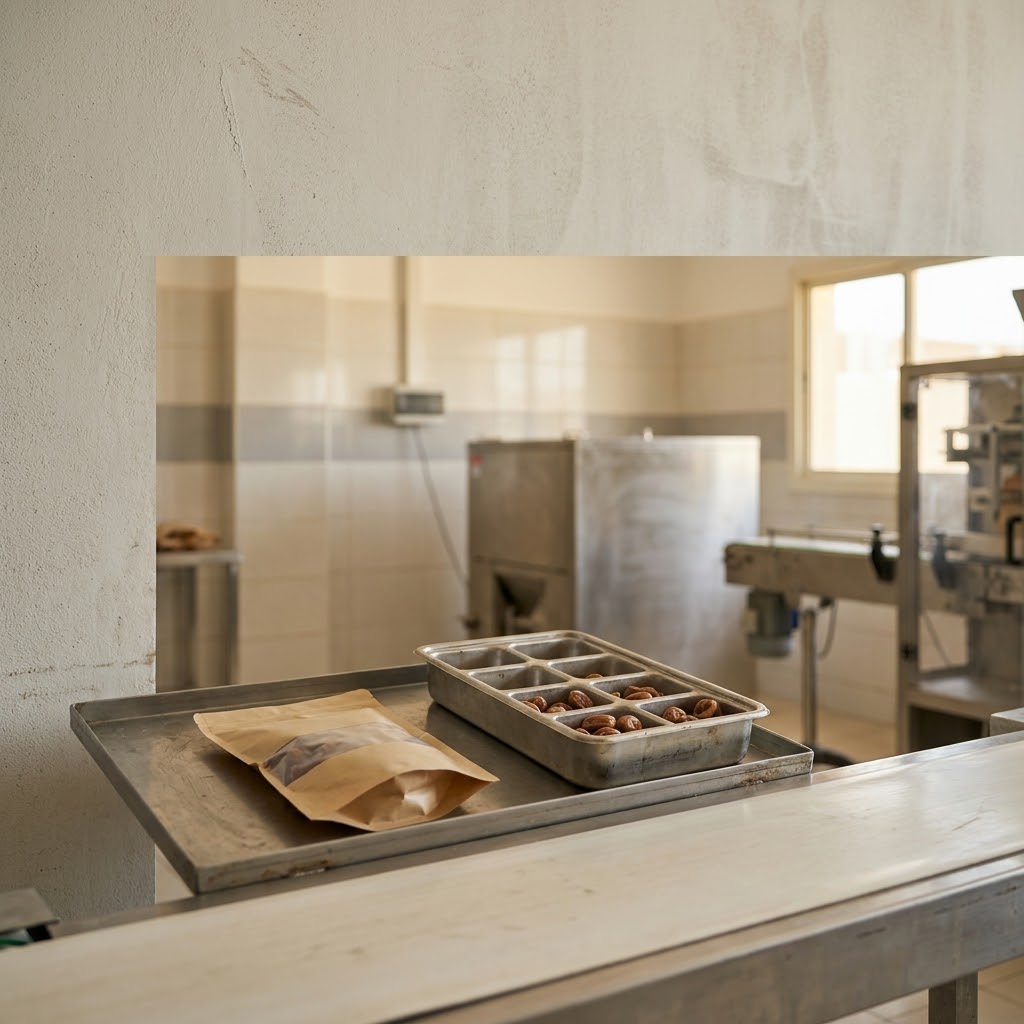
A food processing business changes raw or partly prepared ingredients into a new food product. A food manufacturing business repeats that process under controlled factory conditions. Packaging protects the finished product, gives required information and prepares it for storage, sale or export.
These activities are different from importing finished food, distributing other brands or operating a restaurant. A manufacturer must plan the product, factory, process, hygiene controls, packaging, testing, traceability and approvals as one connected system.
This guide explains the main planning questions for canned food, ready meals, dried products, spices, sauces, packaged food and export production in Oman. Exact requirements depend on the product, ingredients, process, location, production capacity and destination market.
The basic approval logic
- Define every product and production process.
- Select commercial and industrial activities that match the real work.
- Choose a location that accepts the activity and required utilities.
- Design the factory before signing equipment and construction contracts.
- Complete industrial, environmental, civil-protection and location approvals.
- Build and validate the production, food-safety and packaging system.
- Test and register each product where the applicable system requires it.
- Start commercial production only after the required licences are active.
Important: A commercial registration alone does not normally prove that a food factory may start production. Product, industrial, environmental, municipal, civil-protection and other approvals may still apply.
Food manufacturing in Oman at a glance
| Planning area | Main question | Typical evidence or control |
|---|---|---|
| Business activity | What exactly will the factory make? | Product list, process description and correct activity selection |
| Location | Can the site legally and technically support the factory? | Land or lease approval, zoning, utilities and location consent |
| Industrial approval | Is the manufacturing activity licensed? | Industrial licence and stated production capacity |
| Environment | What waste, emissions, water use or noise will the factory create? | Environmental classification, permit and any required study |
| Food safety | How will contamination be prevented? | Hygiene zoning, sanitation, pest control and process controls |
| Product compliance | Does each product meet the applicable specification? | Formula, label, nutrition information and laboratory reports |
| Shelf life | How long is the product safe and acceptable? | Validated shelf-life study under expected storage conditions |
| Traceability | Can every batch be followed and recalled? | Supplier lots, batch codes, production records and dispatch records |
| Export | Does the destination accept the product and documents? | Destination rules, test reports, certificates and customs file |
1. Define the manufacturing model first
Do not begin with a broad description such as “food business” or “general food production.” Start with a complete list of products and explain what happens to each product inside the facility.
For example, washing, cutting and packing vegetables is different from cooking a shelf-stable sauce. Roasting and grinding spices is different from mixing a powdered drink. Canning fish is different from producing frozen ready meals. Different processes can lead to different activities, equipment, hazards, utilities and approvals.
Manufacturing is not the same as trading
| Model | What the business does | Main compliance focus |
|---|---|---|
| Food manufacturing | Transforms ingredients into a new finished product | Factory, process, food safety, product and industrial approvals |
| Food packaging inside production | Packs the factory’s own finished food | Food-contact material, seal integrity, label and batch control |
| Packaging manufacture | Makes bottles, trays, films, pouches, cartons or other packaging | A separate manufacturing process and possibly separate industrial activities |
| Food trading | Buys and sells finished products without manufacturing them | Trading activity, product registration, storage and distribution |
| Food import and distribution | Imports products or ingredients and supplies the local market | Customs, product controls, warehouse and distribution requirements |
A factory may need more than one activity when it produces several unrelated product groups or also sells products made by other manufacturers. Use the search Oman commercial activity codes tool to identify possible codes. The tool is only a search aid. It does not confirm foreign-ownership eligibility, industrial approval or regulator acceptance.
2. Product categories and approval planning
Each product family creates a different technical file. The table below is a planning guide, not an official product classification.
| Product category | Typical process questions | Important control areas |
|---|---|---|
| Canned food | Cooking, filling, sealing, heat treatment and cooling | Container integrity, thermal process, microbiology and batch records |
| Ready meals | Raw preparation, cooking, cooling, filling and chilled or frozen storage | Time and temperature, allergen separation and cold chain |
| Dried food | Drying method, final moisture, packing and storage | Water activity, mould risk, foreign matter and moisture barrier |
| Spices and powders | Cleaning, roasting, grinding, blending and filling | Contamination, allergens, dust control, metal detection and humidity |
| Sauces and condiments | Mixing, heating, acidity control, hot filling or cold filling | pH, preservative limits, seal control and shelf-life validation |
| Packaged snacks | Cooking or baking, seasoning, cooling and packing | Oil quality, oxidation, allergens and package atmosphere |
| Chilled products | Preparation, rapid cooling, packing and refrigerated dispatch | Cold-chain limits, short shelf life and microbiological controls |
| Frozen products | Preparation, freezing, frozen storage and transport | Freezing performance, temperature records and thawing instructions |
One activity may not cover every product. A factory producing spices, dairy products, meat products and plastic food containers may need separate activities and approvals. Confirm the exact scope before buying equipment or signing a long lease.
3. Choose the factory location
The correct location depends on the production process, land use, building type, utilities, waste, transport, workforce and target market. Food manufacturing is normally better suited to an approved industrial location than a normal shop, office or residential building.
Before signing a lease, complete a factory location assessment in Oman. Check whether the selected industrial city, free zone or other approved site accepts the proposed activity and production capacity.
Location questions to answer
- Is the activity accepted on the selected plot or unit?
- Is there enough clean water for production and sanitation?
- Is the electricity supply suitable for the production line and cold rooms?
- Is gas, steam, compressed air or another utility needed?
- Can wastewater and food waste be handled legally?
- Can raw materials and finished goods move without crossing unsafe routes?
- Is there space for future capacity, quarantine stock and a recall area?
- Can trucks enter, turn, load and leave without blocking hygiene areas?
- Does the building support fire separation, emergency exits and safe chemical storage?
- Will staff transport and worker facilities be practical?
Mainland industrial location or free zone?
A mainland industrial location can be practical when the factory will sell directly into Oman. A free zone can be useful for export-oriented production, port access or a supply chain built around imported inputs. Local-market access, customs treatment, land terms and operating rules differ by zone. Export-oriented manufacturers can compare the SOHAR Freezone setup and facility route.
Export-focused investors can request a free-zone investment assessment in Oman. A free-zone licence does not automatically make a product Omani in origin and does not remove destination-country food rules.
4. Design the factory around product flow
The factory layout should reduce contamination, unnecessary movement and product damage. A good design follows the product from receiving to dispatch and keeps incompatible activities apart.
A simple production flow
- Supplier delivery and receiving inspection
- Raw-material quarantine and release
- Dry, chilled or frozen ingredient storage
- Washing, sorting or preparation
- Processing, cooking, drying, grinding or mixing
- Cooling or product stabilisation
- Filling, sealing and coding
- Metal detection, check-weighing or other final controls
- Finished-product quarantine
- Quality release
- Finished-goods storage
- Dispatch and transport
Not every factory needs every stage. The process must match the product. The important point is to show where materials enter, where they change, where safety is controlled and where the final batch is released.
Rooms and zones often needed
- Receiving and inspection area
- Raw-material quarantine
- Dry ingredient store
- Chilled and frozen storage
- Packaging-material store
- Preparation and washing room
- High-care or post-cook zone
- Finished-product quarantine
- Released finished-goods store
- Rejected and returned goods area
- Chemical and cleaning store
- Waste holding area
- Staff changing and handwashing areas
- Quality-control or sample room
Do not use a copied factory plan. A spice factory, canned-food line and chilled-meal facility have different contamination risks. The layout should be prepared for the real process, equipment, staff and capacity.
5. Select equipment after the process is fixed
Equipment should not be selected only by price or maximum output. It must match the formula, batch size, cleaning method, food-contact requirements, available utilities and packaging format.
| Equipment area | Planning questions |
|---|---|
| Preparation | Can equipment be cleaned fully? Does it create product traps or cross-contamination? |
| Processing | Can time, temperature, pressure, pH or moisture be measured and recorded? |
| Cooling | Can the product reach the required temperature fast enough and consistently? |
| Filling | Is the filler suitable for the product viscosity, particle size and hygiene level? |
| Sealing | Can seal strength and closure integrity be checked? |
| Detection | Is metal detection, X-ray, sieving or another foreign-body control needed? |
| Cleaning | Will cleaning be manual, clean-in-place or a combined system? |
| Utilities | What water, drainage, electricity, steam, gas, air and ventilation are required? |
Ask the supplier for food-contact declarations, material specifications, electrical requirements, water use, cleaning instructions, spare-parts support, calibration needs and commissioning records. Imported equipment may also need customs documentation and installation planning.
6. Build a food-safety and hygiene system
A safe factory needs more than clean walls and uniforms. It needs written controls that staff can follow and managers can verify.
Basic programmes
- Approved supplier and ingredient-control programme
- Personal hygiene and illness-reporting rules
- Cleaning and sanitation procedures
- Pest-control programme with mapped devices and service records
- Water-quality control
- Waste handling and removal
- Glass, brittle plastic and foreign-body control
- Preventive maintenance
- Calibration of measuring devices
- Allergen management
- Chemical storage and use
- Food-contact packaging approval
- Training and competency records
- Traceability, complaint and recall procedures
HACCP and ISO 22000
A Hazard Analysis and Critical Control Point plan identifies important food-safety hazards and the controls needed for the real product and process. ISO 22000 is a wider food-safety management system. A customer, tender, retailer or export market may request certification.
Certification is not a replacement for the required government licence or product approval. A small factory should still use a product-specific hazard analysis, written procedures and records even when formal certification is not yet required.
Hygiene zoning
Separate dirty, raw, clean and high-care operations. Staff, tools, waste, raw materials and finished products should not move freely between zones. Colour-coded equipment, controlled doors, handwashing points and changing procedures can support the separation.
Products that are ready to eat after the final kill step need special care. Cooked food should not meet raw ingredients, dirty containers or staff coming directly from low-hygiene areas.
7. Packaging inside a food factory
Packaging is part of the food-safety and shelf-life system. It must be suitable for direct or indirect food contact, the filling temperature, expected storage, transport and product chemistry.
Packaging questions
- Is the material approved for the intended food contact?
- Can it tolerate hot filling, freezing, retort processing or oil contact?
- Does it block enough moisture, oxygen, light or odour?
- Can the package be sealed consistently?
- Can the seal be tested without damaging sale stock?
- Will the package survive stacking, transport and temperature changes?
- Can the batch code and date remain readable throughout shelf life?
- Are packaging suppliers and material lots traceable?
When packaging becomes a separate industrial activity
Placing the factory’s own food into a purchased pouch, bottle, can or carton is normally part of the food-production process. Making the pouch, bottle, tray, film, cap, carton or other packaging material can be a different industrial activity.
The distinction matters when the company converts plastic, paper, metal or another material into packaging, sells empty packaging, prints packaging for other companies or operates a separate packaging-production line. Confirm the commercial and industrial activities for both sides of the operation.
8. Food labels and product files
Do not print a large quantity of packaging before the label is reviewed. A label error can delay product registration, block a shipment or force the company to destroy or rework packaging.
Information commonly planned for a label
- Product name
- Ingredient list in descending order
- Allergen information
- Net quantity
- Nutrition information where required
- Production and expiry or best-before information
- Storage and handling instructions
- Preparation or use instructions where needed
- Manufacturer name and address
- Country of origin
- Batch or lot code
- Any required warning
- Evidence for nutrition, health, halal or other claims
Labels for Oman and other Arabic-speaking markets should be planned with clear Arabic information and any other permitted language. The exact wording, date format, nutrition panel, claims and required statements depend on the applicable product specification and destination.
The official Oman food-product registration service states that products made in Oman may be checked before local sale. Its listed documents include a product image, a PDF label, nutrition information, an invoice or packing list where applicable, a laboratory report and evidence supporting any nutrition or health claim. The current service also states that one product is registered per application.
Practical rule: Keep one controlled product file for every flavour, size or formula that is treated as a separate product. Do not assume that approval of one item automatically covers the full range.
9. Shelf-life testing and product validation
Shelf life is not a marketing estimate. It is the period during which the product remains safe, legal and acceptable when it is made, packed, stored and transported under defined conditions.
There is no single shelf-life period for all sauces, spices, meals or canned food. The study must consider the formula, pH, water activity, process, packaging barrier, seal, storage temperature, expected handling and relevant microorganisms.
A shelf-life plan may include
- Microbiological testing
- Chemical and nutritional testing
- pH and water-activity monitoring
- Moisture, oxidation or rancidity checks
- Colour, flavour, texture and odour review
- Package and seal inspection
- Storage under normal expected conditions
- Temperature-abuse or transport simulation where relevant
- Testing at planned intervals until the proposed end date
Real-time and accelerated studies
A real-time study stores the product under normal conditions for the full planned period. An accelerated study uses more stressful conditions to identify likely changes earlier. Accelerated testing can support development, but it may not replace real-time validation for every product.
Use a competent laboratory and a qualified food technologist to define the testing plan. Keep the final report, sample identity, batch records, method, storage conditions and conclusion in the product file.
10. Batch traceability and food recall
A factory should be able to identify which ingredients and packaging entered each finished batch, where that batch was stored and which customers received it.
Minimum traceability records
- Supplier name and approved status
- Ingredient name, supplier lot and receiving date
- Packaging-material supplier and lot
- Production date, line and internal batch number
- Operators and important process records
- Quality checks and release decision
- Quantity produced, rejected and released
- Warehouse location
- Customer, invoice, dispatch date and quantity
The batch code printed on the pack should connect to the internal production file. It should not be created only for appearance.
Recall readiness
Create a recall team, contact list, decision process, stock-blocking method and communication template before the first sale. Run a mock recall to test whether the company can identify affected materials and customers within a practical time.
Returned or recalled product should be held in a controlled area until an authorised decision is made. It must not return to normal sale stock by mistake.
11. Imported ingredients, packaging and machinery
A factory may import ingredients, additives, packaging, processing equipment and spare parts. Each item should be reviewed before shipment for the correct HS code, permit, product standard, certificate and customs document.
Oman Customs uses the Bayan system for customs declarations. Commercial invoices, origin documents, shipment records and any required permits should match the real goods. Companies that need help preparing a live shipment can use customs documentation support in Oman.
Imported food inputs
- Confirm whether the ingredient or additive is permitted for the product.
- Check the specification, purity and intended use.
- Obtain a supplier certificate of analysis where appropriate.
- Confirm allergen and genetically modified ingredient information.
- Check health, halal, veterinary or phytosanitary documents where relevant.
- Keep the supplier lot connected to the finished batch.
Imported packaging
Ask for material composition, food-contact suitability, migration or compliance evidence where relevant, printing-ink information and a full technical specification. The material should be approved for the exact product and process, not only described as “food grade” in a sales message.
12. Exporting processed food from Oman
Export approval is not one universal certificate. Requirements depend on the product and destination. A GCC market, the United States, India, East Africa or another market may apply different label, ingredient, testing, facility-registration and certificate rules.
Export file checklist
- Destination-country product and label review
- Approved product formula and specification
- Laboratory reports accepted for the destination
- Commercial invoice and packing list
- Certificate of origin where needed
- Food health, safety, free-sale or export certificate where required
- Halal evidence for relevant products and markets
- Veterinary or phytosanitary documents where relevant
- Transport temperature and container requirements
- Customs declaration and export permits
Official Oman services for food export can require a valid commercial registration and activity licence, registration in Bayan, a sales invoice and an approved laboratory report. Product-specific or destination-specific documents may also apply.
Origin and trade agreements
Manufacturing in Oman does not automatically qualify every product for preferential origin. The product must meet the rule of origin for its HS code and the chosen agreement. Simple storage, relabelling or repacking may not create Omani origin.
Keep supplier origin, bill of materials, production, cost, batch and transport records when a tariff preference is part of the business model. Confirm the origin rule before finalising the formula and supply chain.
13. Short company, residence and banking pathway
The legal company is only one part of the factory project. The company activities, industrial location, external approvals and planned ownership should be reviewed together. For a structured first review, use Oman company setup advisory.
Simple sequence
- Confirm shareholders, ownership and proposed activities.
- Prepare the commercial-registration route.
- Select the industrial location and obtain location consent.
- Apply for industrial and related approvals.
- Complete construction, equipment installation and inspections.
- Prepare product, food-safety and laboratory files.
- Complete product and operating approvals.
- Open the operating, labour, customs, tax and banking files needed by the project.
Owner and technical workforce
Investor residence, employee permissions and technical staff approvals are separate from the company and factory licences. Job titles, labour permissions, Omanisation and reserved occupations can change. Plan the organisation chart before ordering a labour-intensive production line.
Factories can use workforce compliance support in Oman to review job titles, local hiring duties and labour-file coordination. Final decisions remain with the Ministry of Labour and other competent authorities.
Banking and operating account
A bank may request the business plan, shareholders’ information, source of funds, factory lease, equipment invoices, expected suppliers, customers and transaction routes. The bank independently decides whether to approve the account or finance.
Prepare the file early through business banking preparation support. Do not assume that a commercial registration or industrial approval guarantees bank acceptance.
14. Industrial, environmental and safety approvals
Oman’s current government service directory includes an industrial-licence service under the Ministry of Commerce, Industry and Investment Promotion. The industrial licence is the approval that allows the approved manufacturing operation to start after issuance, subject to the other required permissions.
Environmental approval depends on the project classification, location, production capacity and impact. The Environment Authority publishes different permit routes for activities inside approved industrial estates and for projects outside them. An environmental study or site visit may be required.
Industrial-city operating approvals may also require evidence such as a civil-protection certificate, building-completion certificate and insurance. Civil-protection approval can include plan review, equipment requirements and a final site inspection.
Approval order matters. Do not complete construction before the relevant plans are accepted. Do not start commercial production because the equipment has arrived. Confirm the active industrial, environmental, fire-safety, location and food approvals first.
15. Costs and planning tools
The cost of a food factory cannot be reduced to a general company-registration fee. The main budget normally includes the legal company, industrial location, design, approvals, construction, utilities, machinery, laboratory work, packaging development, initial stock, staff and working capital.
| Cost group | Examples |
|---|---|
| Company and legal setup | Commercial registration, documents, external approvals and professional coordination |
| Location | Land or unit rent, deposits, industrial-estate charges and utility connections |
| Design and approvals | Architectural, process, fire, environmental and engineering work |
| Building and fit-out | Floors, walls, drainage, ventilation, cold rooms, loading and staff facilities |
| Equipment | Processing, filling, packing, quality control, cleaning and spare parts |
| Product development | Formula work, pilot batches, labels, laboratory testing and shelf-life studies |
| Operations | Ingredients, packaging, salaries, transport, maintenance, pest control and insurance |
| Working capital | Stock, customer credit, export cycle, rejected batches and delayed approvals |
The mainland company registration cost estimator can show an indicative company and investor-residence starting point. It does not calculate industrial land, construction, utilities, factory machinery, product development, environmental studies, laboratory testing, inventory or sector approvals.
16. Common mistakes
Using one vague activity for many products
A broad commercial description may not cover the real manufacturing lines. List each product family and process before registration.
Signing the factory lease too early
The site may not accept the activity, production capacity, wastewater, cold storage or fire-safety design. Obtain technical confirmation first.
Buying equipment before fixing the formula
The selected equipment may not handle the product viscosity, particle size, heating method, cleaning system or packaging format.
Printing packaging before label review
A small wording or nutrition error can make a large quantity of packaging unusable.
Copying a shelf life from a competitor
A competitor may use a different formula, process, preservative, package or storage system. Shelf life must be validated for the real product.
Treating certification as the full licence
HACCP or ISO certification does not replace industrial, environmental, civil-protection, product or location approvals.
No batch-level records
Without supplier lots, process records and customer dispatch records, the company cannot investigate a complaint or perform a controlled recall.
Assuming exports will be automatically duty free
Trade-agreement benefits depend on the HS code, origin rule, production records and correct customs claim.
17. Practical factory checklist
- Prepare the complete product and flavour list.
- Write a simple process flow for every product family.
- Identify raw, ready-to-eat, allergen and high-care risks.
- Confirm possible commercial and industrial activities.
- Check ownership and external-approval conditions.
- Compare mainland industrial cities and free-zone options.
- Confirm water, power, drainage, gas, steam and cold-chain needs.
- Prepare a factory layout based on one-way product flow.
- Define equipment specifications before requesting quotations.
- Prepare environmental and waste information.
- Complete fire-safety and building approvals.
- Develop sanitation, pest-control and maintenance programmes.
- Prepare the product formula and specification.
- Select food-contact packaging and obtain supplier evidence.
- Review Arabic and destination-market labels.
- Plan laboratory and shelf-life testing.
- Create batch coding, traceability and recall procedures.
- Prepare import and export customs documents.
- Build the staffing and Omanisation plan.
- Keep working capital for approval delays and trial production.
Frequently asked questions
Can a foreign investor own a food manufacturing company in Oman?
Foreign ownership is available for many activities, but the exact position depends on the selected activity, current restricted lists and any sector approval. Confirm the live activity before registration.
Is food manufacturing the same as food trading?
No. Manufacturing transforms ingredients inside an approved production process. Trading buys and sells finished products. A company doing both may need activities and approvals for both models.
Can I manufacture food in a normal warehouse?
Not automatically. The location, building, utilities, drainage, hygiene design, fire safety and approved use must support the real food process. Confirm the site before signing a lease.
Does one industrial licence cover all food products?
Not always. Different product groups and processes can require separate activities, product files or approvals. List every planned product before applying.
Must every locally made food product be registered?
The current official food-product registration service includes products produced in Oman and states that one product is submitted per application. The exact route and whether a product is subject to conformity procedures should be checked in the live system.
Do I need HACCP or ISO 22000?
A product-specific food-safety system is important. Formal certification may be requested by a regulator, customer, retailer, tender or export market. Certification does not replace government licences.
How is the expiry date decided?
The date should be supported by a shelf-life study for the actual formula, process, package and storage condition. It should not be copied from another product.
Is packaging a separate business activity?
Packing the factory’s own food is part of production. Manufacturing bottles, pouches, trays, cartons or other packaging can be a separate industrial activity. Confirm the real scope before registration.
Can a free-zone factory sell in Oman?
Local-market access depends on the zone, customs treatment, company activities and product approvals. A free-zone licence should not be treated as automatic unrestricted mainland access.
Does manufacturing in Oman give automatic Omani origin?
No. Origin depends on the relevant rule for the product and trade agreement. Simple repacking, relabelling or storage may not be enough.
Related Oman Verified guides and services
Distribution after production
Review warehousing, wholesale customers and local delivery in the guide to food distribution and wholesale in Oman.
Export origin planning
Compare active agreements, product coverage and origin evidence in Oman’s trade agreements.
United States export route
Understand the product-specific origin and customs questions under the Oman–US Free Trade Agreement.
Tax and VAT operations
Factories needing registration, filing or ongoing records can review corporate tax compliance support in Oman.
Conclusion
A food factory in Oman should be planned from the product backwards. First define what will be made. Then design the process, factory, hygiene system, packaging, testing, approvals and supply chain around that product.
The strongest project file is not the one with the most documents. It is the one where the commercial activity, industrial licence, location, equipment, food-safety controls, label, laboratory evidence and batch records all describe the same real operation.
International setup support
Oman Verified supports international investors with Oman-side food-processing and manufacturing setup, including company formation, industrial licensing, food approvals and coordination with engineering, laboratory and other specialist providers where required. Live requirements depend on the product, process, capacity, location, ownership, nationality and destination market and are confirmed with the relevant authorities before major commitments.
Official sources
- Gov.om — Apply for an Industrial License
- Gov.om — Apply for a Food Product Registration Certificate
- Environment Authority — Environmental Permit Services
- Gov.om — Industrial Activity Licence in Industrial Cities
- Gov.om — Final Civil Protection Licence for an Establishment
- Oman Customs — Customs Declaration through Bayan
- Gov.om — Food Safety Certificate for Export Outside the Gulf
- Oman Customs — Certification to Export Foodstuffs to GCC Countries
- Ministry of Commerce, Industry and Investment Promotion — Services Directory
Official public information reviewed on July 30, 2026. Confirm the current requirements in the live government systems before submission.