
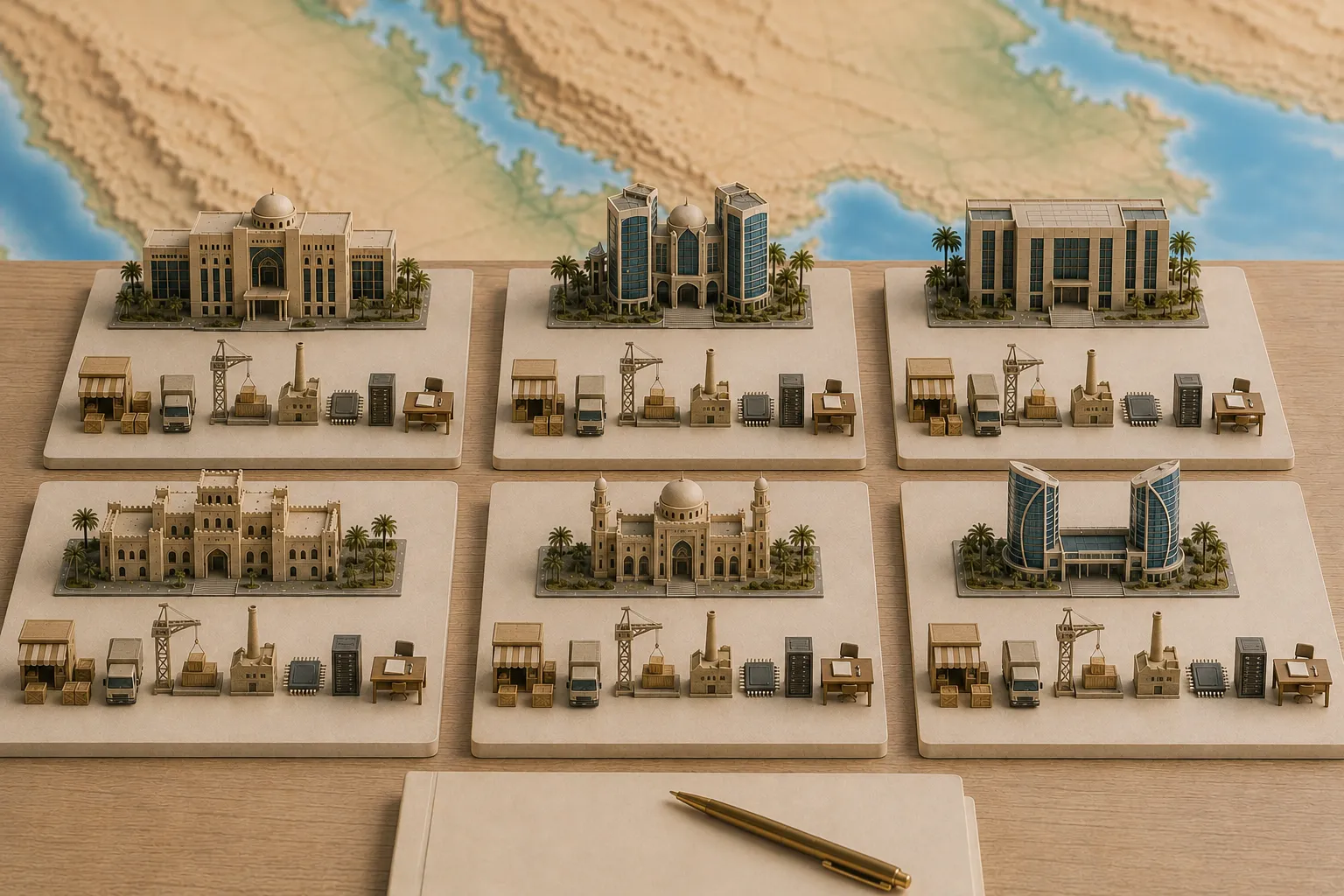
The best GCC country depends on what the company will sell, where its customers are and what it must operate. A country that works well for regional distribution may be a poor choice for a small consulting firm.
This guide compares Oman, the United Arab Emirates, Saudi Arabia, Qatar, Bahrain and Kuwait. It covers general trading, logistics, manufacturing, e-commerce, technology, consulting, fintech, construction, tourism and regional-headquarters operations.
The scores are editorial decision tools. They are not government rankings, legal opinions or promises of approval. Test the exact activity, customer, location, premises, staff plan and banking profile before choosing a country.
Start with the operating model
- Customer: local consumers, local companies, government buyers or overseas clients?
- Operation: office, shop, warehouse, factory, fleet, hotel or regulated platform?
- Money flow: local collections, cross-border invoices, trade finance or investor funding?
- People: founder only, specialist team, field workers or senior regional management?
- Geography: one domestic market, the full GCC, India and East Africa, or global clients?
Decision rule: choose the country only after these five answers are clear.
At a glance: which country often fits which model?
| Business model | Often strongest starting markets | Conditional alternatives | Main warning |
|---|---|---|---|
| General trading | UAE, Saudi Arabia | Oman, Qatar, Bahrain, Kuwait | A licence does not create demand or product approval. |
| Logistics and warehousing | UAE, Oman, Saudi Arabia | Qatar, Bahrain, Kuwait | The cargo route must justify the location. |
| Manufacturing and export | Saudi Arabia, Oman, UAE | Bahrain, Qatar, Kuwait | Land, utilities and customer access matter more than the CR fee. |
| E-commerce | UAE, Saudi Arabia | Oman, Qatar, Bahrain, Kuwait | Local fulfilment, consumer law and product rules still apply. |
| Technology and startups | UAE, Saudi Arabia | Bahrain, Qatar, Oman | Funding, customers and regulated activities are separate tests. |
| Consulting and services | UAE, Saudi Arabia | Oman, Bahrain, Qatar, Kuwait | A small market needs a narrow, high-value offer. |
| Fintech | UAE, Bahrain, Saudi Arabia, Qatar | Oman, Kuwait | Company registration is not a financial-services licence. |
| Construction and projects | Saudi Arabia, UAE | Oman, Qatar, Kuwait, Bahrain | Classification, bonds, staff and payment cycles can control entry. |
| Tourism and hospitality | UAE, Saudi Arabia, Oman | Qatar, Bahrain | Demand is location- and concept-specific. |
| Regional headquarters | UAE, Saudi Arabia | Bahrain, Qatar | A paper office without real functions creates tax and banking risk. |
Why the business model must come before the country
Country comparisons often start with ownership, tax or a low setup price. These points matter, but they do not show whether the company can operate.
A trader needs import rights, product approval, storage and buyers. A software firm may need only a clear activity, contracts, a bank account and suitable staff. A manufacturer needs land, power, water, environmental approval, raw materials and transport. A fintech company needs regulator acceptance before it can offer a regulated service.
The correct sequence is business model, target market, regulatory path, operating location and then legal entity. Reversing this order can leave the investor with a company that cannot perform the planned work.
Method, evidence and weighting
The comparison uses official public information reviewed on 10 August 2026. It also uses a single base case: a foreign-owned, non-oil company with a lawful activity, real premises where required, normal commercial staffing and no promised government or bank approval.
Each factor receives an editorial score from 1 to 5. A score of 5 means a strong fit for many cases. A score of 3 means the country can fit, but the answer depends on the model. A score of 1 means major limits or a weak general fit. The difference between close scores is not statistically precise.
| Factor | What the score considers | Small founder weight | Established SME weight | Multinational weight |
|---|---|---|---|---|
| Market demand | Reach, buyer depth and project access | 20% | 25% | 20% |
| Setup and operating cost | Relative entry and fixed-cost pressure, not a quoted package | 25% | 10% | 5% |
| Regulation | Activity route, specialist regulators and operating clarity | 15% | 10% | 15% |
| Labour | Access to needed roles and localisation duties | 10% | 10% | 10% |
| Tax | General burden, available regimes and compliance conditions | 5% | 5% | 10% |
| Banking and funding | Financial depth, payment needs and investor ecosystem | 10% | 15% | 15% |
| Infrastructure | Ports, airports, roads, digital systems and business facilities | 5% | 15% | 10% |
| Incentives | Relevant and conditional support, not headline promises | 5% | 5% | 10% |
| Export potential | Trade routes, zones, connectivity and re-export logic | 5% | 5% | 5% |
Important: Tax holidays, free-zone treatment, grants and regulator sandboxes have conditions. A headline benefit should receive no value in the decision until the exact company and income qualify.
Country capability summary
| Factor | Oman | UAE | Saudi | Qatar | Bahrain | Kuwait |
|---|---|---|---|---|---|---|
| Market demand | 3 | 5 | 5 | 3 | 3 | 4 |
| Setup and operating cost | 4 | 3 | 2 | 3 | 4 | 2 |
| Regulation | 4 | 4 | 3 | 4 | 4 | 2 |
| Labour | 3 | 5 | 3 | 4 | 4 | 3 |
| Tax fit | 3 | 4 | 2 | 4 | 4 | 2 |
| Banking and funding | 3 | 5 | 4 | 4 | 4 | 3 |
| Infrastructure | 4 | 5 | 4 | 4 | 4 | 3 |
| Incentives | 4 | 4 | 4 | 4 | 3 | 3 |
| Export potential | 5 | 5 | 4 | 4 | 4 | 3 |
Oman is strongest when the plan has a real reason to use its ports, industrial land, free zones, location on the Arabian Sea or a focused local B2B market. It is weaker for models that need a very large consumer base or a dense venture-capital network.
The UAE offers deep trade, logistics, finance, technology and regional-management ecosystems. It can suit fast regional entry, but competition and operating costs can be high. Free-zone tax treatment is conditional, not automatic.
Saudi Arabia offers the broadest single domestic market and large project demand in the GCC. It often suits businesses ready for local operations, staffing and compliance. It can be too heavy for a founder who wants only a small regional desk.
Qatar can fit specialist B2B, aviation-linked logistics, technology, financial and high-value projects. The local market is smaller, so the customer case should be specific. QFC and Qatar Free Zones serve different purposes.
Bahrain can fit lean service teams, financial services, fintech and some regional operations. Its compact market and access toward eastern Saudi Arabia can be useful, but the company should not treat Bahrain as a substitute for a Saudi operating presence when the work is inside Saudi Arabia.
Kuwait has purchasing power and opportunities in infrastructure, technology and specialist services. Foreign ownership and market entry may need a more selective route. A normal company, a local-partner structure and a KDIPA investment licence are not equal paths.
General trading and distribution
The UAE often fits a distributor that needs many shipping routes, re-export capacity, suppliers and regional buyers. Saudi Arabia often fits a trader whose main goal is the Saudi domestic market. These advantages can come with stronger competition, premises needs and product-compliance work.
Oman can fit a focused importer serving Omani buyers or a trader using a port-linked export route. It is less suitable when the plan depends on high-volume local retail with no tested customer base. Qatar, Bahrain and Kuwait can work for products with known buyers, but a generic “sell everything” model is weak in any of them.
| Trading objective | Country logic | Check before setup |
|---|---|---|
| Regional re-export | UAE or Oman when the port, zone and route add real value | Customs status, storage, origin and final market |
| Saudi domestic sales | Saudi operating entity is often the direct route | Product approval, importer role, tax and distribution |
| Small specialist distribution | Any GCC market with proven buyers | Signed interest, margins and payment time |
| Regulated goods | Country follows the product regulator | Food, medicine, telecom, chemicals or other permits |
Logistics and warehousing
Logistics should follow cargo, not a low-cost licence. The UAE has a deep global logistics cluster. Oman has strong Indian Ocean access through Sohar, Salalah and Duqm, with no need for every route to pass through the Strait of Hormuz. Saudi Arabia is important when the cargo serves its domestic market or large projects. Qatar is strong for air cargo and selected port-linked operations.
Bahrain can support Gulf distribution and access toward eastern Saudi Arabia. Kuwait can fit domestic distribution and project cargo, but the exact customs, ownership and facility route needs early review.
For an Oman route, compare port, airport, customer and customs flows through an Oman free-zone selection advisory. A free-zone company does not remove customs, VAT or product rules when goods enter the local market.
Khazaen can suit warehousing, wholesale and light industry near Greater Muscat when the dry-port and road network support the plan. Review the specific Khazaen location and investment assessment before committing to land or a facility.
Manufacturing and export
Saudi Arabia can fit a manufacturer selling into a large domestic market or major supply chain. Oman can fit export-led industry, minerals, food processing, chemicals, metals, energy-linked projects and production that benefits from port access. The UAE can fit high-value manufacturing that needs advanced logistics and regional commercial services.
Bahrain can suit selected manufacturing with regional distribution. Qatar’s incentives focus on advanced industries and high-value logistics, but eligibility conditions can include investment, experience and job commitments. Kuwait can fit projects linked to local demand or national development, while entry should be checked through the correct investment route.
In Oman, free zones, special economic zones and Madayn industrial cities are not interchangeable. Use industrial location advisory in Oman to compare land, utilities, local-market access, export plans and regulator needs.
Factory budget rule: compare the same factory in every country. Include land, building, power, water, gas, environmental studies, equipment, import duties, working capital, local staff, logistics and customer delivery. A licence-fee table alone is not a factory comparison.
E-commerce and online operations
The UAE and Saudi Arabia usually offer the strongest first look for consumer e-commerce. The UAE supports regional logistics and marketplace operations. Saudi Arabia offers a large local customer base. Both markets also bring competition, advertising cost, returns, consumer rules and product-compliance duties.
Oman, Qatar, Bahrain and Kuwait can work for a focused product, subscription or B2B platform. The smaller market means the unit economics must be strong. A foreign website does not remove local VAT, customs, consumer, payment or delivery rules.
- Identify who imports the goods.
- Confirm where stock is held.
- Confirm who invoices the customer.
- Map returns, warranties and payment settlements.
- Check every product approval before shipping.
Technology and startups
The UAE offers the deepest regional mix of investors, corporate buyers, free zones and international talent. Saudi Arabia can suit technology companies selling into large enterprises, government-linked programmes or local digital demand. Both markets may require more cash and local commercial work than a remote founder expects.
Bahrain is relevant for fintech and lean regional service teams. Qatar can suit enterprise technology, financial services and programmes linked to its digital priorities. Oman can fit software development, specialist B2B services and export work when the founder has a clear client path. It is weaker for a startup that depends on a large local venture market.
Knowledge Oasis Muscat is a technology park, not a universal answer for every IT company. Compare admission, space, staff and client access through a Knowledge Oasis Muscat location assessment.
Consulting and professional services
Consulting is light in assets but heavy in trust, licensing and sales. The UAE can fit regional consulting and international client work. Saudi Arabia can fit firms with local demand, sector experience and staff. Oman, Bahrain and Qatar can fit a narrow B2B speciality. Kuwait can fit specialists with a clear client or project route.
A generic “business consultancy” plan is not enough. Define the deliverable, client, professional licence, responsible manager, staff title and contract. Engineering, legal, audit, health and financial work can have separate ownership and qualification rules.
Investors who choose Oman should review the entity, activity and approval path through Oman company setup advisory. Registration, residence and banking remain separate decisions.
When the service depends on customers, suppliers or local specialists, use evidence-based B2B market-entry coordination in Oman. An introduction does not promise a contract.
Fintech and financial services
The UAE, Bahrain, Saudi Arabia and Qatar have clear financial regulators and innovation routes. The right choice depends on the product: payments, lending, insurance, investment, crypto assets, open banking and financial software do not use one licence.
Bahrain’s Central Bank operates a regulatory sandbox. Qatar Financial Centre offers an onshore legal and tax framework for approved activities. Saudi Arabia and the UAE offer larger customer and funding ecosystems, with separate regulators by activity. Kuwait also operates a fintech sandbox. Oman should be considered when the product has a real Omani use case and the responsible regulator accepts the route.
Regulatory warning: A sandbox can permit controlled testing. It is not the same as a full commercial licence. Do not take customer money or market a regulated service before the correct authority allows it.
Construction and project businesses
Saudi Arabia and the UAE often offer the largest construction and project pipelines. They also bring strong competition, prequalification, bonds, insurance, technical staff and payment risk. A new entity without track record may need a subcontract, joint venture or specialist niche before it can bid directly.
Oman can fit industrial, logistics, energy, tourism and infrastructure specialists with relevant experience. Qatar and Kuwait can fit firms tied to defined projects. Bahrain can suit smaller specialist and maintenance work. In every country, the tender, contractor classification and project-owner requirements can matter more than basic company ownership.
Tourism and hospitality
The UAE supports large visitor volumes and many hospitality formats. Saudi Arabia is building tourism destinations and domestic demand, but projects can require scale and strong execution. Oman can fit nature, culture, adventure, coastal and high-quality niche concepts when location and seasonality are realistic.
Qatar can fit premium, events and stopover models. Bahrain can fit short-break, business and entertainment demand. Kuwait is usually a more selective tourism case. Hotel, tour, transport, food, alcohol, property and environmental approvals should be mapped separately.
Regional headquarters and holding structures
The UAE remains a strong regional-management base because of its connectivity, financial depth and professional-services network. Saudi Arabia’s Regional Headquarters programme is relevant to multinational groups that will perform qualifying regional functions and meet its rules. It should not be used as a label for an ordinary sales office.
Bahrain and Qatar can fit selected finance, treasury, professional and regional functions. Oman can fit a regional operating base when the group needs Oman, Indian Ocean logistics or a local industrial platform. Kuwait is usually a country-specific operating decision rather than the first general RHQ choice.
A holding company should have a clear reason: ownership, governance, funding, risk separation or exit planning. Tax residence, substance, transfer pricing, permanent establishment, beneficial ownership and bank review must follow the real functions.
When two GCC countries are more rational than one
One company does not need to perform every regional function. A two-country model can be rational when each entity has real work.
| Operating combination | Possible logic | Required control |
|---|---|---|
| UAE commercial hub + Oman production | Regional sales and finance in the UAE; factory or port-led export in Oman | Real contracts, transfer pricing, customs and substance |
| Oman production + Saudi distribution | Manufacture or consolidate in Oman; sell through a Saudi operating entity | Origin, product approval, importer and local tax |
| Saudi operating company + Bahrain support | Saudi customer delivery with selected finance or service functions in Bahrain | No artificial shifting of Saudi activity or profit |
| Qatar or Bahrain specialist centre + UAE regional sales | Regulated or specialist capability in one market; wider commercial reach in another | Separate licences, staff and regulator permissions |
Two countries are not better when they only double licences, accounts, tax filings and management. Add a second entity only when its function can be written in one clear sentence and supported by people, contracts and money flow.
Oman locations by business model
| Oman location | Models to test | Do not assume |
|---|---|---|
| Muscat mainland | Consulting, local services, technology, trading and headquarters for Oman operations | Every activity can use a simple office. |
| Sohar | Port logistics, metals, chemicals, food, manufacturing and UAE-linked distribution | Every free-zone incentive applies to every income. |
| Salalah | Trans-shipment, East Africa and Indian Ocean trade, food, chemicals and export industry | The local customer base alone will support a large project. |
| Duqm | Heavy industry, energy, minerals, fisheries, logistics and large land needs | Distance from major population centres has no operating effect. |
| Madayn industrial cities | Production serving Oman and GCC markets in several governorates | All cities have the same utilities, occupancy or sector fit. |
| Knowledge Oasis Muscat | Technology and knowledge-based companies | It is a free zone or required for every software company. |
| Khazaen | Warehousing, wholesale, food logistics, light industry and Muscat-linked distribution | A dry-port location removes mainland customs duties. |
Founder, SME and multinational scorecards
Small founder
Cost receives the highest weight. The founder should prefer a market with proven buyers and low fixed commitments. Oman or Bahrain can fit a focused service or B2B model. The UAE can fit when regional sales and connections justify the higher burn. Saudi Arabia usually needs a stronger local operating case. Qatar and Kuwait need a clear customer before entry.
Established SME
Demand, banking, infrastructure and export reach carry more weight. The UAE and Saudi Arabia often lead for market access. Oman can become a strong fit for logistics, manufacturing and specialised Oman work. Qatar and Bahrain can fit sector-focused expansion. Kuwait can fit when a local client, partner or approved investment route is already visible.
Multinational
Market scale, regulation, banking, infrastructure, incentives and management substance matter most. The UAE and Saudi Arabia often support broad regional functions. Oman can lead for an industrial or port-based platform. Qatar and Bahrain can lead for selected financial or specialist functions. Kuwait is strongest when the group has a defined country operation or approved strategic investment.
| Profile | Strong first-look options | Conditional options | Stop signal |
|---|---|---|---|
| Small founder | Oman, Bahrain or UAE, depending on client and burn | Saudi, Qatar, Kuwait | No confirmed buyer and less than 12 months of cash |
| Established SME | UAE, Saudi, Oman | Qatar, Bahrain, Kuwait | Country chosen only for a tax or visa headline |
| Multinational | UAE, Saudi; Oman for industrial and logistics roles | Qatar, Bahrain, Kuwait | No real regional function, staff or decision-making |
Common mistakes
- Choosing the country from the cheapest advertised licence.
- Using one national strategy document as proof of customer demand.
- Comparing a flexi-desk service company with a factory or warehouse company.
- Treating mainland, free zone, special economic zone and financial centre as equal.
- Counting a tax holiday before checking qualifying income, substance and reporting.
- Assuming 100% ownership means every activity is open.
- Expecting a company licence to guarantee residence, staff permits or banking.
- Creating two GCC entities without separate functions and contracts.
- Ignoring localisation, professional qualifications and restricted job titles.
- Entering a smaller market with a broad offer and no named buyer.
Practical country-selection checklist
- Write the first-year products and services.
- Name the first 20 possible customers.
- Map the product, sector and professional approvals.
- Choose local sales, export, re-export or regional management as the main role.
- Compare identical premises, staff and assets in each country.
- Build a 12-month low-sales cash plan.
- Check tax, customs, VAT and cross-border payments.
- Prepare the shareholder, source-of-funds and banking file.
- Check localisation and foreign staff before promising jobs.
- Define what would make you stop, delay or choose another country.
For an Oman plan, start by using the Oman business activity finder. It helps search activity codes. It does not prove foreign-ownership eligibility, licence approval or regulator acceptance.
You can also use the Oman company setup cost calculator. It estimates general Oman mainland company and investor-residence costs only. It does not compare another GCC country or calculate land, factories, utilities, fleets, equipment, inventory, specialist licences or sector approvals.
Frequently asked questions
Which GCC country is best for a small service business?
There is no universal answer. Oman or Bahrain can fit a focused B2B service with low fixed costs. The UAE can fit regional sales and international clients. Saudi Arabia can fit a service with clear local demand and enough operating capacity.
Which GCC country is best for general trading?
The UAE often fits regional re-export and multi-market distribution. Saudi Arabia often fits direct access to a large domestic market. Oman can fit focused imports, port-linked distribution and export. The product, buyer and cargo route should decide.
Is Oman cheaper than the UAE or Saudi Arabia?
It can have lower fixed costs for some models, but the comparison must use the same activity, premises, staff, approvals and assets. A low registration cost does not prove that the total operation is cheaper.
Which GCC country is best for manufacturing?
Saudi Arabia can fit domestic-scale production. Oman can fit export-led and port-linked industry. The UAE can fit high-value manufacturing with strong logistics. Bahrain, Qatar and Kuwait can fit selected projects. Compare utilities, land, inputs and buyers before ranking them.
Can one GCC free-zone company sell across all six countries?
Not automatically. Each sale can create local customs, VAT, importer, product, consumer and permanent-establishment questions. A free-zone licence is not a single GCC operating licence.
Does 100% foreign ownership mean no local partner is ever needed?
No. Full ownership may be available for many activities, while restricted or regulated activities can have other rules. A commercial partner may also be useful for market access, but its role must be real and documented.
Should a company use two GCC countries?
Only when each entity performs a real function. Examples include production in Oman and distribution in Saudi Arabia, or regional sales in the UAE and production in Oman. Substance, customs, transfer pricing and banking must match the structure.
Can an adviser guarantee the best country or approval?
No. The decision can be improved through evidence and official checks. Company, licence, tax, residence, labour, banking and regulator decisions remain with the responsible bodies.
Related Oman Verified guides

Is Oman Right for You?
Test whether Oman fits the investor’s real objective before choosing a company or residence route.
Logistics and Freight Forwarding
Review logistics and freight-forwarding requirements in Oman, including warehousing, trucking and customs roles.

IT and Software Company in Oman
Check IT and software company requirements in Oman, including activities, staff and special approvals.
Conclusion
The best GCC country is the one that supports the real business model. The UAE and Saudi Arabia often lead for regional scale and large demand. Oman can lead for port-linked logistics, export manufacturing and focused B2B operations. Bahrain and Qatar can lead in selected financial, technology and specialist roles. Kuwait can fit a defined local or strategic investment case.
Do not choose from one score. Use the score to find the two or three countries that deserve a detailed feasibility check. Then compare the same activity, premises, staff, tax, bank file, customer and 12-month budget.
GCC market-entry support
Oman Verified works with international founders and investors comparing GCC markets and can coordinate the Oman-side setup when Oman is the selected route. Company, ownership, licensing, tax, customs, residence, labour, banking, funding and regulatory matters are completed through the responsible authorities and institutions based on the facts of each case.
Official sources
- World Bank — Gulf Cooperation Council economic overview
- GCC Secretariat — Customs Union of the GCC Member States
- Oman Tax Authority — Tax rates
- OPAZ — Special economic zones, free zones and industrial cities FAQ
- OPAZ — Oman investment zones and incentives
- Madayn — Knowledge Oasis Muscat
- OPAZ — Khazaen Economic City
- UAE Ministry of Economy and Tourism — Free zones
- UAE Federal Tax Authority — Corporate tax guide for free-zone persons
- Invest in Dubai — Business sectors and setup routes
- Jebel Ali Free Zone — Logistics, trade and manufacturing facilities
- Saudi Ministry of Investment — Updated Investment Law
- Invest Saudi — Investor services and Regional Headquarters programme
- ZATCA — Tax guideline for Regional Headquarters in Saudi Arabia
- Qatar Financial Centre — QFC benefits and tax framework
- Qatar Free Zones — Ownership and incentive framework
- Invest Qatar — Investment incentives
- Bahrain EDB — Investor questions and business framework
- Bahrain National Bureau for Revenue — VAT
- Central Bank of Bahrain — Fintech and Regulatory Sandbox
- Kuwait Direct Investment Promotion Authority — Investment routes and sectors
- Central Bank of Kuwait — Wolooj Regulatory Sandbox
Official public information reviewed on August 10, 2026. Confirm the current requirements in the live government systems before submission.